Poizot-Martin Isabelle, Naqvi Alissa, Obry-Roguet Véronique, Valantin Marc-Antoine, Cuzin Lise, Billaud Eric, Cheret Antoine, Rey David, Jacomet Christine, Duvivier Claudine, Pugliese Pascal, Pradat Pierre, Cotte Laurent
Aix-Marseille University, APHM Hôpital Sainte-Marguerite, Immuno-Hematology Clinic, Marseille, France; Inserm U912 (SESSTIM), Marseille, France.
CHU de Nice, Hôpital Archet 1, Service de Maladies Infectieuses, Unité de Virologie Clinique, Nice, France.
PLoS One. 2015 Oct 21;10(10):e0141164. doi: 10.1371/journal.pone.0141164. eCollection 2015.
Development of direct acting antivirals (DAA) offers new benefits for patients with chronic hepatitis C. The combination of these drugs with antiretroviral treatment (cART) is a real challenge in HIV/HCV coinfected patients. The aim of this study was to describe potential drug-drug interactions between DAAs and antiretroviral drugs in a cohort of HIV/HCV coinfected patients.
Cross-sectional study of all HIV/HCV coinfected patients attending at least one visit in 2012 in the multicenter French Dat'AIDS cohort. A simulation of drug-drug interactions between antiretroviral treatment and DAAs available in 2015 was performed.
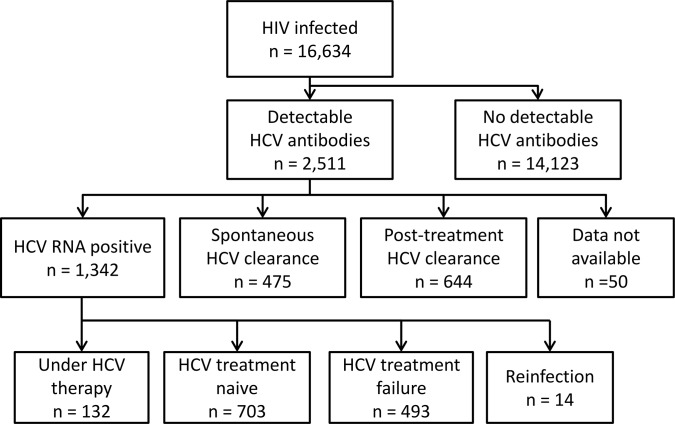
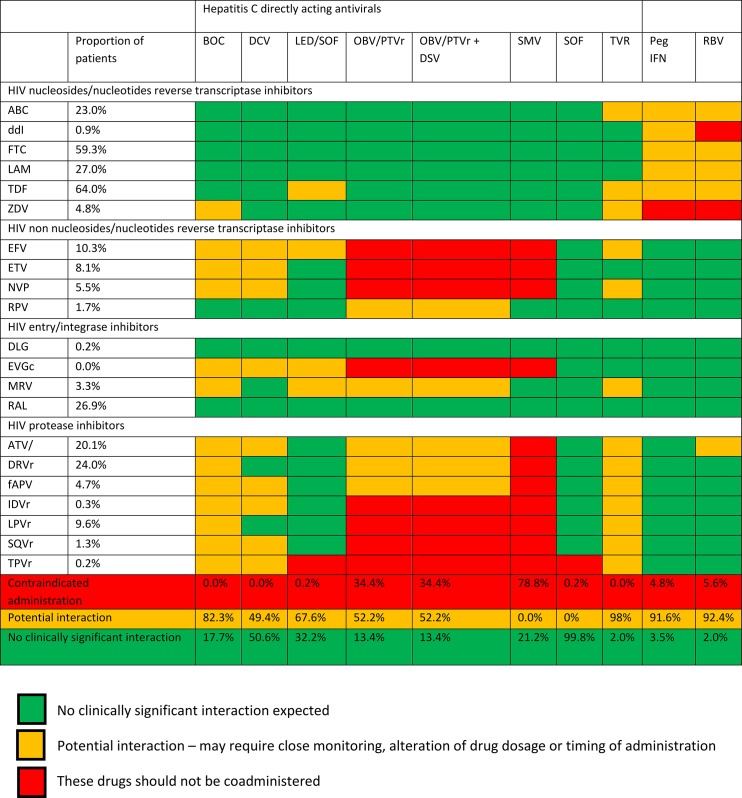
Of 16,634 HIV-infected patients, 2,511 had detectable anti-HCV antibodies, of whom 1,196 had a detectable HCV-RNA and were not receiving HCV treatment at the time of analysis. 97.1% of these patients were receiving cART and 81.2% had a plasma HIV RNA <50 copies/mL. cART included combinations of nucleoside reverse transcriptase inhibitors with a boosted protease inhibitor in 43.6%, a non-nucleoside reverse transcriptase inhibitor in 17.3%, an integrase inhibitor in 15.4% and various combinations or antiretroviral drugs in 23.7% of patients. A previous treatment against HCV had been administered in 64.4% of patients. Contraindicated associations/potential interactions were expected between cART and respectively sofosbuvir (0.2%/0%), sofosbuvir/ledipasvir (0.2%/67.6%), daclatasvir (0%/49.4%), ombitasvir/boosted paritaprevir (with or without dasabuvir) (34.4%/52.2%) and simeprevir (78.8%/0%).
Significant potential drug-drug interactions are expected between cART and the currently available DAAs in the majority of HIV/HCV coinfected patients. Sofosbuvir/ledipasvir and sofosbuvir/daclatasvir with or without ribavirin appeared the most suitable combinations in our population. A close collaboration between hepatologists and HIV/AIDS specialists appears necessary for the management of HCV treatment concomitantly to cART.
直接作用抗病毒药物(DAA)的研发为慢性丙型肝炎患者带来了新的益处。在HIV/HCV合并感染患者中,将这些药物与抗逆转录病毒治疗(cART)联合使用是一项真正的挑战。本研究的目的是描述一组HIV/HCV合并感染患者中DAA与抗逆转录病毒药物之间潜在的药物相互作用。
对2012年在法国多中心Dat'AIDS队列中至少就诊一次的所有HIV/HCV合并感染患者进行横断面研究。对2015年可用的抗逆转录病毒治疗与DAA之间的药物相互作用进行了模拟。
在16634例HIV感染患者中,2511例可检测到抗HCV抗体,其中1196例可检测到HCV-RNA,且在分析时未接受HCV治疗。这些患者中97.1%正在接受cART,81.2%的血浆HIV RNA<50拷贝/mL。cART包括核苷类逆转录酶抑制剂与增强型蛋白酶抑制剂联合使用的患者占43.6%,使用非核苷类逆转录酶抑制剂的患者占17.3%,使用整合酶抑制剂的患者占15.4%,使用各种联合或抗逆转录病毒药物组合的患者占23.7%。64.4%的患者曾接受过抗HCV治疗。预计cART与索磷布韦(0.2%/0%)、索磷布韦/来迪帕司韦(0.2%/67.6%)、达卡他韦(0%/49.4%)、奥比他韦/增强型帕利普韦(含或不含达沙布韦)(34.4%/52.2%)和simeprevir(78.8%/0%)之间分别存在禁忌联合/潜在相互作用。
在大多数HIV/HCV合并感染患者中,预计cART与目前可用的DAA之间存在显著的潜在药物相互作用。索磷布韦/来迪帕司韦以及含或不含利巴韦林的索磷布韦/达卡他韦似乎是我们研究人群中最合适的组合。对于在接受cART的同时进行HCV治疗的管理,肝病专家和HIV/AIDS专家之间密切合作似乎是必要的。