Mamalis Andrew, Koo Eugene, Isseroff R Rivkah, Murphy William, Jagdeo Jared
Department of Dermatology, University of California Davis, Sacramento, CA, United States of America; Dermatology Service, Sacramento VA Medical Center, Mather, CA, United States of America.
Department of Dermatology, University of California Davis, Sacramento, CA, United States of America; Department of Internal Medicine, University of California Davis, Sacramento, CA, United States of America.
PLoS One. 2015 Oct 21;10(10):e0140628. doi: 10.1371/journal.pone.0140628. eCollection 2015.
Skin fibrosis is a significant medical problem that leads to a functional, aesthetic, and psychosocial impact on quality-of-life. Light-emitting diode-generated 633-nm red light (LED-RL) is part of the visible light spectrum that is not known to cause DNA damage and is considered a safe, non-invasive, inexpensive, and portable potential alternative to ultraviolet phototherapy that may change the treatment paradigm of fibrotic skin disease.
The goal of our study was to investigate the how reactive oxygen species (ROS) free radicals generated by high fluence LED-RL inhibit the migration of skin fibroblasts, the main cell type involved in skin fibrosis. Fibroblast migration speed is increased in skin fibrosis, and we studied cellular migration speed of cultured human skin fibroblasts as a surrogate measure of high fluence LED-RL effect on fibroblast function. To ascertain the inhibitory role of LED-RL generated ROS on migration speed, we hypothesized that resveratrol, a potent antioxidant, could prevent the photoinhibitory effects of high fluence LED-RL on fibroblast migration speed.
High fluence LED-RL generated ROS were measured by flow cytometry analysis using dihydrorhodamine (DHR). For purposes of comparison, we assessed the effects of ROS generated by hydrogen peroxide (H2O2) on fibroblast migration speed and the ability of resveratrol, a well known antioxidant, to prevent LED-RL and H2O2 generated ROS-associated changes in fibroblast migration speed. To determine whether resveratrol could prevent the high fluence LED-RL ROS-mediated photoinhibition of human skin fibroblast migration, treated cells were incubated with resveratrol at concentrations of 0.0001% and 0.001% for 24 hours, irradiated with high fluences LED-RL of 480, 640, and 800 J/cm2.
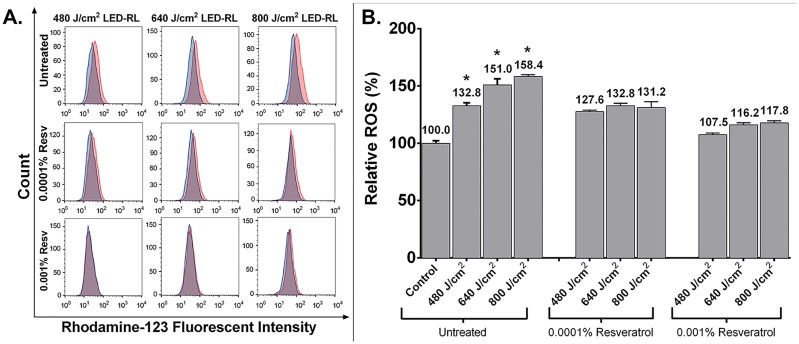
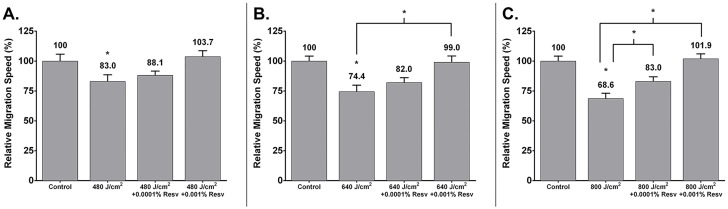
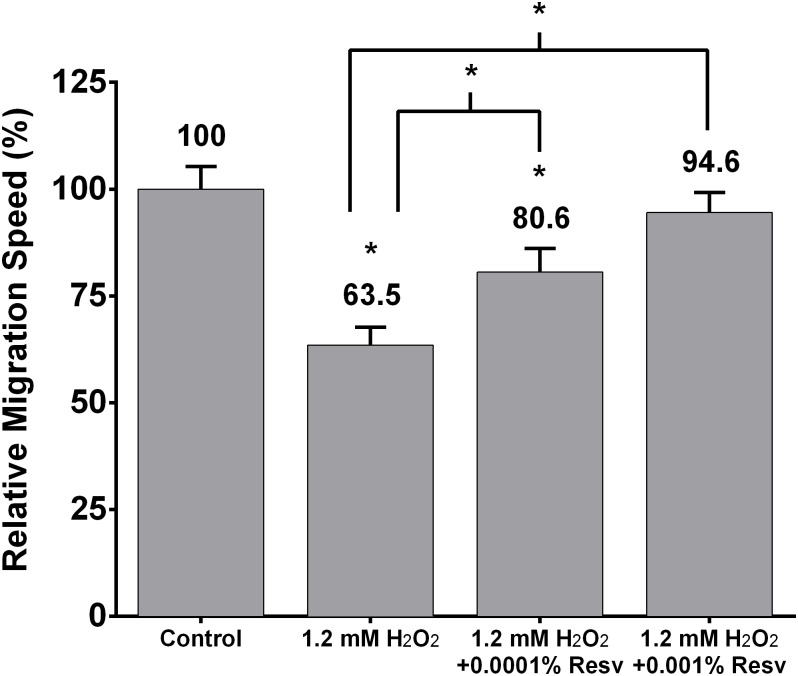
High fluence LED-RL increases intracellular fibroblast ROS and decreases fibroblast migration speed. LED-RL at 480, 640 and 800 J/cm2 increased ROS levels to 132.8%, 151.0%, and 158.4% relative to matched controls, respectively. These LED-RL associated increases in ROS were prevented by pretreating cells with 0.0001% or 0.001% resveratrol. Next, we quantified the effect of hydrogen peroxide (H2O2)-associated ROS on fibroblast migration speed, and found that while H2O2-associated ROS significantly decreased relative fibroblast migration speed, pretreatment with 0.0001% or 0.001% resveratrol significantly prevented the decreases in migration speed. Furthermore, we found that LED-RL at 480, 640 and 800 J/cm2 decreased fibroblast migration speed to 83.0%, 74.4%, and 68.6% relative to matched controls, respectively. We hypothesized that these decreases in fibroblast migration speed were due to associated increases in ROS generation. Pretreatment with 0.0001% and 0.001% resveratrol prevented the LED-RL associated decreases in migration speed.
High fluence LED-RL increases ROS and is associated with decreased fibroblast migration speed. We provide mechanistic support that the decreased migration speed associated with high fluence LED-RL is mediated by ROS, by demonstrating that resveratrol prevents high fluence LED-RL associated migration speed change. These data lend support to an increasing scientific body of evidence that high fluence LED-RL has anti-fibrotic properties. We hypothesize that our findings may result in a greater understanding of the fundamental mechanisms underlying visible light interaction with skin and we anticipate clinicians and other researchers may utilize these pathways for patient benefit.
皮肤纤维化是一个重大的医学问题,会对生活质量产生功能、美学和心理社会方面的影响。发光二极管产生的633纳米红光(LED-RL)是可见光谱的一部分,已知不会导致DNA损伤,被认为是一种安全、无创、廉价且便携的潜在替代紫外线光疗的方法,可能会改变纤维化皮肤病的治疗模式。
我们研究的目的是探讨高能量LED-RL产生的活性氧(ROS)自由基如何抑制皮肤成纤维细胞的迁移,皮肤成纤维细胞是参与皮肤纤维化的主要细胞类型。在皮肤纤维化中,成纤维细胞迁移速度会增加,我们研究培养的人皮肤成纤维细胞的细胞迁移速度,作为高能量LED-RL对成纤维细胞功能影响的替代指标。为了确定LED-RL产生的ROS对迁移速度的抑制作用,我们假设白藜芦醇(一种有效的抗氧化剂)可以预防高能量LED-RL对成纤维细胞迁移速度的光抑制作用。
使用二氢罗丹明(DHR)通过流式细胞术分析测量高能量LED-RL产生的ROS。为了进行比较,我们评估了过氧化氢(H2O2)产生的ROS对成纤维细胞迁移速度的影响,以及白藜芦醇(一种著名的抗氧化剂)预防LED-RL和H2O2产生的ROS相关的成纤维细胞迁移速度变化的能力。为了确定白藜芦醇是否可以预防高能量LED-RL ROS介导的人皮肤成纤维细胞迁移的光抑制,将处理后的细胞分别用浓度为0.0001%和0.001%的白藜芦醇孵育24小时,然后用480、640和800 J/cm2的高能量LED-RL照射。
高能量LED-RL增加细胞内成纤维细胞ROS水平并降低成纤维细胞迁移速度。480、640和800 J/cm2的LED-RL分别使ROS水平相对于匹配的对照组增加到132.8%、151.0%和158.4%。用0.0001%或0.001%的白藜芦醇预处理细胞可预防这些与LED-RL相关的ROS增加。接下来,我们量化了过氧化氢(H2O2)相关的ROS对成纤维细胞迁移速度的影响,发现虽然H2O2相关的ROS显著降低了相对成纤维细胞迁移速度,但用0.0001%或0.001%的白藜芦醇预处理可显著预防迁移速度的降低。此外,我们发现480、640和800 J/cm2的LED-RL分别使成纤维细胞迁移速度相对于匹配的对照组降低到83.0%、74.4%和68.6%。我们假设这些成纤维细胞迁移速度的降低是由于ROS产生的相关增加。用0.0001%和0.001%的白藜芦醇预处理可预防与LED-RL相关的迁移速度降低。
高能量LED-RL增加ROS并与成纤维细胞迁移速度降低相关。我们通过证明白藜芦醇可预防与高能量LED-RL相关的迁移速度变化,为高能量LED-RL相关的迁移速度降低是由ROS介导提供了机制支持。这些数据支持了越来越多的科学证据,即高能量LED-RL具有抗纤维化特性。我们假设我们的发现可能会使人们对可见光与皮肤相互作用的基本机制有更深入的了解,并且我们预计临床医生和其他研究人员可能会利用这些途径为患者带来益处。