Zdunek Artur, Kozioł Arkadiusz, Cybulska Justyna, Lekka Małgorzata, Pieczywek Piotr M
Planta. 2016 Feb;243(2):519-29. doi: 10.1007/s00425-015-2423-0. Epub 2015 Oct 26.
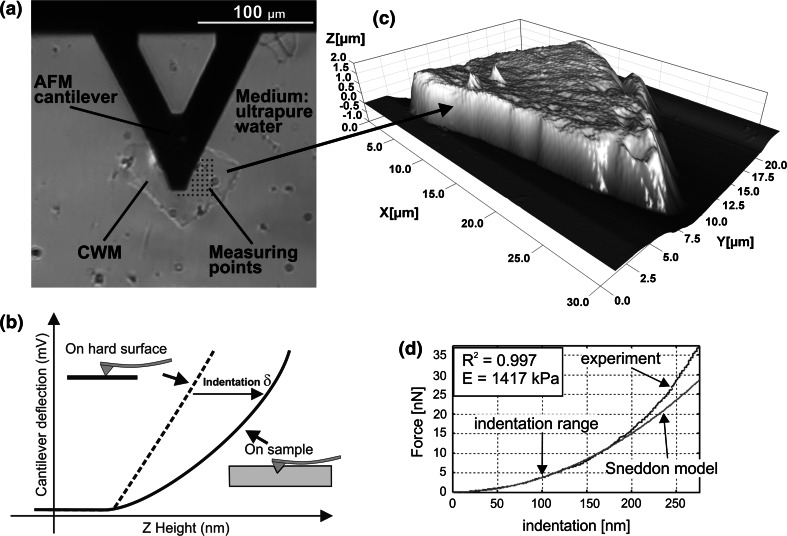
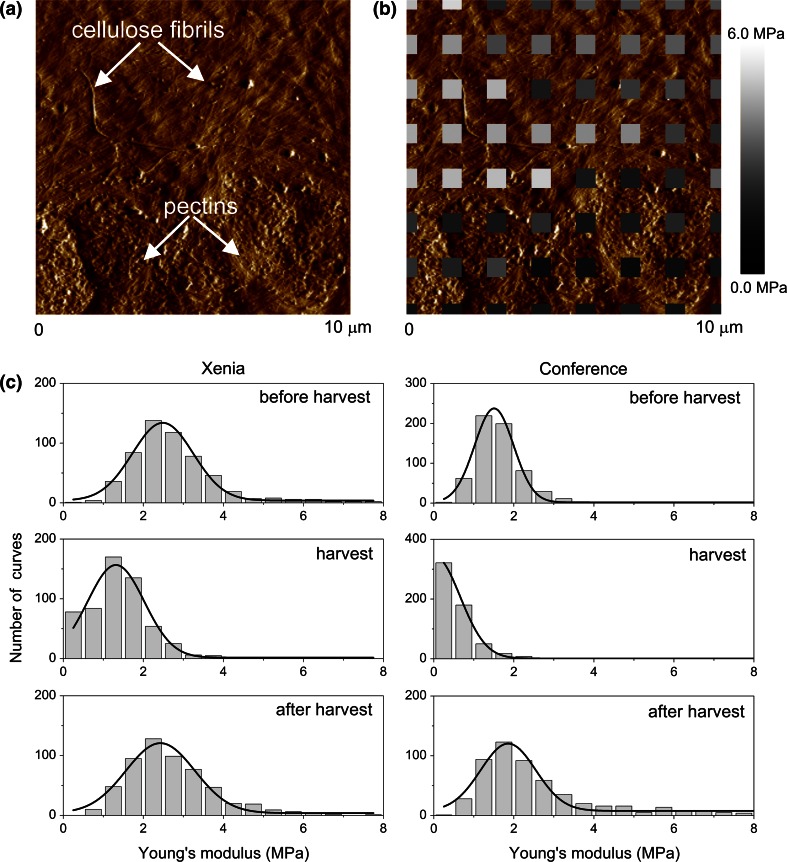
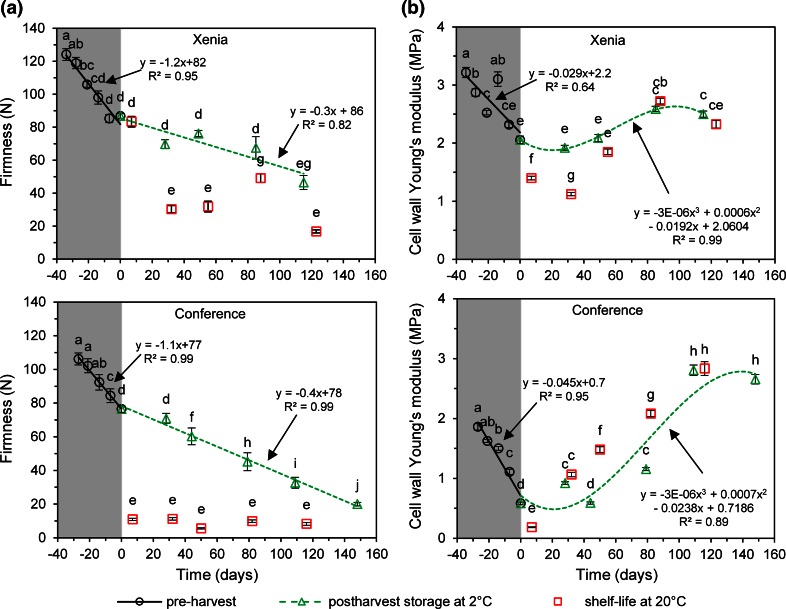
The Young's modulus of the primary cell walls of pears decreases linearly during the pre-harvest on-tree maturation and increases during postharvest storage, and does not correlate with firmness of fruit. The determination of mechanical properties of cell walls is indispensable for understanding the mechanism of physiological softening and deterioration of quality of fruits during postharvest storage. The Young's modulus of the primary cell walls from pear fruit (Pyrus communis L., cultivars 'Conference' and 'Xenia') during pre-harvest maturation and postharvest storage in an ambient atmosphere at 2 °C followed by shelf life was studied using atomic force microscopy (AFM). The results were related to the firmness of fruits, galacturonic acid content in water, chelator, sodium carbonate and insoluble pectin fractions, polygalacturonase and pectin methylesterase activities. The Young's modulus of the primary cell walls decreased linearly during the last month of pre-harvest maturation from 3.2 ± 1.8 to 1.1 ± 0.7 MPa for 'Conference' and from 1.9 ± 1.2 to 0.2 ± 0.1 MPa for 'Xenia' which correlated with linear firmness decrease. During postharvest storage the cell wall Young's modulus increased while firmness continued to decrease. Correlation analysis for the entire period of the experiment showed a lack of straightforward relation between the Young's modulus of primary cell walls and fruit firmness. The Young's modulus of cell walls correlated negatively either with galacturonic acid content in sodium carbonate soluble pectin ('Conference') or with insoluble pectin fractions ('Xenia') and positively with polygalacturonase activity. It was therefore evidenced that covalently linked pectins play the key role for the stiffness of fruit cell walls. Based on the obtained results, the model explaining the fruit transition from firm and crispy to soft and mealy was proposed.
梨初生细胞壁的杨氏模量在采前树上成熟期间呈线性下降,在采后贮藏期间则升高,且与果实硬度无关。细胞壁力学性能的测定对于理解采后贮藏期间果实生理软化和品质劣变的机制至关重要。利用原子力显微镜(AFM)研究了梨果实(西洋梨,品种‘康佛伦斯’和‘克妮亚’)在采前成熟和采后于2℃环境大气中贮藏随后货架期期间初生细胞壁的杨氏模量。研究结果与果实硬度、水中半乳糖醛酸含量、螯合剂、碳酸钠和不溶性果胶组分、多聚半乳糖醛酸酶和果胶甲酯酶活性相关。对于‘康佛伦斯’,采前成熟最后一个月期间,初生细胞壁的杨氏模量从3.2±1.8兆帕线性下降至1.1±0.7兆帕;对于‘克妮亚’,从1.9±1.2兆帕降至0.2±0.1兆帕,这与硬度的线性下降相关。采后贮藏期间,细胞壁杨氏模量升高而硬度继续下降。对整个实验期间的相关性分析表明,初生细胞壁的杨氏模量与果实硬度之间缺乏直接关系。细胞壁的杨氏模量与碳酸钠可溶性果胶中的半乳糖醛酸含量(‘康佛伦斯’)或与不溶性果胶组分(‘克妮亚’)呈负相关,与多聚半乳糖醛酸酶活性呈正相关。因此证明,共价连接的果胶对果实细胞壁的硬度起关键作用。基于所得结果,提出了解释果实从硬脆到软绵转变的模型。