Peng Shiqiu, Li Yineng
State Key Laboratory of Tropical Oceanography, South China Sea Institute of Oceanology, Chinese Academy of Sciences, Guangzhou, China, 510301.
Sci Rep. 2015 Oct 26;5:15496. doi: 10.1038/srep15496.
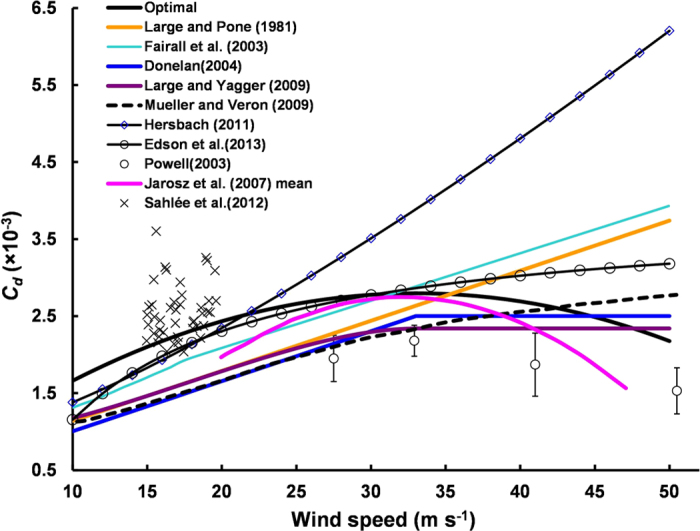
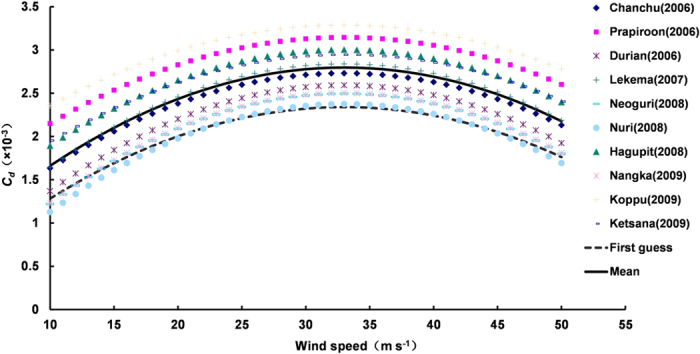
Drag coefficient (Cd) is an essential metric in the calculation of momentum exchange over the air-sea interface and thus has large impacts on the simulation or forecast of the upper ocean state associated with sea surface winds such as storm surges. Generally, Cd is a function of wind speed. However, the exact relationship between Cd and wind speed is still in dispute, and the widely-used formula that is a linear function of wind speed in an ocean model could lead to large bias at high wind speed. Here we establish a parabolic model of Cd based on storm surge observations and simulation in the South China Sea (SCS) through a number of tropical cyclone cases. Simulation of storm surges for independent Tropical cyclones (TCs) cases indicates that the new parabolic model of Cd outperforms traditional linear models.
拖曳系数(Cd)是计算海气界面动量交换的一个重要指标,因此对与海面风相关的上层海洋状态(如风暴潮)的模拟或预报有很大影响。一般来说,Cd是风速的函数。然而,Cd与风速的确切关系仍存在争议,海洋模型中广泛使用的风速线性函数公式在高风速下可能会导致较大偏差。在此,我们通过多个热带气旋案例,基于南海(SCS)的风暴潮观测和模拟建立了Cd的抛物线模型。对独立热带气旋(TC)案例的风暴潮模拟表明,新的Cd抛物线模型优于传统的线性模型。