Wang Ke-Feng, Yang Hang, Jiang Wen-Qi, Li Su, Cai Yu-Chen
State Key Laboratory of Oncology in South China, Collaborative Innovation Center for Cancer Medicine, Sun Yat-sen University Cancer Center, Guangzhou, Guangdong 510060, P.R. China.
Int J Mol Med. 2015 Dec;36(6):1556-62. doi: 10.3892/ijmm.2015.2378. Epub 2015 Oct 16.
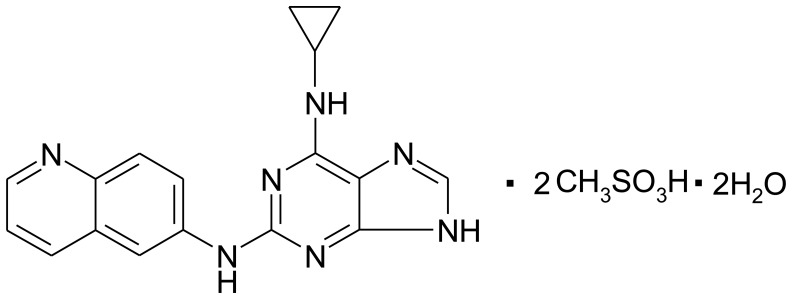
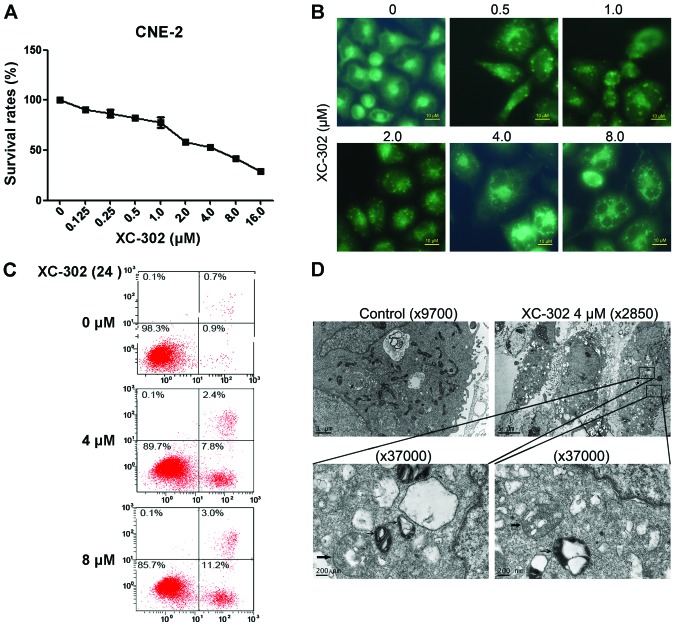
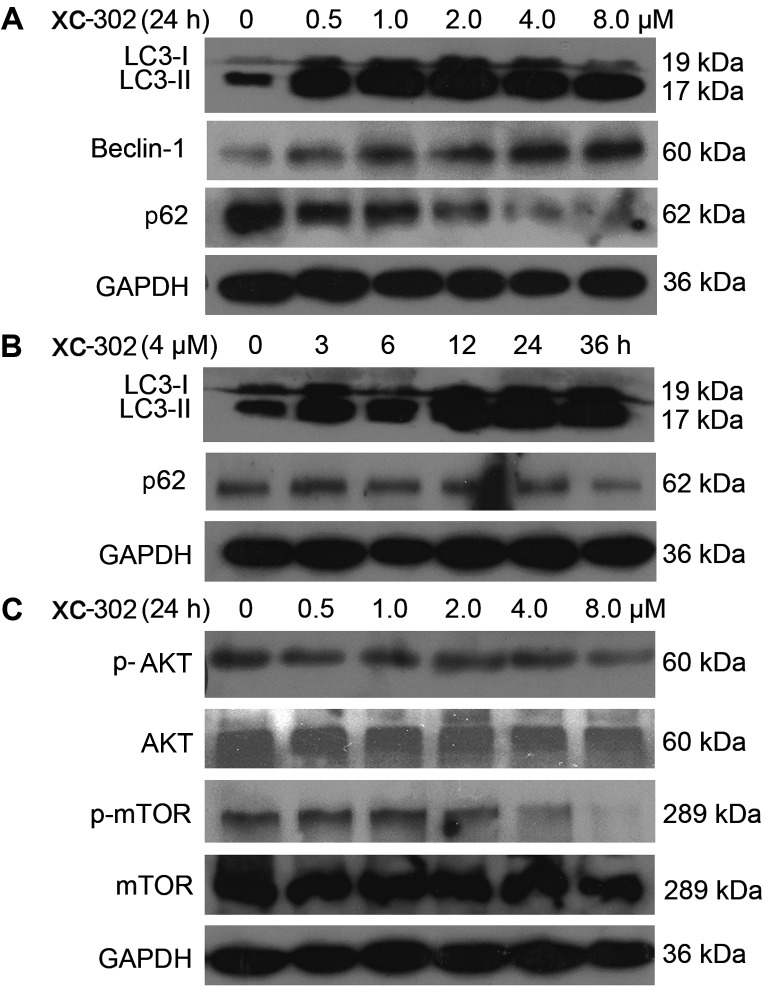
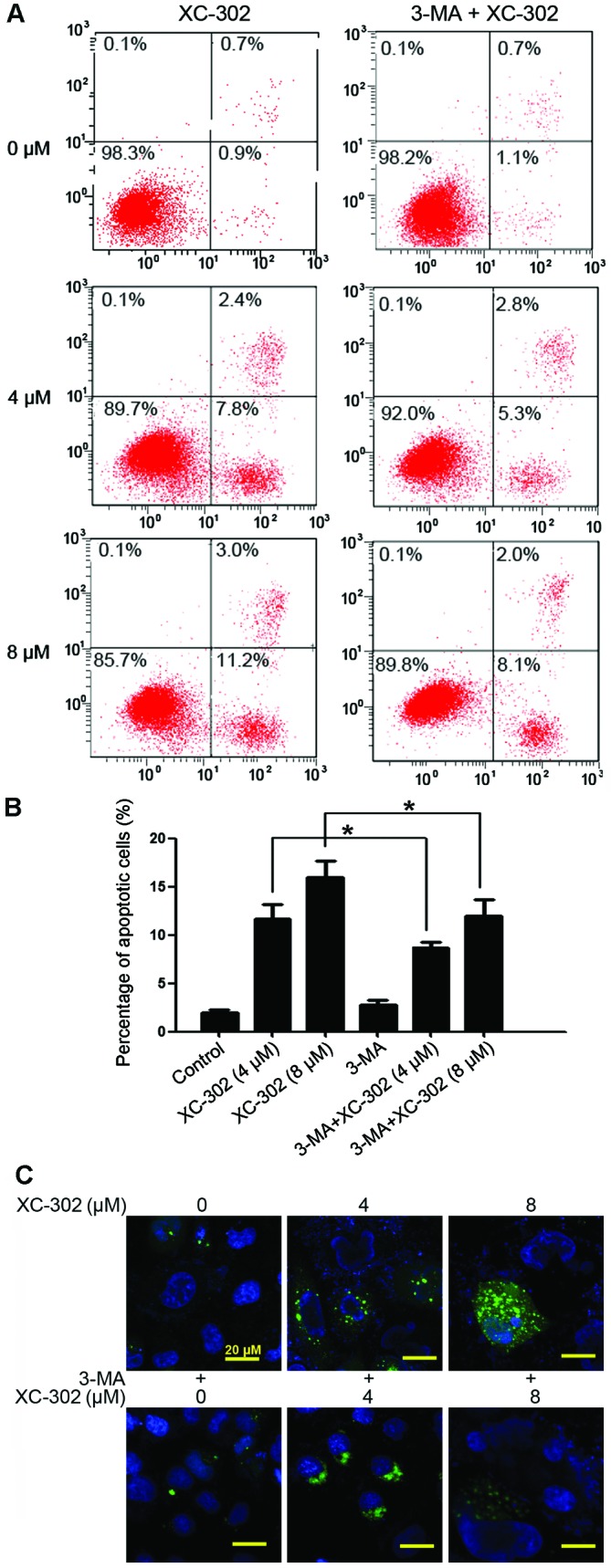
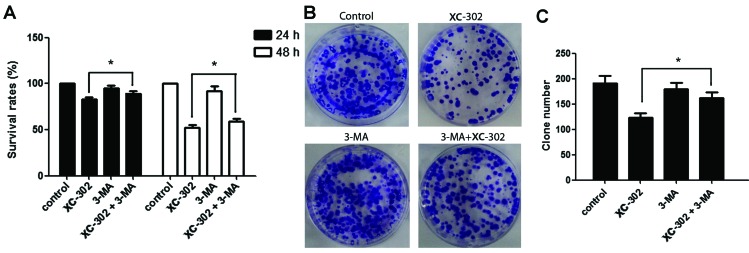
There are numerous studies that demonstrate the anti-neoplastic activity of phosphatidylinositol 3-kinase (PI3K) inhibitors and the mechanisms of inducing autophagy in cancer cells. The new anticancer drug puquitinib mesylate (XC-302) is a molecular-targeted drug, which suppresses the activity of PI3K directly. However, it remains unclear whether XC‑302 can develop an antitumor effect by inducing autophagy in nasopharyngeal cancer cells. The MTT assay was used to study the anti-proliferative effects of XC-302. Subsequently, autophagy was determined by monodansylcadaverine (MDC) staining, punctate localization of green fluorescent protein (GFP)-light chain 3 (LC3), LC3 protein blotting and electron microscopy. The expression levels of beclin 1, p62, protein kinase B (AKT), phospho (p)‑AKT, mechanistic target of rapamycin (mTOR) and p‑mTOR in XC-302‑induced autophagy were detected. Autophagy inhibition was assayed by 3-methyladenine (3‑MA) or small interfering RNA (siRNA) silencing of beclin 1. XC-302 inhibited the viability of CNE‑2 in a dose-dependent manner and the IC50 of 72 h was 5.2 µmol/l. After cells were exposed to XC-302 for 24 h, MDC-labeled autophagolysosomes were evident in CNE-2 cells by fluorescence microscope. Autophagosomes and autolysosomes were identified by transmission electron microscopy. Following transfection with GFP‑LC3, XC-302 induced a significant accumulation of GFP‑LC3, as monitored by a confocal microscope, which was reduced by 3-MA. XC-302 induced the formation of LC3‑II, increased beclin 1 levels and decreased the expression of p62. Additionally, the expression levels of p‑AKT and p‑mTOR were reduced with the elevation of XC-302. Knockdown of beclin 1 with siRNA or co-treatment with 3-MA enhanced significantly the survival of CNE-2 and promoted the ability of clone formation. XC-302 also induced apoptosis in CNE-2, and when autophagy was inhibited by 3-MA, the apoptosis rate was decreased. The present data provides the evidence that XC-302 can induce autophagy in CNE-2, which promotes the program of cell death and inhibits the PI3K/AKT/mTOR signaling pathway. Furthermore, XC-302 also promoted apoptosis in CNE-2 cells, which could be reduced when autophagy was suppressed, meaning that autophagy may interact with apoptosis to induce cell death.
有大量研究证明了磷脂酰肌醇3激酶(PI3K)抑制剂的抗肿瘤活性以及在癌细胞中诱导自噬的机制。新型抗癌药物甲磺酸普喹替尼(XC - 302)是一种分子靶向药物,可直接抑制PI3K的活性。然而,XC - 302是否能通过诱导鼻咽癌细胞自噬发挥抗肿瘤作用仍不清楚。采用MTT法研究XC - 302的抗增殖作用。随后,通过单丹磺酰尸胺(MDC)染色、绿色荧光蛋白(GFP)-轻链3(LC3)的点状定位、LC3蛋白印迹和电子显微镜检测自噬。检测XC - 302诱导自噬过程中beclin 1、p62、蛋白激酶B(AKT)、磷酸化(p)-AKT、雷帕霉素靶蛋白(mTOR)和p - mTOR的表达水平。通过3 - 甲基腺嘌呤(3 - MA)或beclin 1的小干扰RNA(siRNA)沉默检测自噬抑制情况。XC - 302以剂量依赖性方式抑制CNE - 2的活力,72 h的IC50为5.2 μmol/l。细胞暴露于XC - 302 24 h后,荧光显微镜下可见CNE - 2细胞中有MDC标记的自噬溶酶体。通过透射电子显微镜鉴定出自噬体和自溶酶体。转染GFP - LC3后,共聚焦显微镜监测显示XC - 302诱导GFP - LC3显著积累,3 - MA可使其减少。XC - 302诱导LC3 - II形成,增加beclin 1水平并降低p62的表达。此外,随着XC - 302浓度升高,p - AKT和p - mTOR的表达水平降低。用siRNA敲低beclin 1或与3 - MA联合处理可显著提高CNE - 2的存活率并促进克隆形成能力。XC - 302还可诱导CNE - 2细胞凋亡,当用3 - MA抑制自噬时,凋亡率降低。目前的数据表明XC - 302可在CNE - 2中诱导自噬,促进细胞死亡程序并抑制PI3K/AKT/mTOR信号通路。此外,XC - 302还可促进CNE - 2细胞凋亡,当自噬被抑制时凋亡可减少,这意味着自噬可能与凋亡相互作用诱导细胞死亡。