
六个用于检测老年女性营养不良或营养不良风险的简单问题。
Six simple questions to detect malnutrition or malnutrition risk in elderly women.
作者信息
Gutiérrez-Gómez Tranquilina, Cortés Ernesto, Palazón-Bru Antonio, Peñarrieta-de Córdova Isabel, Gil-Guillén Vicente Francisco, Ferrer-Diego Rosa María
机构信息
Tampico School of Nursing, Autonomous University of Tamaulipas , Tampico, TAMPS , Mexico.
Department of Pharmacology, Pediatrics and Organic Chemistry, Miguel Hernández University , San Juan de Alicante, Alicante , Spain.
出版信息
PeerJ. 2015 Oct 13;3:e1316. doi: 10.7717/peerj.1316. eCollection 2015.
UNLABELLED
Of the numerous instruments available to detect nutritional risk, the most widely used is the Mini Nutritional Assessment (MNA), but it takes 15-20 min to complete and its systematic administration in primary care units is not feasible in practice. We developed a tool to evaluate malnutrition risk that can be completed more rapidly using just clinical variables. Between 2008 and 2013, we conducted a cross-sectional study of 418 women aged ≥60 years from Mexico. Our outcome was positive MNA and our secondary variables included were: physical activity, diabetes mellitus, hypertension, educational level, dentition, psychological problems, living arrangements, history of falls, age and the number of tablets taken daily. The sample was divided randomly into two groups: construction and validation. Construction: a risk table was constructed to estimate the likelihood of the outcome, and risk groups were formed.
VALIDATION
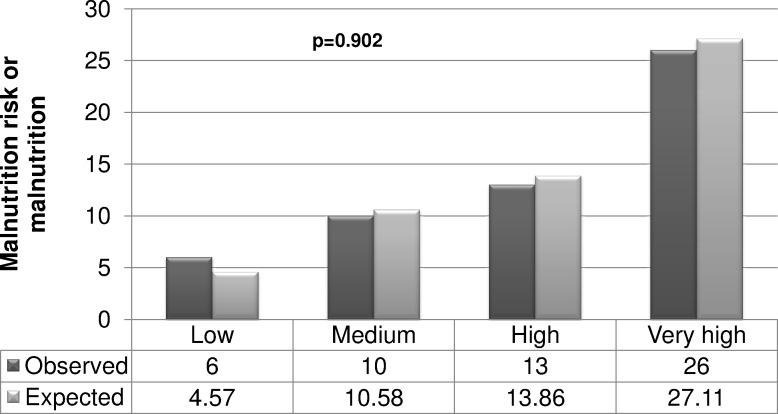
the area under the ROC curve (AUC) was calculated and we compared the expected and the observed outcomes. The following risk factors were identified: physical activity, hypertension, diabetes, dentition, psychological problems and living with the family. The AUC was 0.77 (95% CI [0.68-0.86], p < 0.001). No differences were found between the expected and the observed outcomes (p = 0.902). This study presents a new malnutrition screening test for use in elderly women. The test is based on six very simple, quick and easy-to-evaluate questions, enabling the MNA to be reserved for confirmation. However, it should be used with caution until validation studies have been performed in other geographical areas.
未标注
在众多可用于检测营养风险的工具中,使用最广泛的是微型营养评定法(MNA),但完成该评定需要15至20分钟,并且在基层医疗单位系统地应用该评定法在实际操作中并不可行。我们开发了一种仅使用临床变量就能更快完成的营养不良风险评估工具。在2008年至2013年期间,我们对418名年龄≥60岁的墨西哥女性进行了一项横断面研究。我们的观察指标是MNA结果呈阳性,次要变量包括:身体活动、糖尿病、高血压、教育程度、牙齿状况、心理问题、生活安排、跌倒史、年龄以及每日服药数量。样本被随机分为两组:构建组和验证组。构建组:构建一个风险表以估计观察指标出现的可能性,并形成风险组。
验证组
计算ROC曲线下面积(AUC),并比较预期结果和观察结果。确定了以下风险因素:身体活动、高血压、糖尿病、牙齿状况、心理问题以及与家人同住。AUC为0.77(95%置信区间[0.68 - 0.86],p < 0.001)。预期结果和观察结果之间未发现差异(p = 0.902)。本研究提出了一种用于老年女性的新型营养不良筛查测试。该测试基于六个非常简单、快速且易于评估的问题,使得MNA可留作确认之用。然而,在其他地理区域进行验证研究之前,应谨慎使用。


 Zotero 插件