Chow Selina, Chow Ronald, Popovic Mila, Lam Michael, Popovic Marko, Merrick Joav, Stashefsky Margalit Ruth Naomi, Lam Henry, Milakovic Milica, Chow Edward, Popovic Jelena
Toronto East General Hospital , Toronto, ON , Canada.
Sunnybrook Health Sciences Centre , Toronto, ON , Canada.
Front Public Health. 2015 Oct 7;3:225. doi: 10.3389/fpubh.2015.00225. eCollection 2015.
Newborn babies in need of critical medical attention are normally admitted to the neonatal intensive care unit (NICU). These infants tend to be preterm, have low birth weight, and/or have serious medical conditions. Neonatal survival varies, but progress in perinatal and neonatal care has notably diminished mortality rates. In this selected review, we examine and compare the NICU mortality rates and etiologies of death in different countries.
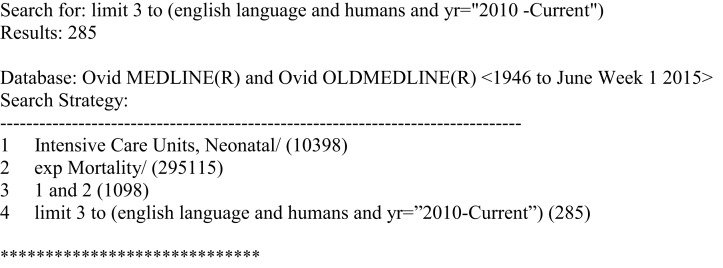
A literature search was conducted in Ovid MEDLINE, OLDMEDLINE, EMBASE Classic, and EMBASE. The primary endpoint was the mortality rates in NICUs. Secondary endpoints included the reasons for death and the correlation between infant age and mortality outcome. For the main analysis, we examined all infants admitted to NICUs. Subgroup analyses included extremely low birth weight infants (based on the authors' own definition), very low birth weight infants, very preterm infants, preterm infants, preterm infants with a birth weight of ≤1,500 g, and by developed and developing countries.
The literature search yielded 1,865 articles, of which 20 were included. The total mortality rates greatly varied among countries. Infants in developed and developing countries had similar ages at death, ranging from 4 to 20 days and 1 to 28.9 days, respectively. The mortality rates ranged from 4 to 46% in developed countries and 0.2 to 64.4% in developing countries.
The mortality rates of NICUs vary between nations but remain high in both developing and developed countries.
需要重症医疗护理的新生儿通常会被收治到新生儿重症监护病房(NICU)。这些婴儿往往早产、出生体重低和/或患有严重疾病。新生儿存活率各不相同,但围产期和新生儿护理方面的进展显著降低了死亡率。在这篇综述中,我们研究并比较了不同国家新生儿重症监护病房的死亡率及死亡原因。
在Ovid MEDLINE、OLDMEDLINE、EMBASE Classic和EMBASE中进行文献检索。主要终点是新生儿重症监护病房的死亡率。次要终点包括死亡原因以及婴儿年龄与死亡结局之间的相关性。对于主要分析,我们研究了所有收治到新生儿重症监护病房的婴儿。亚组分析包括极低出生体重儿(根据作者自己的定义)、超低出生体重儿、极早产儿、早产儿、出生体重≤1500g的早产儿,以及按发达国家和发展中国家进行分类。
文献检索共得到1865篇文章,其中20篇被纳入。各国的总死亡率差异很大。发达国家和发展中国家的婴儿死亡年龄相似,分别为4至20天和1至28.9天。发达国家的死亡率在4%至46%之间,发展中国家为0.2%至64.4%。
各国新生儿重症监护病房的死亡率有所不同,但在发展中国家和发达国家都仍然很高。