NIHR University College London Hospitals Biomedical Research Centre, Department of Clinical and Experimental Epilepsy, UCL Institute of Neurology, London, UK.
NIHR University College London Hospitals Biomedical Research Centre, Department of Clinical and Experimental Epilepsy, UCL Institute of Neurology, London, UK ; The Epilepsy Society, Chalfont-St-Peter, Bucks, UK ; Neuroscience Department, Polytechnic University of Marche, Ancona, Italy.
EBioMedicine. 2015 Jul 10;2(9):1063-70. doi: 10.1016/j.ebiom.2015.07.005. eCollection 2015 Sep.
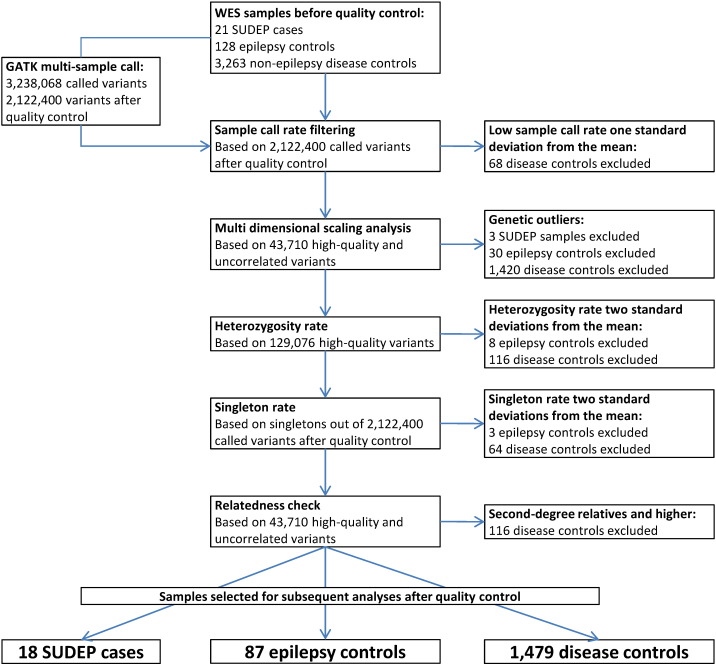
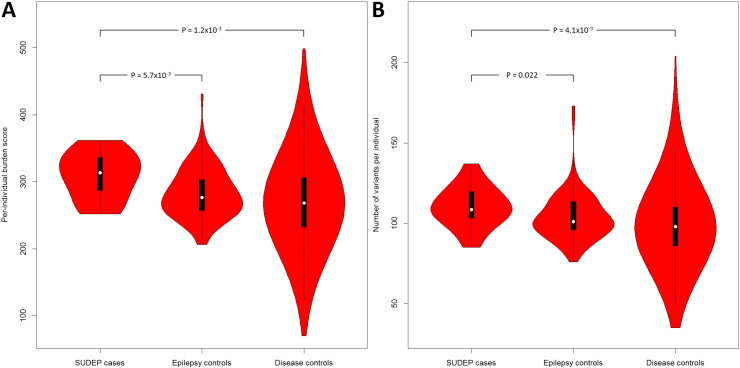
Sudden unexpected death in epilepsy (SUDEP) represents the most severe degree of the spectrum of epilepsy severity and is the commonest cause of epilepsy-related premature mortality. The precise pathophysiology and the genetic architecture of SUDEP remain elusive. Aiming to elucidate the genetic basis of SUDEP, we analysed rare, protein-changing variants from whole-exome sequences of 18 people who died of SUDEP, 87 living people with epilepsy and 1479 non-epilepsy disease controls. Association analysis revealed a significantly increased genome-wide polygenic burden per individual in the SUDEP cohort when compared to epilepsy (P = 5.7 × 10(- 3)) and non-epilepsy disease controls (P = 1.2 × 10(- 3)). The polygenic burden was driven both by the number of variants per individual, and over-representation of variants likely to be deleterious in the SUDEP cohort. As determined by this study, more than a thousand genes contribute to the observed polygenic burden within the framework of this study. Subsequent gene-based association analysis revealed five possible candidate genes significantly associated with SUDEP or epilepsy, but no one single gene emerges as common to the SUDEP cases. Our findings provide further evidence for a genetic susceptibility to SUDEP, and suggest an extensive polygenic contribution to SUDEP causation. Thus, an overall increased burden of deleterious variants in a highly polygenic background might be important in rendering a given individual more susceptible to SUDEP. Our findings suggest that exome sequencing in people with epilepsy might eventually contribute to generating SUDEP risk estimates, promoting stratified medicine in epilepsy, with the eventual aim of reducing an individual patient's risk of SUDEP.
癫痫猝死症 (SUDEP) 是癫痫严重程度谱中最严重的程度,也是癫痫相关过早死亡的最常见原因。SUDEP 的精确病理生理学和遗传结构仍然难以捉摸。为了阐明 SUDEP 的遗传基础,我们分析了 18 名死于 SUDEP 的人、87 名现患癫痫的人和 1479 名非癫痫疾病对照者的外显子组全序列中的罕见、蛋白改变变体。与癫痫(P=5.7×10(-3)) 和非癫痫疾病对照(P=1.2×10(-3)) 相比,SUDEP 队列中个体的全基因组多基因负担明显增加。多基因负担既受个体变异数量的驱动,也受 SUDEP 队列中可能有害变异的过表达驱动。根据这项研究,超过一千个基因在该研究框架内导致了观察到的多基因负担。随后的基于基因的关联分析显示,五个可能与 SUDEP 或癫痫相关的候选基因显著相关,但没有一个基因与 SUDEP 病例共同出现。我们的发现为 SUDEP 的遗传易感性提供了进一步的证据,并表明 SUDEP 发病机制存在广泛的多基因贡献。因此,在高度多基因背景下有害变异的整体负担增加可能在使个体更容易发生 SUDEP 方面很重要。我们的研究结果表明,对癫痫患者进行外显子组测序最终可能有助于生成 SUDEP 风险估计,促进癫痫的分层医学,最终目标是降低个体患者的 SUDEP 风险。