Department of Clinical and Experimental Epilepsy, UCL Queen Square Institute of Neurology, London, UK.
Chalfont Centre for Epilepsy, Bucks, UK.
Epilepsia. 2021 Mar;62 Suppl 2(Suppl 2):S90-S105. doi: 10.1111/epi.16539. Epub 2020 Jul 24.
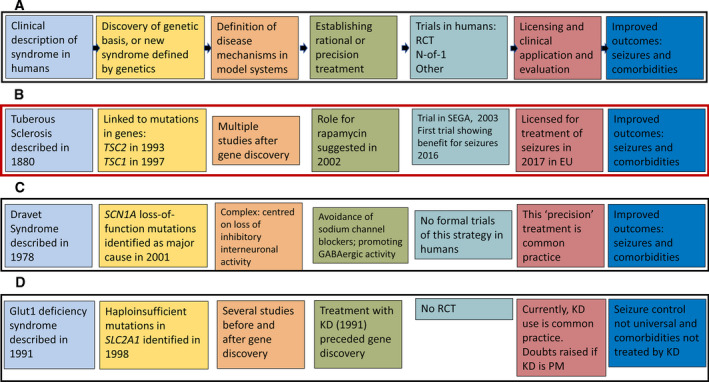
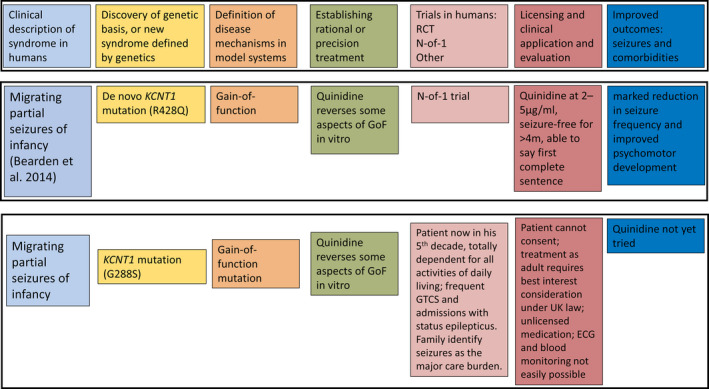
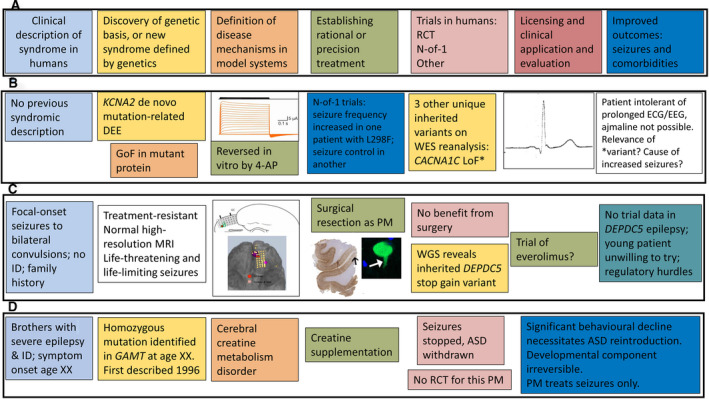
Precision medicine in the epilepsies has gathered much attention, especially with gene discovery pushing forward new understanding of disease biology. Several targeted treatments are emerging, some with considerable sophistication and individual-level tailoring. There have been rare achievements in improving short-term outcomes in a few very select patients with epilepsy. The prospects for further targeted, repurposed, or novel treatments seem promising. Along with much-needed success, difficulties are also arising. Precision treatments do not always work, and sometimes are inaccessible or do not yet exist. Failures of precision medicine may not find their way to broader scrutiny. Precision medicine is not a new concept: It has been boosted by genetics and is often focused on genetically determined epilepsies, typically considered to be driven in an individual by a single genetic variant. Often the mechanisms generating the full clinical phenotype from such a perceived single cause are incompletely understood. The impact of additional genetic variation and other factors that might influence the clinical presentation represent complexities that are not usually considered. Precision success and precision failure are usually equally incompletely explained. There is a need for more comprehensive evaluation and a more rigorous framework, bringing together information that is both necessary and sufficient to explain clinical presentation and clinical responses to precision treatment in a precision approach that considers the full picture not only of the effects of a single variant, but also of its genomic and other measurable environment, within the context of the whole person. As we may be on the brink of a treatment revolution, progress must be considered and reasoned: One possible framework is proposed for the evaluation of precision treatments.
精准医疗在癫痫领域备受关注,特别是随着基因发现推动了对疾病生物学的新理解。一些靶向治疗方法正在涌现,其中一些具有相当的复杂性和个性化定制。在为数极少的癫痫患者中,已经取得了改善短期预后的罕见成就。进一步的靶向、再利用或新型治疗方法的前景似乎很有希望。随着人们对精准治疗的迫切需求,也出现了一些困难。精准治疗并不总是有效,有时无法获得或尚不存在。精准医学的失败可能不会引起更广泛的关注。精准医学并不是一个新概念:它得到了遗传学的推动,通常专注于由单一基因突变引起的遗传性癫痫,通常被认为是由单个遗传变异驱动的个体疾病。通常,从单一病因产生完整临床表型的机制尚不完全清楚。其他可能影响临床表现的遗传变异和其他因素的影响通常不被认为是复杂的。精准治疗的成功和失败通常同样解释不清。需要更全面的评估和更严格的框架,汇集既必要又充分的信息,以解释精准治疗对临床表型和临床反应的影响,采用精准方法考虑全貌,不仅要考虑单一变异的影响,还要考虑其基因组和其他可测量的环境,以及整个人的背景。由于我们可能正处于治疗革命的边缘,因此必须对进展进行考虑和推理:提出了一个用于评估精准治疗的框架。