Bairi Venu Gopal, Bourdo Shawn E, Sacre Nicolas, Nair Dev, Berry Brian C, Biris Alexandru S, Viswanathan Tito
Department of chemistry, University of Arkansas at Little Rock, 2801 S. University Ave, Little Rock, AR 72204, USA.
Center for Integrative Nanotechnology Sciences, University of Arkansas at Little Rock, 2801 S. University Ave, Little Rock, AR 72204, USA.
Sensors (Basel). 2015 Oct 16;15(10):26415-29. doi: 10.3390/s151026415.
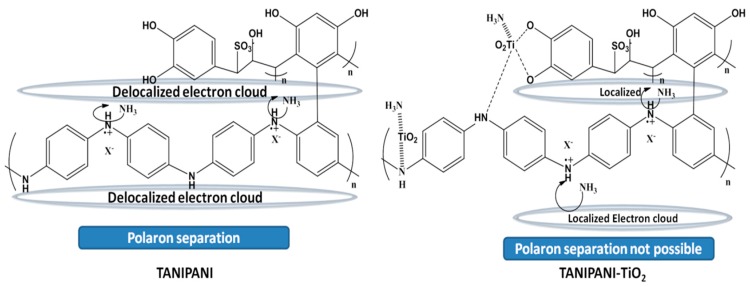
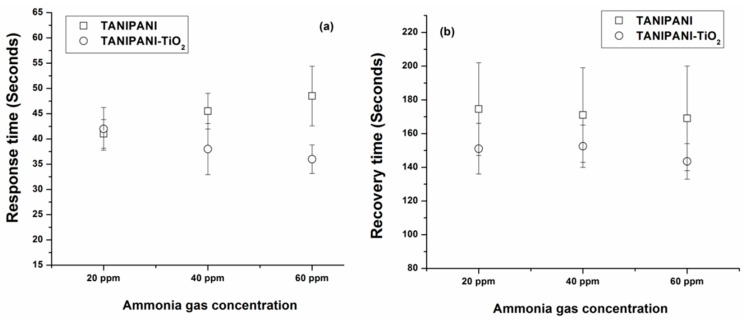
A highly active tannin doped polyaniline-TiO₂ composite ammonia gas sensor was developed and the mechanism behind the gas sensing activity was reported for the first time. A tanninsulfonic acid doped polyaniline (TANIPANI)-titanium dioxide nanocomposite was synthesized by an in situ polymerization of aniline in the presence of tanninsulfonic acid and titanium dioxide nanoparticles. X-ray diffraction and thermogravimetric analysis were utilized to determine the incorporation of TiO₂ in TANIPANI matrix. UV-Visible and infrared spectroscopy studies provided information about the electronic interactions among tannin, polyaniline, and TiO₂. Scanning electron microscopy (SEM) along with energy dispersive X-ray spectroscopy (EDS) and atomic force microscopy (AFM) surface analysis techniques were used to investigate the metal oxide dispersions inside polyaniline matrix. Gas sensors were prepared by spin coating solutions of TANIPANI-TiO₂ and TANIPANI composites onto glass slides. Sensors were tested at three different concentrations (20 ppm, 40 ppm, and 60 ppm) of ammonia gas at ambient temperature conditions by measuring the changes in surface resistivity of the films with respect to time. Ammonia gas sensing plots are presented showing the response values, response times and recovery times. The TANIPANI-TiO₂ composite exhibited better response and shorter recovery times when compared to TANIPANI control and other polyaniline composites that have been reported in the literature. For the first time a proposed mechanism of gas sensing basing on the polaron band localization and its effects on the gas sensing behavior of polyaniline are reported.
研制出一种高活性单宁掺杂聚苯胺 - 二氧化钛复合氨气传感器,并首次报道了其气敏活性背后的机理。通过在单宁磺酸和二氧化钛纳米颗粒存在下苯胺的原位聚合反应,合成了单宁磺酸掺杂聚苯胺(TANIPANI)- 二氧化钛纳米复合材料。利用X射线衍射和热重分析来确定二氧化钛在TANIPANI基体中的掺入情况。紫外 - 可见光谱和红外光谱研究提供了有关单宁、聚苯胺和二氧化钛之间电子相互作用的信息。扫描电子显微镜(SEM)以及能量色散X射线光谱(EDS)和原子力显微镜(AFM)表面分析技术被用于研究聚苯胺基体内金属氧化物的分散情况。通过将TANIPANI - 二氧化钛和TANIPANI复合材料的溶液旋涂到载玻片上来制备气体传感器。在环境温度条件下,通过测量薄膜表面电阻率随时间的变化,对传感器在三种不同浓度(20 ppm、40 ppm和60 ppm)的氨气中进行测试。给出了氨气传感曲线,显示了响应值、响应时间和恢复时间。与TANIPANI对照物和文献中报道的其他聚苯胺复合材料相比,TANIPANI - 二氧化钛复合材料表现出更好的响应和更短的恢复时间。首次报道了一种基于极化子能带定位及其对聚苯胺气敏行为影响的气敏机理。