Kustatscher Georg, Grabowski Piotr, Rappsilber Juri
Wellcome Trust Centre for Cell Biology, University of Edinburgh, UK.
Department of Bioanalytics, Institute of Biotechnology, Technische Universität Berlin, Berlin, Germany.
Proteomics. 2016 Feb;16(3):393-401. doi: 10.1002/pmic.201500267. Epub 2016 Jan 25.
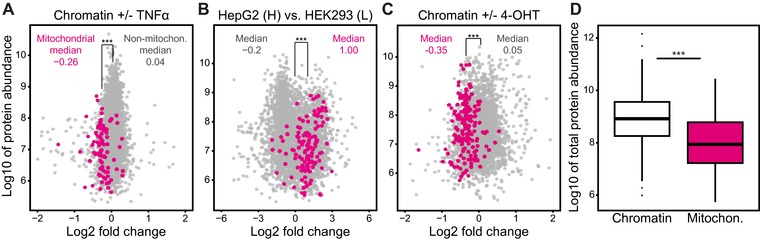
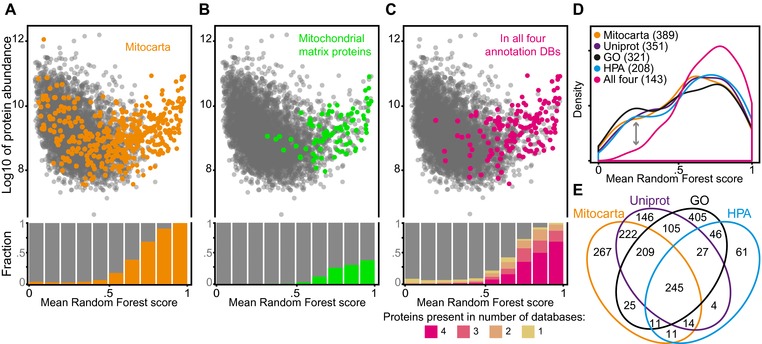
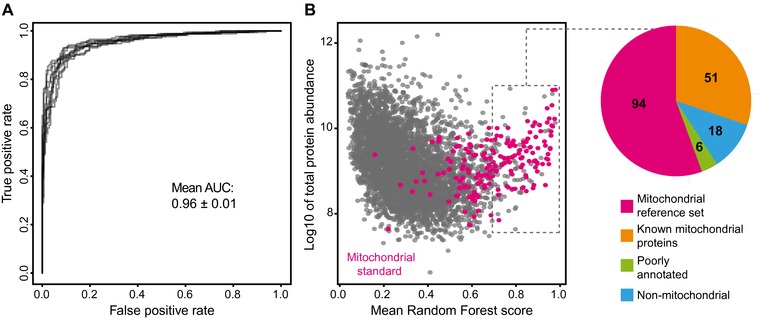
Subcellular localization is an important aspect of protein function, but the protein composition of many intracellular compartments is poorly characterized. For example, many nuclear bodies are challenging to isolate biochemically and thus remain inaccessible to proteomics. Here, we explore covariation in proteomics data as an alternative route to subcellular proteomes. Rather than targeting a structure of interest biochemically, we target it by machine learning. This becomes possible by taking data obtained for one organelle and searching it for traces of another organelle. As an extreme example and proof-of-concept we predict mitochondrial proteins based on their covariation in published interphase chromatin data. We detect about ⅓ of the known mitochondrial proteins in our chromatin data, presumably most as contaminants. However, these proteins are not present at random. We show covariation of mitochondrial proteins in chromatin proteomics data. We then exploit this covariation by multiclassifier combinatorial proteomics to define a list of mitochondrial proteins. This list agrees well with different databases on mitochondrial composition. This benchmark test raises the possibility that, in principle, covariation proteomics may also be applicable to structures for which no biochemical isolation procedures are available.
亚细胞定位是蛋白质功能的一个重要方面,但许多细胞内区室的蛋白质组成却鲜有表征。例如,许多核体在生化分离方面具有挑战性,因此蛋白质组学难以对其进行研究。在此,我们探索蛋白质组学数据中的共变关系,将其作为获取亚细胞蛋白质组的另一条途径。我们并非通过生化方法靶向感兴趣的结构,而是借助机器学习来实现。这是通过获取一个细胞器的数据并从中搜索另一个细胞器的踪迹得以实现的。作为一个极端的例子和概念验证,我们基于已发表的间期染色质数据中的共变关系来预测线粒体蛋白。我们在染色质数据中检测到约三分之一的已知线粒体蛋白,推测其中大部分是污染物。然而,这些蛋白质并非随机出现。我们展示了染色质蛋白质组学数据中线粒体蛋白的共变关系。然后,我们通过多分类器组合蛋白质组学利用这种共变关系来确定一份线粒体蛋白列表。该列表与关于线粒体组成的不同数据库高度吻合。这项基准测试表明,原则上,共变蛋白质组学也可能适用于尚无生化分离方法的结构。