Sun Weili, Han Xiao, Wu Siyuan, Yang Chuanhua
From the Division of Gastroenterology and Hepatology, Ren Ji Hospital, School of Medicine, Shanghai Jiao Tong University, Shanghai Institute of Digestive Disease, Shanghai, China.
Medicine (Baltimore). 2015 Oct;94(43):e1649. doi: 10.1097/MD.0000000000001649.
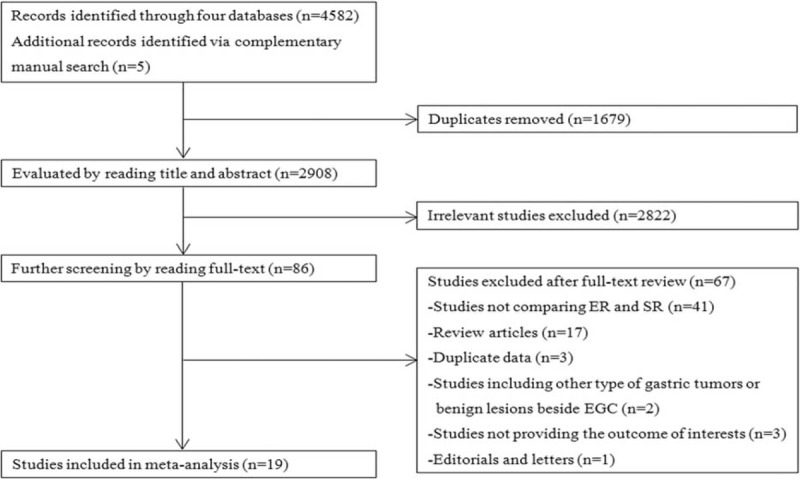
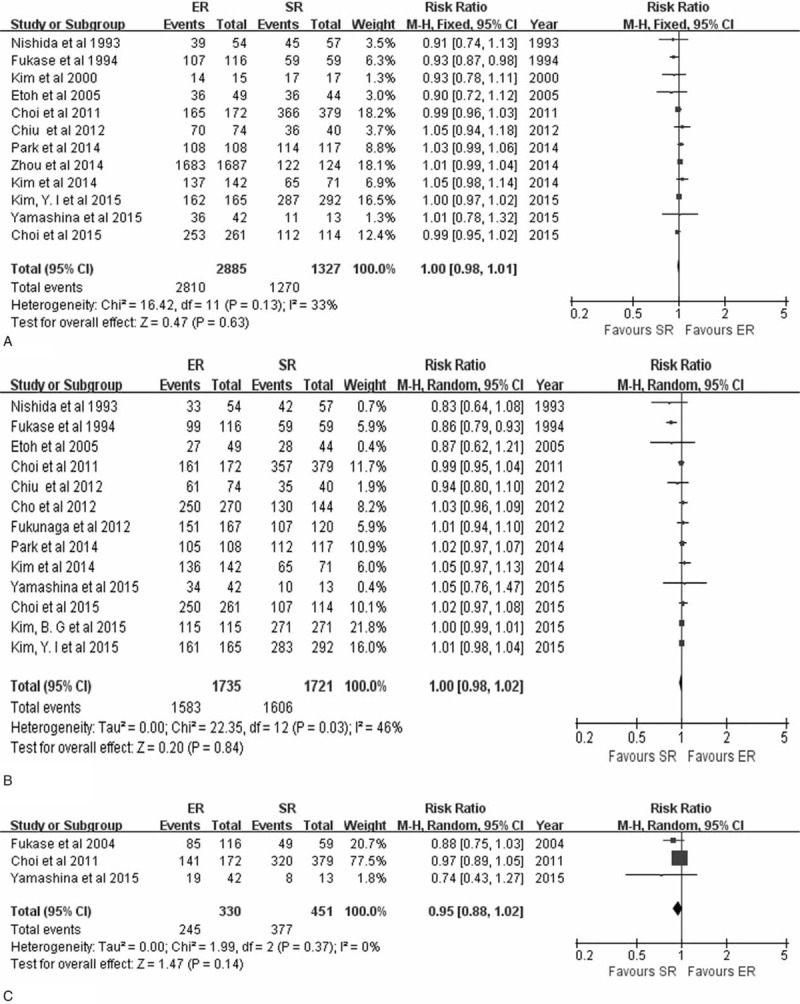
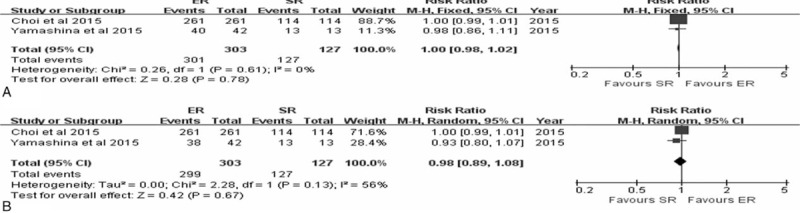
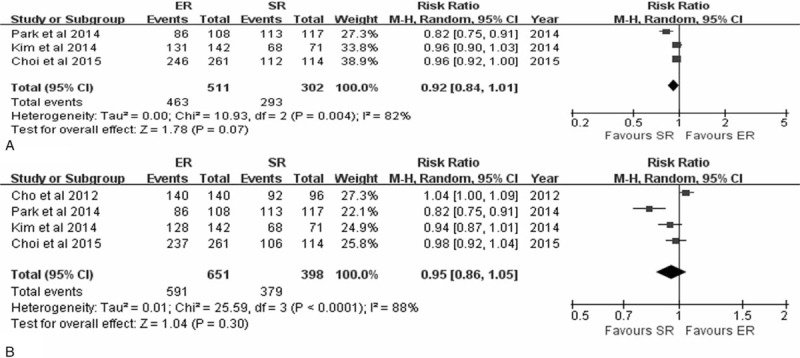
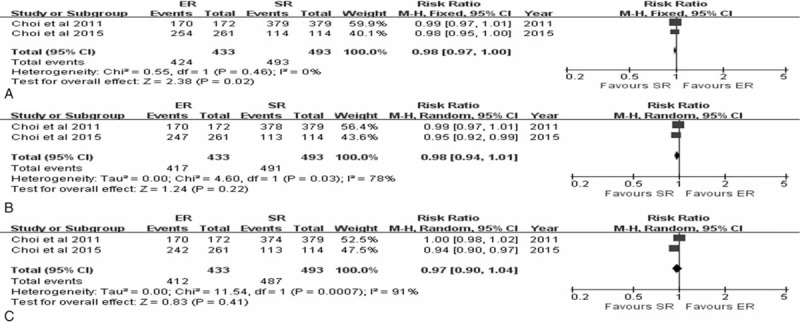
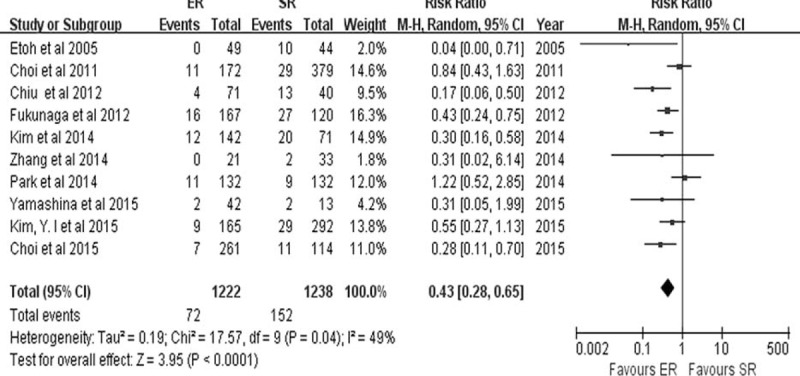
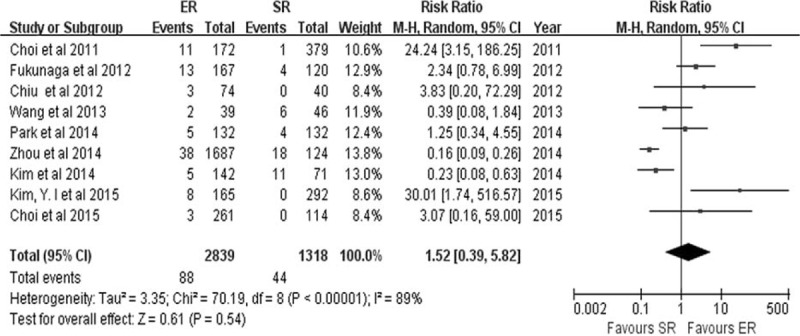
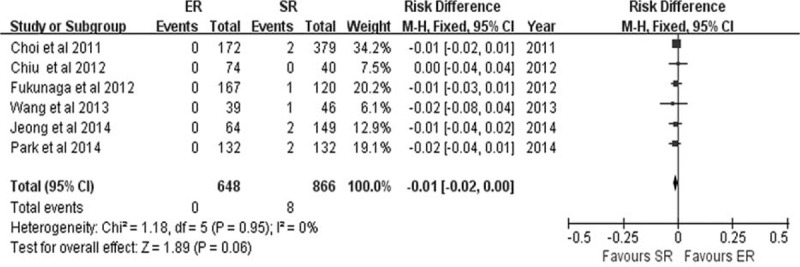
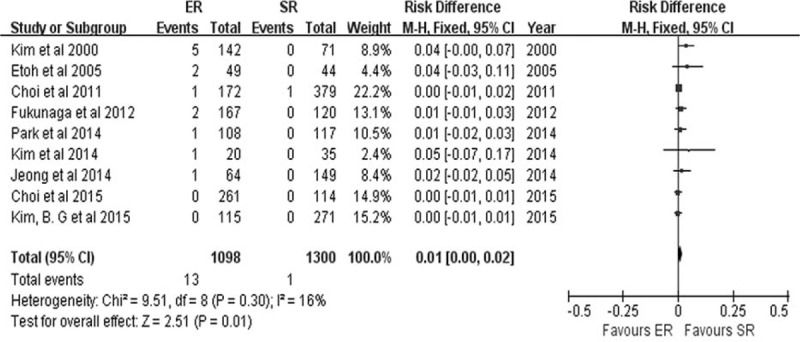
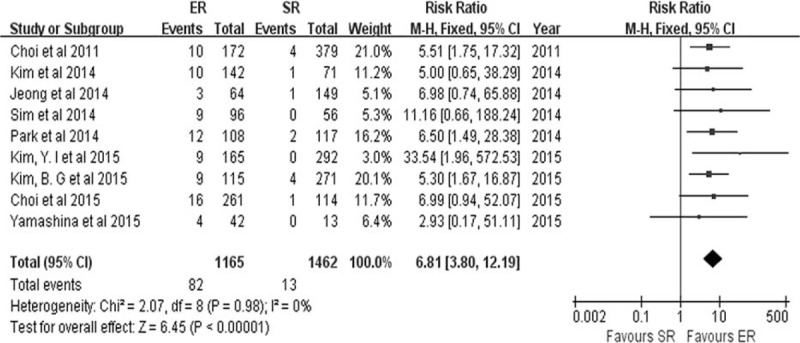
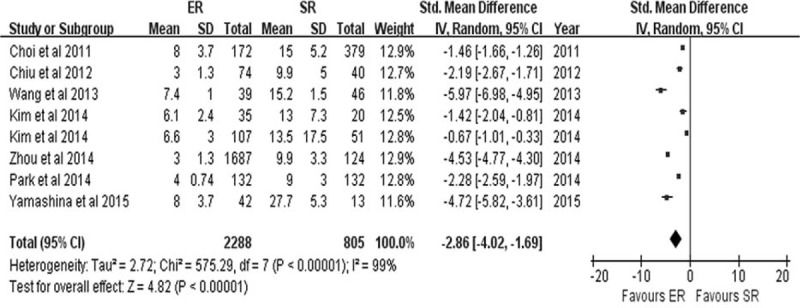
Endoscopic resection (ER) has been widely accepted to treat early gastric cancer (EGC) in place of surgical resection (SR). The aim of this meta-analysis was to conduct a comprehensive comparison between the two methods.Four literature databases, including PubMed, Web of Science, the Cochrane Library, and EMBASE, were searched for studies that compared ER with SR to treat EGC. In this meta-analysis, primary and secondary endpoints were compared between the two groups. Primary endpoints included overall survival (OS), disease-specific survival (DSS), disease-free survival (DFS), and recurrence-free survival (RFS). Secondary endpoints included operation-related death, local recurrence, metachronous lesions, procedure-related complication, bleeding, hospital stay, operation time, and cost.Nineteen studies consisting of a total of 6118 patients were identified and selected for evaluation. Meta-analysis showed that long-term outcomes of ER versus SR for EGC were comparable in terms of 5-year OS (risk ratio [RR] 1.00, 95% confidence interval [CI] 0.98-1.02), DSS (RR 0.98, 95% CI 0.89-1.08), DFS (RR 0.95, 95% CI 0.86-1.05), and RFS (RR 0.98, 95% CI 0.94-1.01). However, ER had shorter operation time (standardized mean difference [SMD] -3.39, 95% CI -3.58 to 3.20), hospital stay (SMD -2.86, 95% CI -4.02 to -1.69), lower costs (SMD -5.30, 95% CI -10.37 to -0.22), and fewer procedure-related complications (RR 0.43, 95% CI 0.28-0.65) compared to SR. Nevertheless, ER had higher incidences of local recurrence (risk difference 0.01, 95% CI 0.00-0.02) and metachronous lesions (RR 6.81, 95% CI 3.80-12.19).Endoscopic resection was associated with similar long-term outcomes and considerable advantages concerning operation time, hospital stay, costs, and complications, compared with SR, and was also associated with disadvantages such as higher incidence of local recurrence and metachronous lesions. Further high-quality studies from more countries are required to confirm these results.
内镜切除术(ER)已被广泛接受用于替代手术切除(SR)治疗早期胃癌(EGC)。本荟萃分析的目的是对这两种方法进行全面比较。检索了四个文献数据库,包括PubMed、科学网、考克兰图书馆和EMBASE,以查找比较ER与SR治疗EGC的研究。在本荟萃分析中,比较了两组的主要和次要终点。主要终点包括总生存期(OS)、疾病特异性生存期(DSS)、无病生存期(DFS)和无复发生存期(RFS)。次要终点包括手术相关死亡、局部复发、异时性病变、手术相关并发症、出血、住院时间、手术时间和费用。共确定并选择了19项研究,总计6118例患者进行评估。荟萃分析表明,就5年总生存期(风险比[RR]1.00,95%置信区间[CI]0.98 - 1.02)、疾病特异性生存期(RR 0.98,95% CI 0.89 - 1.08)、无病生存期(RR 0.95,95% CI 0.86 - 1.05)和无复发生存期(RR 0.98,95% CI 0.94 - 1.01)而言,ER与SR治疗EGC的长期结局相当。然而,与SR相比,ER的手术时间更短(标准化均差[SMD] - 3.39,95% CI - 3.58至 - 3.2)、住院时间更短(SMD - 2.86,95% CI - 4.02至 - 1.69)、费用更低(SMD - 5.30,95% CI - 10.37至 - 0.22)且手术相关并发症更少(RR 0.43,95% CI 0.28 - 0.65)。尽管如此,ER的局部复发(风险差0.01,95% CI 0.00 - 0.02)和异时性病变发生率更高(RR 6.81,95% CI 3.80 - 12.19)。与SR相比,内镜切除术具有相似的长期结局,并且在手术时间、住院时间、费用和并发症方面具有相当大的优势,但也存在局部复发和异时性病变发生率较高等缺点。需要更多国家的进一步高质量研究来证实这些结果。