Ko Mingchung, Lee Yaling, Chen Chuchieh, Chou Pesus, Chu Dachen
From the Department of Emergency Medicine and Surgery, Taipei City Hospital (MK, DC); Institute of Public Health and Community Medicine Research Center, National Yang-Ming University (MK, YL, PC, DC); Department of Health Care Management, National Taipei University of Nursing and Health Sciences (MK, CC, DC); Department of Dentistry, Taipei City Hospital (YL); and Department of Dentistry, School of Dentistry, National Yang-Ming University, Taipei, Taiwan (YL).
Medicine (Baltimore). 2015 Oct;94(43):e1770. doi: 10.1097/MD.0000000000001770.
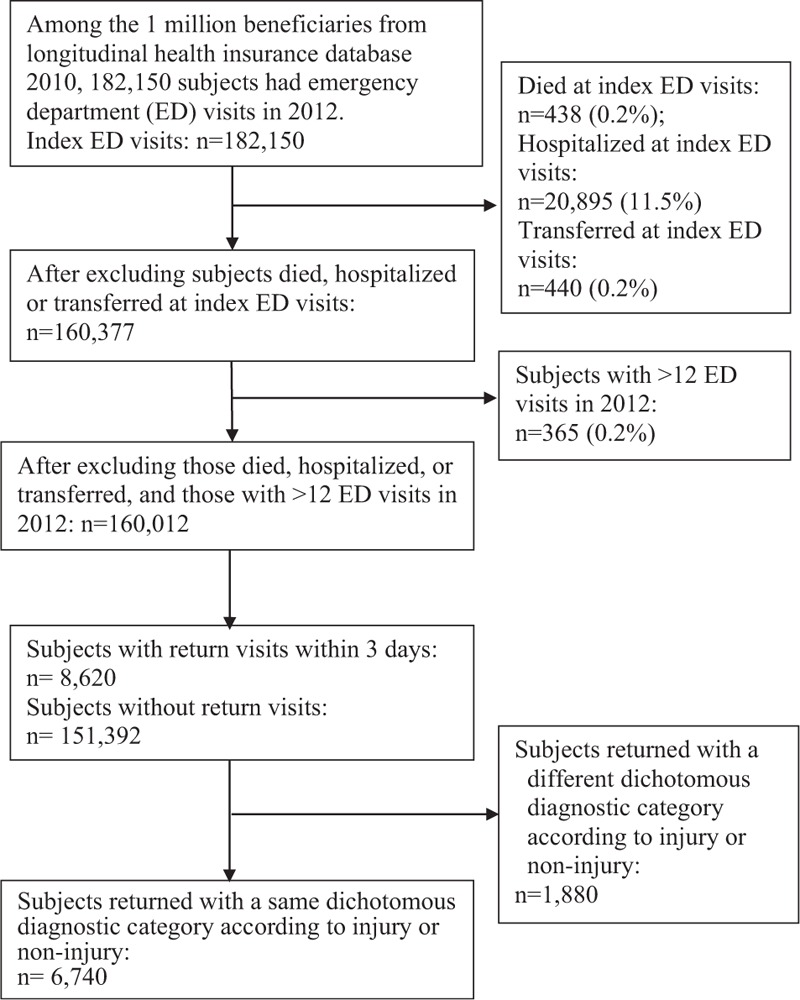
The aim of this study is to estimate the proportion of and predictors for early return visits (ERVs) to the emergency department (ED) in Taiwan.This is a population-based study using data of 1 million people randomly selected from all beneficiaries of the Taiwan National Health Insurance. All ED visits in 2012 were analyzed. The ERVs to the ED were defined as those ED revisits within 3 days after the initial ED visit. We employed a generalized estimation equation model to investigate the independent effects of various characteristics associated with the initial ED visit on ERVs.The overall proportion of ERVs within 3 days with a same dichotomous diagnostic category according to injury or noninjury was 4.3% (6740/158,132), and the overall proportion of hospitalizations after ERVs was 24.1% (1627/6740). Male subjects (4.3%) were more likely to have ERVs with an adjusted odds ratio (AOR) of 1.10 (95% confidence interval [CI]: 1.04-1.16). Compared with patients aged 18 to 64 years (4.0%), those aged >64 years had a significantly increased risk of ERVs (6.2%, AOR: 1.49, 95% CI: 1.39-1.59). In comparison to patients with injury diagnoses (2.2%), those with noninjury diagnoses had a higher risk of ERVs (5.2%, AOR: 2.50, 95% CI: 2.33-2.70). Compared with patients initially treated at medical centers (3.7%), those initially treated at regional (4.5%, AOR: 1.28, 95% CI: 1.20-1.37) or district hospitals (4.5%, AOR: 1.38, 95% CI: 1.27-1.49) had significantly higher risks of ERVs. Among the 6740 patients with ERVs, 2622 (38.9%) returned to a different hospital, and these patients tended to be those aged 18 to 64 years and initially treated at district hospitals.The risk of ERVs was associated with demographic characteristics and accreditation level of hospital. We noted a large proportion of patients with ERVs to a different hospital. The reason underlying this phenomenon warrants further investigations.
本研究旨在估算台湾地区急诊室(ED)早期复诊(ERV)的比例及其预测因素。这是一项基于人群的研究,使用从台湾全民健康保险所有受益人中随机抽取的100万人的数据。对2012年所有急诊室就诊情况进行了分析。急诊室的早期复诊定义为初次急诊室就诊后3天内的再次急诊室就诊。我们采用广义估计方程模型来研究与初次急诊室就诊相关的各种特征对早期复诊的独立影响。根据损伤或非损伤情况,同一二分诊断类别下3天内早期复诊的总体比例为4.3%(6740/158,132),早期复诊后住院的总体比例为24.1%(1627/6740)。男性患者(4.3%)更有可能出现早期复诊,调整后的优势比(AOR)为1.10(95%置信区间[CI]:1.04 - 1.16)。与18至64岁的患者(4.0%)相比,64岁以上的患者出现早期复诊的风险显著增加(6.2%,AOR:1.49,95% CI:1.39 - 1.59)。与有损伤诊断的患者(2.2%)相比,无损伤诊断的患者出现早期复诊的风险更高(5.2%,AOR:2.50,95% CI:2.33 - 2.70)。与最初在医学中心接受治疗的患者(3.7%)相比,最初在地区医院(4.5%,AOR:1.28,95% CI:1.20 - 1.37)或区医院(4.5%,AOR:1.38,95% CI:1.27 - 1.49)接受治疗的患者出现早期复诊的风险显著更高。在6740例早期复诊患者中,2622例(38.9%)返回了不同的医院,这些患者往往是18至64岁且最初在区医院接受治疗的患者。早期复诊的风险与人口统计学特征和医院的认证水平有关。我们注意到有很大一部分早期复诊患者返回了不同的医院。这一现象背后的原因值得进一步调查。