Koo Peter K, Weitzman Matthew, Sabanaygam Chandran R, van Golen Kenneth L, Mochrie Simon G J
Department of Physics, Yale University, New Haven, Connecticut, United States of America.
Department of Biological Sciences, University of Delaware, Newark, Delaware, United States of America.
PLoS Comput Biol. 2015 Oct 29;11(10):e1004297. doi: 10.1371/journal.pcbi.1004297. eCollection 2015 Oct.
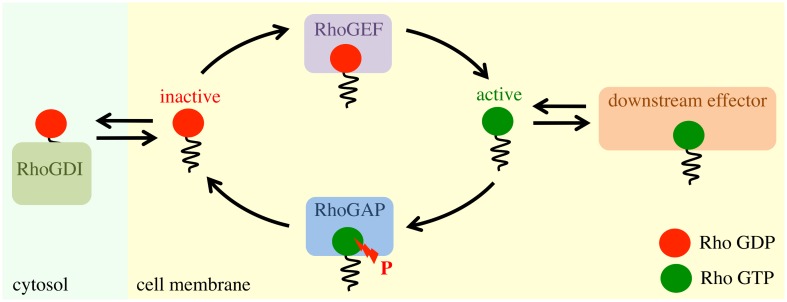
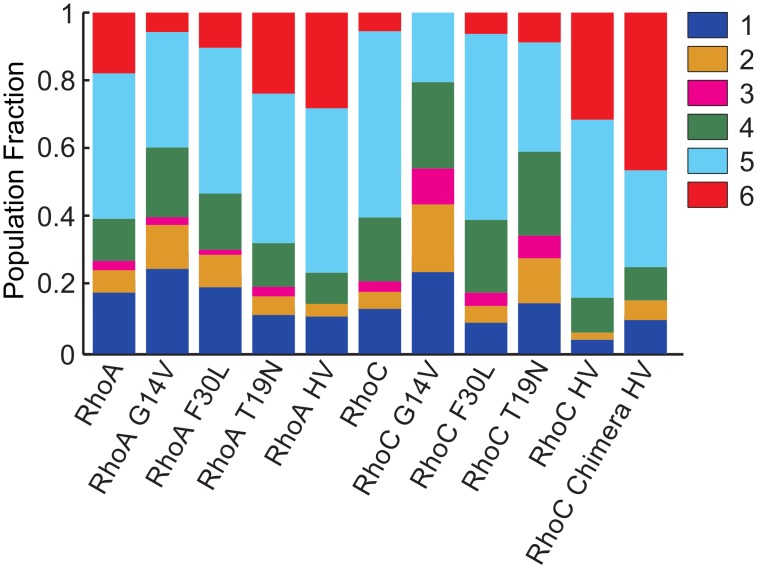
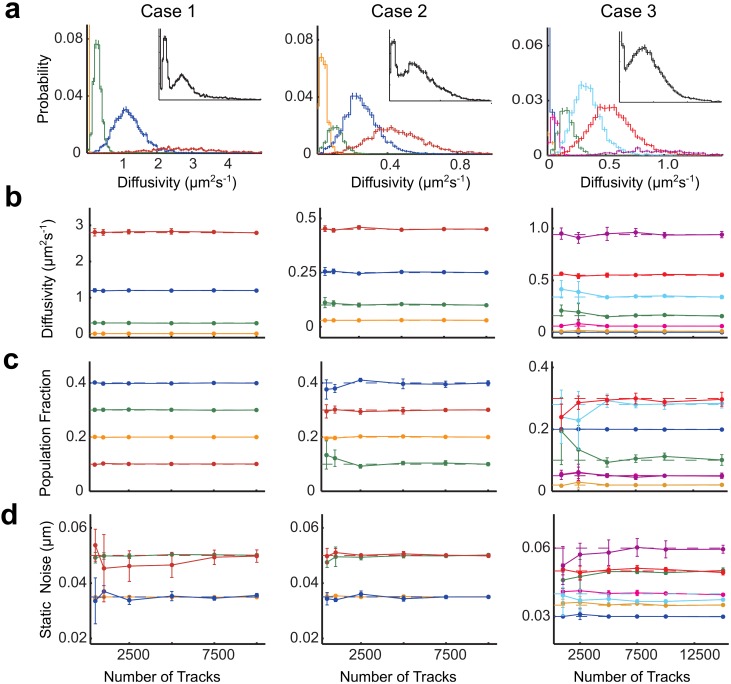
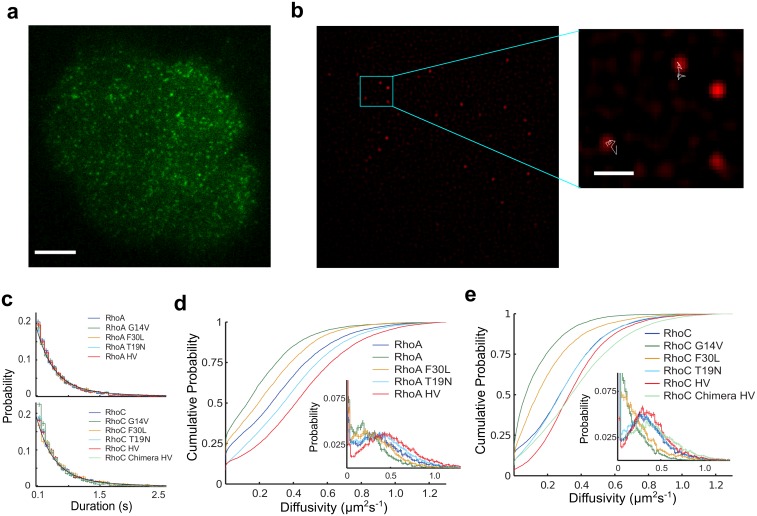
Resolving distinct biochemical interaction states when analyzing the trajectories of diffusing proteins in live cells on an individual basis remains challenging because of the limited statistics provided by the relatively short trajectories available experimentally. Here, we introduce a novel, machine-learning based classification methodology, which we call perturbation expectation-maximization (pEM), that simultaneously analyzes a population of protein trajectories to uncover the system of diffusive behaviors which collectively result from distinct biochemical interactions. We validate the performance of pEM in silico and demonstrate that pEM is capable of uncovering the proper number of underlying diffusive states with an accurate characterization of their diffusion properties. We then apply pEM to experimental protein trajectories of Rho GTPases, an integral regulator of cytoskeletal dynamics and cellular homeostasis, in vivo via single particle tracking photo-activated localization microscopy. Remarkably, pEM uncovers 6 distinct diffusive states conserved across various Rho GTPase family members. The variability across family members in the propensities for each diffusive state reveals non-redundant roles in the activation states of RhoA and RhoC. In a resting cell, our results support a model where RhoA is constantly cycling between activation states, with an imbalance of rates favoring an inactive state. RhoC, on the other hand, remains predominantly inactive.
在逐个分析活细胞中扩散蛋白的轨迹时,由于实验中可用的相对较短的轨迹所提供的统计数据有限,解析不同的生化相互作用状态仍然具有挑战性。在这里,我们引入了一种新颖的基于机器学习的分类方法,我们称之为扰动期望最大化(pEM),它同时分析一组蛋白质轨迹,以揭示由不同生化相互作用共同产生的扩散行为系统。我们在计算机模拟中验证了pEM的性能,并证明pEM能够揭示潜在扩散状态的正确数量,并准确表征其扩散特性。然后,我们通过单粒子跟踪光激活定位显微镜将pEM应用于体内Rho GTPases(细胞骨架动力学和细胞稳态的重要调节因子)的实验蛋白质轨迹。值得注意的是,pEM揭示了6种在各种Rho GTPase家族成员中保守的不同扩散状态。每个扩散状态的倾向在家族成员之间的变异性揭示了RhoA和RhoC激活状态中的非冗余作用。在静息细胞中,我们的结果支持一种模型,即RhoA在激活状态之间不断循环,速率不平衡有利于非活性状态。另一方面,RhoC主要保持非活性状态。