Higuchi Teruhiko, Kamijima Kunitoshi, Nakagome Kazuyuki, Itamura Rio, Asami Yuko, Kuribayashi Kazuhiko, Imaeda Takayuki
aNational Center of Neurology and Psychiatry bClinical Research cMedical Affairs Global Established Pharma Business dClinical Statistics, Pfizer Japan Inc., Tokyo eInternational University of Health and Welfare, Tochigi, Japan.
Int Clin Psychopharmacol. 2016 Jan;31(1):8-19. doi: 10.1097/YIC.0000000000000105.
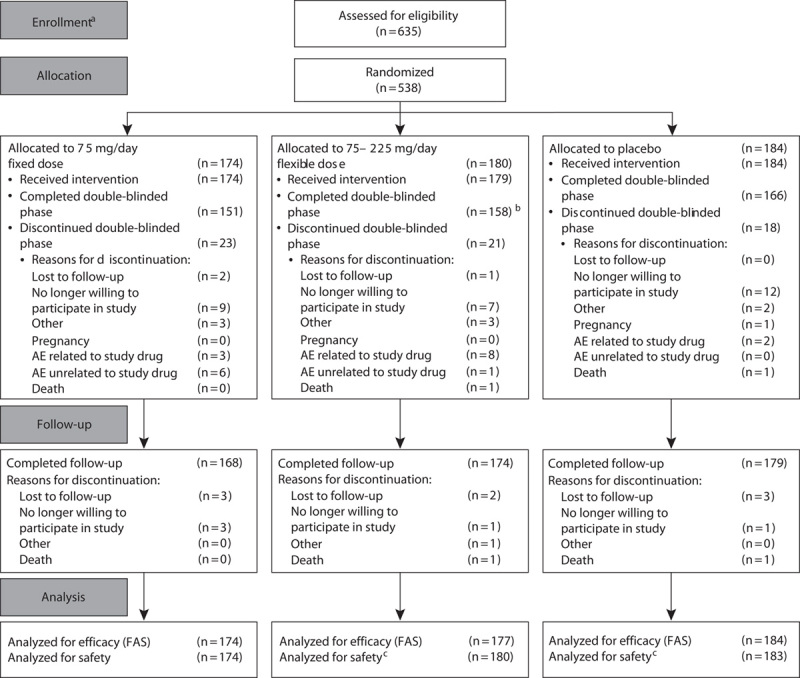
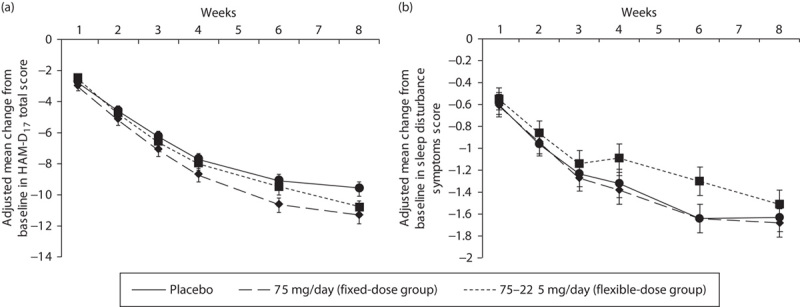
The aim of this study was to assess antidepressant efficacy and safety of venlafaxine extended release in Japanese patients with major depressive disorder (MDD). We carried out a double-blinded, placebo-controlled, randomized study using fixed (75 mg/day) and flexible (75-225 mg/day, most patients attained to 225 mg/day) doses, followed by the long-term, open-labeled, extension study. Outpatients aged at least 20 years diagnosed with MDD were included. The primary efficacy measure was change from baseline in the Hamilton Rating Scale for Depression (HAM-D17) score at week 8; secondary efficacy measures included the Montgomery-Åsberg Depression Rating Scale, the Quick Inventory of Depressive Symptomatology self-report version, HAM-D6, and Clinical Global Impression scales in the double-blinded study. Overall, 538 patients were randomized; significant differences were observed in the primary efficacy variable in the fixed-dose group (-10.76; P=0.031), but not in the flexible-dose (-10.37; P=0.106) group compared with placebo (-9.25). However, the flexible-dose group showed significant efficacy in several secondary measures. Treatment-related adverse events in the treatment period were 51.7 and 67.8% in the fixed-dose and flexible-dose groups, respectively, versus 38.8% with placebo. Throughout the study period, no Japanese-specific adverse events were observed. Thus, venlafaxine extended release was efficacious and safe for MDD treatment in Japan.
本研究旨在评估文拉法辛缓释剂对日本重度抑郁症(MDD)患者的抗抑郁疗效及安全性。我们开展了一项双盲、安慰剂对照、随机研究,采用固定剂量(75毫克/天)和灵活剂量(75 - 225毫克/天,大多数患者达到225毫克/天),随后进行长期、开放标签的扩展研究。纳入了年龄至少20岁、被诊断为MDD的门诊患者。主要疗效指标是第8周时汉密尔顿抑郁量表(HAM - D17)评分相对于基线的变化;次要疗效指标包括蒙哥马利 - 阿斯伯格抑郁量表、抑郁症状快速自评量表、HAM - D6以及双盲研究中的临床总体印象量表。总体而言,538例患者被随机分组;与安慰剂组(-9.25)相比,固定剂量组在主要疗效变量上观察到显著差异(-10.76;P = 0.031),但灵活剂量组未观察到显著差异(-10.37;P = 0.106)。然而,灵活剂量组在几个次要指标上显示出显著疗效。治疗期内,固定剂量组和灵活剂量组与治疗相关的不良事件发生率分别为51.7%和67.8%,而安慰剂组为38.8%。在整个研究期间,未观察到日本特有的不良事件。因此,文拉法辛缓释剂在日本治疗MDD有效且安全。