Han Shuiyun, Gu Feiying, Lin Gang, Sun Xiaojiang, Wang Yuezhen, Wang Zhun, Lin Qingren, Weng Denghu, Xu Yaping, Mao Weimin
1. First Clinical Medical School, Wenzhou Medical University, Wenzhou, China ; 2. Department of Radiation Oncology, Zhejiang Cancer Hospital, Hangzhou China.
2. Department of Radiation Oncology, Zhejiang Cancer Hospital, Hangzhou China.
J Cancer. 2015 Sep 15;6(11):1172-8. doi: 10.7150/jca.12314. eCollection 2015.
Dose escalation of thoracic radiation can improve the local tumor control and surivival, and is in the meantime limited by the occurrence of radiation-induced lung injury (RILI). This study investigated the clinical and dosimetric factors influencing RILI in lung-cancer patients receiving chemoradiotherapy for better radiation planning.
A retrospective analysis was carried out on 161 patients with non-small-cell or small-cell lung cancer (NSCLC and SCLC, respectively), who underwent chemoradiotherapy between April 2010 and May 2011 with a median follow-up time of 545 days (range: 39-1453). Chemotherapy regimens were based on the histological type (squamous cell carcinoma, adenocarcinoma, or SCLC), and radiotherapy was delivered in 1.8-3.0 Gy (median, 2.0 Gy) fractions, once daily, to a total of 39-66 Gy (median, 60 Gy). Univariate analysis was performed to analyze clinical and dosimetric factors associated with RILI. Multivariate analysis using logistic regression identified independent risk factors correlated to RILI.
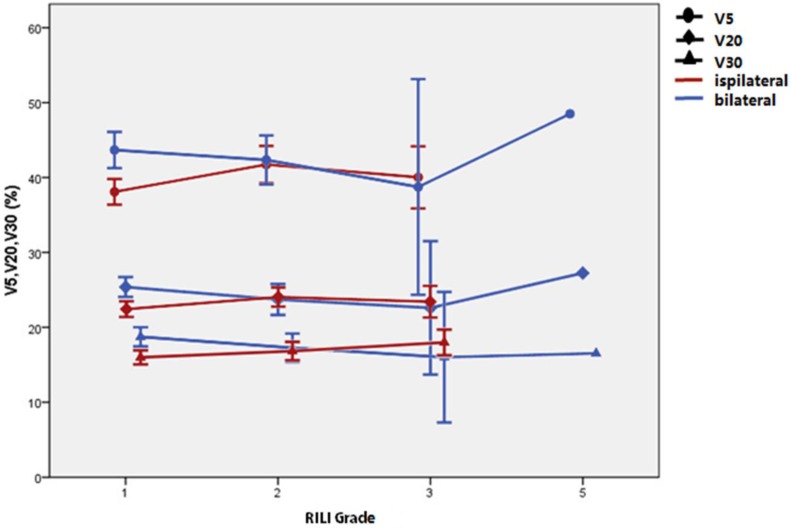
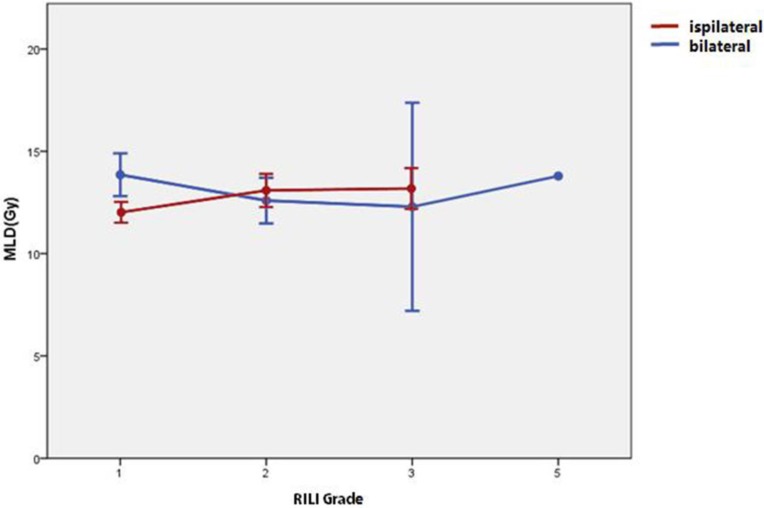
The incidence of symptomatic RILI (≥grade 2) was 31.7%. Univariate analysis showed that V5, V20, and mean lung dose (MLD) were significantly associated with RILI incidence (P=0.029, 0.048, and 0.041, respectively). The association was not statistically significant for histological type (NSCLC vs. SCLC, P = 0.092) or radiation technology (IMRT vs. 3D-CRT, P = 0.095). Multivariate analysis identified MLD as an independent risk factor for symptomatic RILI (OR=1.249, 95%CI=1.055-1.48, P= 0.01). The incidence of bilateral RILI in cases where the tumor was located unilaterally was 22.7% (32/141) and all dosimetric-parameter values were not significantly different (P>0.05) for bilateral versus ipsilateral injury, except grade-1 (low) RILI (P < 0.05). The RILI grade was higher in cases of ipsilateral lung injury than in bilateral cases (Mann-Whitney U test, z=8.216, P< 0.001).
The dosimetric parameter, MLD, was found to be an independent predictive factor for RILI. Additional contralateral injury does not seem to be correlated with increased RILI grade under the condition of conventional radiotherapy treatment planning.
增加胸部放疗剂量可提高局部肿瘤控制率和生存率,但同时会受到放射性肺损伤(RILI)发生的限制。本研究调查了影响接受放化疗的肺癌患者发生RILI的临床和剂量学因素,以优化放疗计划。
对161例非小细胞肺癌或小细胞肺癌(分别为NSCLC和SCLC)患者进行回顾性分析,这些患者于2010年4月至2011年5月接受了放化疗,中位随访时间为545天(范围:39 - 1453天)。化疗方案根据组织学类型(鳞状细胞癌、腺癌或SCLC)制定,放疗采用1.8 - 3.0 Gy(中位剂量2.0 Gy)分次,每日一次,总剂量为39 - 66 Gy(中位剂量60 Gy)。进行单因素分析以分析与RILI相关的临床和剂量学因素。使用逻辑回归进行多因素分析,确定与RILI相关的独立危险因素。
有症状的RILI(≥2级)发生率为31.7%。单因素分析显示,V5、V20和平均肺剂量(MLD)与RILI发生率显著相关(分别为P = 0.029、0.048和0.041)。组织学类型(NSCLC与SCLC,P = 0.092)或放疗技术(调强放疗与三维适形放疗,P = 0.095)与RILI的相关性无统计学意义。多因素分析确定MLD是有症状RILI的独立危险因素(OR = 1.249,95%CI = 1.055 - 1.48,P = 0.01)。肿瘤单侧发生时双侧RILI的发生率为22.7%(32/141),除1级(轻度)RILI外,双侧与同侧损伤的所有剂量学参数值差异均无统计学意义(P>0.05)。同侧肺损伤患者的RILI分级高于双侧损伤患者(Mann-Whitney U检验,z = 8.216,P<0.001)。
剂量学参数MLD被发现是RILI的独立预测因素。在传统放疗计划条件下,额外的对侧损伤似乎与RILI分级增加无关。