Department of Radiation Oncology, Shandong Cancer Hospital, Shandong Academy of Medical Sciences, Jinan, People’s Republic China.
Radiat Oncol. 2012 May 17;7:69. doi: 10.1186/1748-717X-7-69.
Radiation-induced lung injury (RILI) is an important dose-limiting toxicity during thoracic radiotherapy. The purpose of this study is to investigate single photon emission computed tomography (SPECT) perfusion-weighted functional dose-volume histogram (FDVH) for predicting RILI in non-small cell lung cancer (NSCLC) patients treated with definitive chemoradiotherapy.
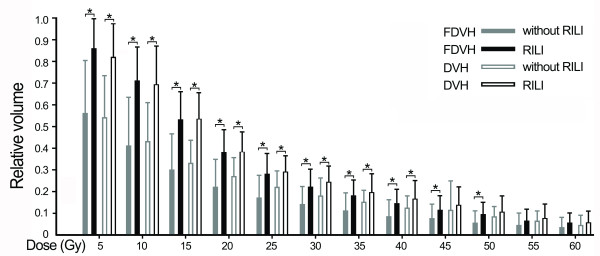
Fifty-seven locally advanced NSCLC patients receiving chemoradiotherapy were enrolled prospectively. Patients had treatment scans and dose calculations to provide a standard dose-volume histogram (DVH). Fusion of SPECT and computed tomography scans provided perfusion-weighted FDVH and associated functional dosimetric parameters (relative volumes of functional lung receiving more than a threshold dose of 5 - 60 Gy at increments of 5 Gy [FV5 - FV60]). The predictive abilities of FDVH and DVH were calculated and compared based on the area under receiver operating characteristic (ROC) curve (AUC).
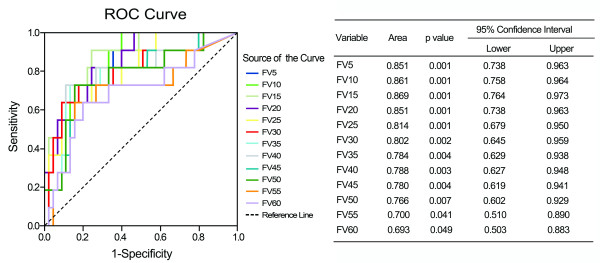
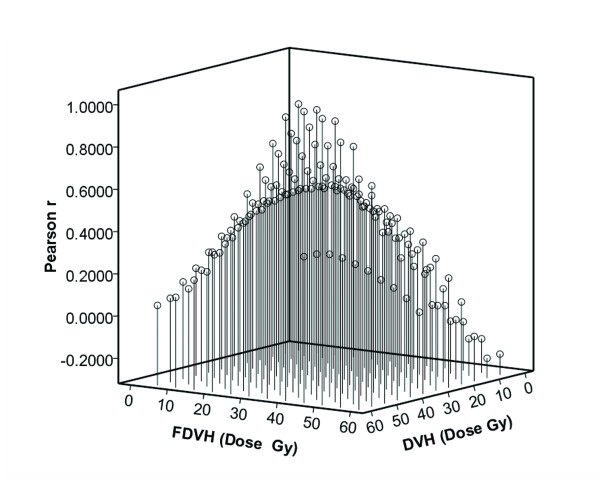
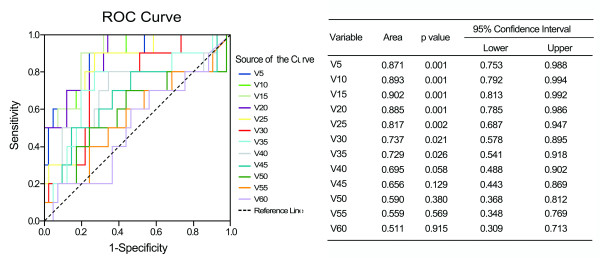
The accumulative incidence of ≥ 2 grade RILI was 19.3% with a median follow-up of 12 months. Univariate analysis showed that the functional (FV5 - FV60) and standard (V5 - V40) parameters were associated with RILI (all value of p < 0.05). Close correlations between a variety of functional and standard parameters were found. By ROC curve analysis, functional metrics (AUCs were 0.784 - 0.869) provided similarly (p value 0.233 - 1.000) predictive outcome to standard metrics (AUCs were 0.695 - 0.902) in lower - median dose level parameters (FV5 - FV40). However, FDVH seemed to add some predictive value in higher dose level, the best statistical significance for comparing FV60 with V60 was 0.693 vs. 0.511 (p = 0.055).
Functional metrics are identified as reliable predictors for RILI, however, this observation still needs to be further verified using a larger sample size.
放射性肺损伤(RILI)是胸部放射治疗的重要剂量限制毒性。本研究旨在探讨单光子发射计算机断层扫描(SPECT)灌注加权功能剂量-体积直方图(FDVH)预测接受根治性放化疗的非小细胞肺癌(NSCLC)患者的 RILI。
前瞻性纳入 57 例接受放化疗的局部晚期 NSCLC 患者。患者进行了治疗扫描和剂量计算,以提供标准剂量-体积直方图(DVH)。SPECT 与计算机断层扫描融合提供灌注加权 FDVH 和相关功能剂量学参数(功能肺的相对体积,在 5-60Gy 每 5Gy 一个增量处接受超过阈值剂量[FV5-FV60])。基于接收者操作特征(ROC)曲线下面积(AUC)计算和比较 FDVH 和 DVH 的预测能力。
≥2 级 RILI 的累积发生率为 19.3%,中位随访时间为 12 个月。单因素分析显示,功能(FV5-FV60)和标准(V5-V40)参数与 RILI 相关(所有 p 值均<0.05)。多种功能和标准参数之间存在密切相关性。通过 ROC 曲线分析,功能指标(AUC 为 0.784-0.869)与标准指标(AUC 为 0.695-0.902)在较低中位剂量水平参数(FV5-FV40)下提供类似(p 值为 0.233-1.000)的预测结果。然而,FDVH 似乎在更高剂量水平下具有一定的预测价值,比较 FV60 与 V60 的最佳统计学意义为 0.693 与 0.511(p=0.055)。
功能指标被确定为 RILI 的可靠预测指标,但这一观察结果仍需要使用更大的样本量进一步验证。