Department of Neurology (A.A., P.E., A.D.E., M.G., K.S., M.G.H., A.G.), Universitätsmedizin Mannheim, University of Heidelberg, Mannheim, Germany; and Theodor Kocher Institute (B.E.), University of Bern, Bern, Switzerland.
Neurol Neuroimmunol Neuroinflamm. 2015 Oct 15;2(6):e164. doi: 10.1212/NXI.0000000000000164. eCollection 2015 Dec.
To investigate the blood-CSF barrier (BCSFB) dysfunction in aseptic meningitis.
In our case series of 14 patients with acute aseptic meningitis, we compared MRI characteristics with CSF findings.
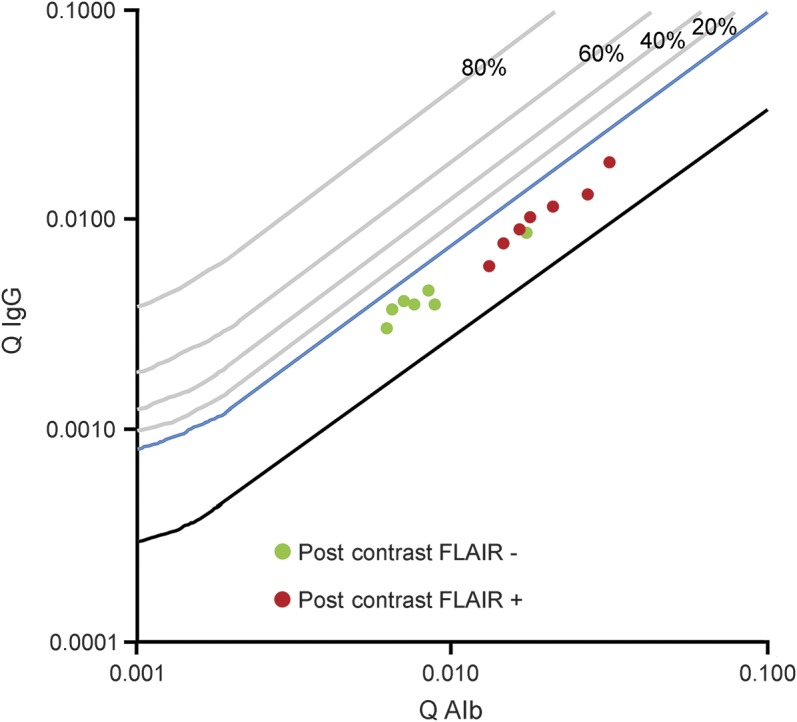
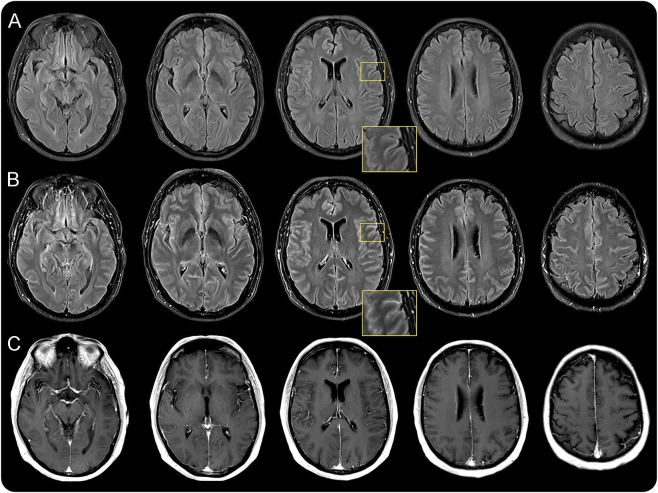
Contrast enhancement in the sulcal space in a leptomeningeal pattern was visualized in 7 patients with BCSFB dysfunction categorized as moderate to severe as evidenced by the CSF/serum albumin ratio (Qalb) but was not present in those with mild or no barrier disturbance (p = 0.001). The Qalb as a marker for the leakiness of the BCSFB and, more indirectly, of the blood-brain barrier (BBB) was positively correlated with the incidence of leptomeningeal contrast enhancement seen on postcontrast fluid-attenuated inversion recovery (FLAIR) MRI (p = 0.003). Patients with a more pronounced brain barrier dysfunction recovered more slowly and stayed longer in the hospital.
The severity of meningeal BBB disturbance can be estimated on postcontrast FLAIR MRI, which may be of diagnostic value in patients with aseptic meningitis.
研究无菌性脑膜炎的血脑屏障(BCSFB)功能障碍。
在我们的 14 例急性无菌性脑膜炎患者的病例系列中,我们比较了 MRI 特征与 CSF 发现。
在 7 例 BCSFB 功能障碍患者中,可见到软脑膜模式的脑沟空间增强,表明 CSF/血清白蛋白比值(Qalb)中度至重度障碍(p = 0.001),而在轻度或无屏障障碍的患者中则不存在(p = 0.001)。作为 BCSFB 通透性的标志物,更间接地作为血脑屏障(BBB)通透性的标志物,Qalb 与增强后液体衰减反转恢复(FLAIR)MRI 上见到的软脑膜增强的发生率呈正相关(p = 0.003)。脑膜 BBB 功能障碍越明显的患者恢复越慢,住院时间也越长。
在增强后 FLAIR MRI 上可以估计脑膜 BBB 障碍的严重程度,这对无菌性脑膜炎患者可能具有诊断价值。