Ren Huiwen, Yang Baoxue, Molina Patrick A, Sands Jeff M, Klein Janet D
Department of Medicine, Renal Division, Emory University School of Medicine, Atlanta, Georgia, United States of America; Department of Pharmacology, School of Basic Medical Sciences, Peking University, Beijing, China.
Department of Pharmacology, School of Basic Medical Sciences, Peking University, Beijing, China.
PLoS One. 2015 Oct 30;10(10):e0141714. doi: 10.1371/journal.pone.0141714. eCollection 2015.
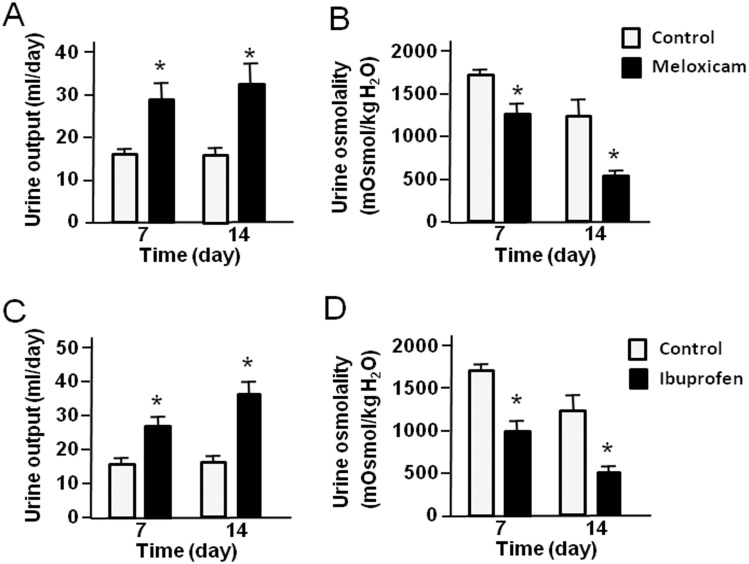
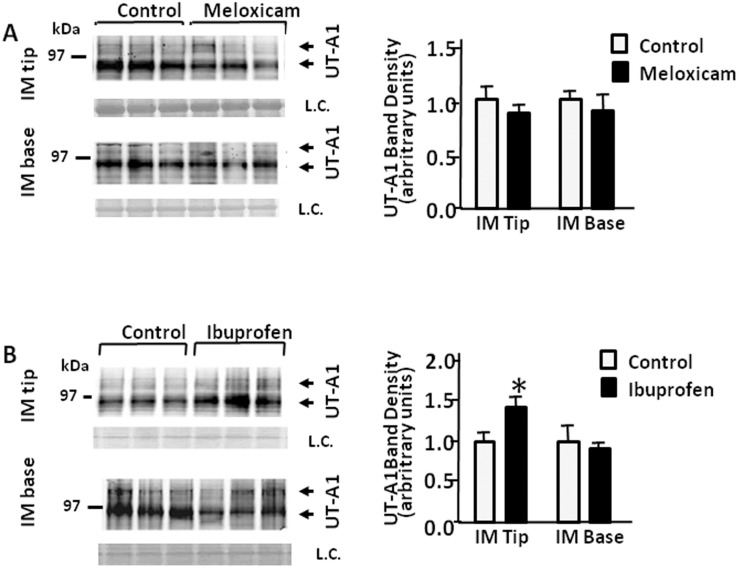
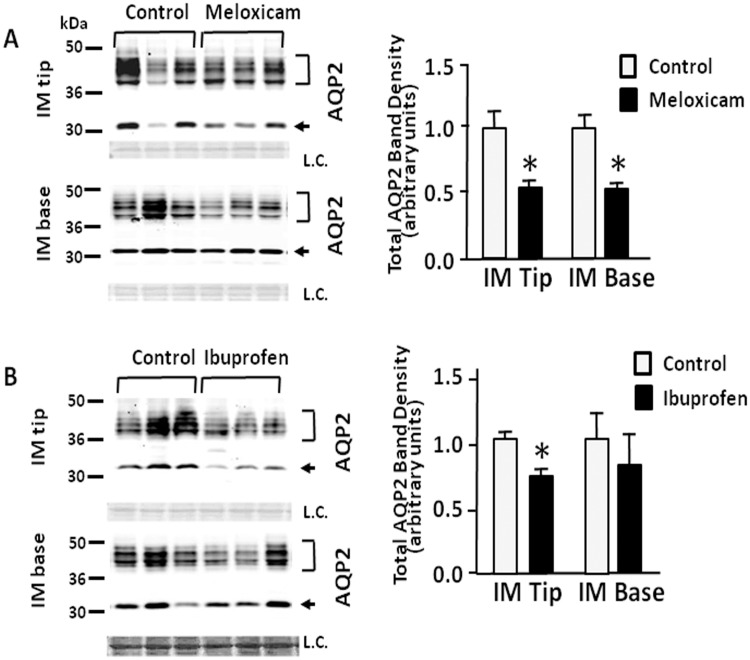
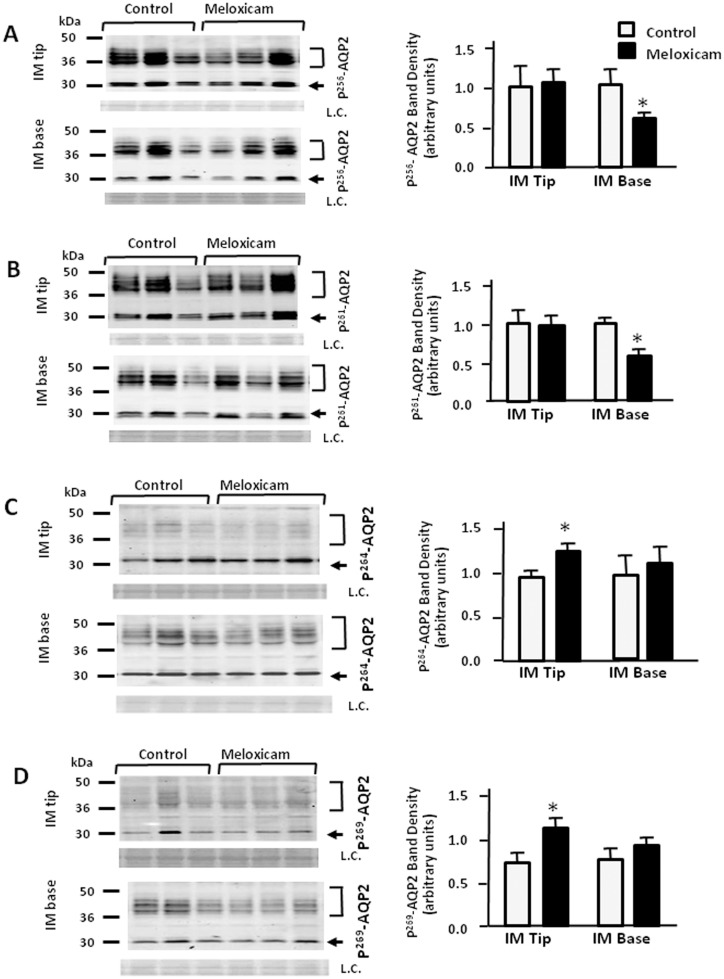
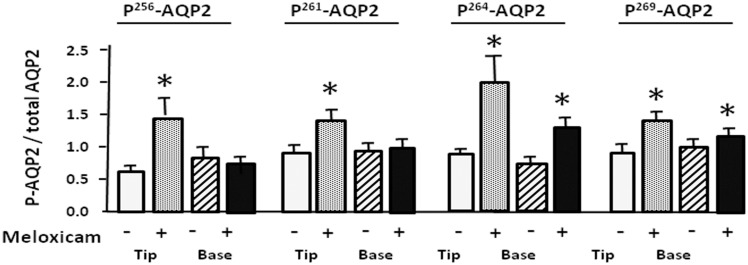
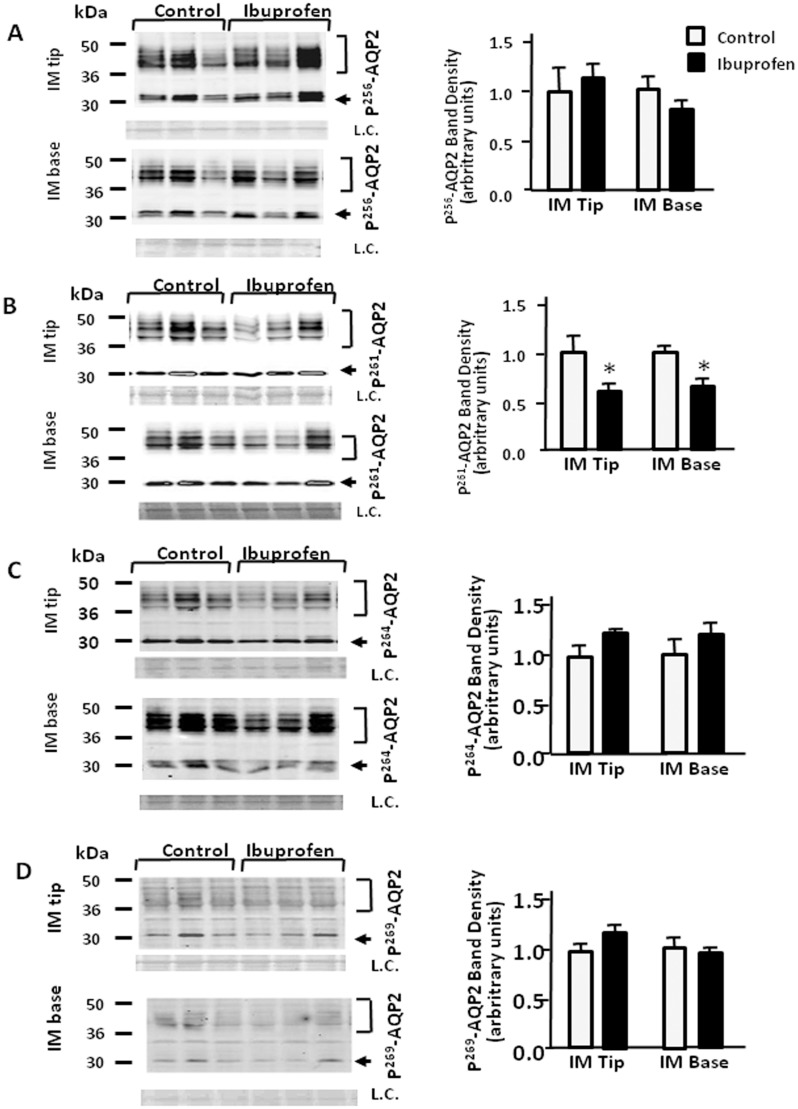
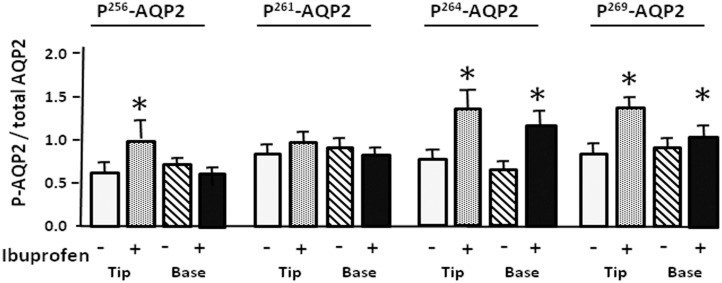
Vasopressin increases urine concentration through activation of aquaporin-2 (AQP2) in the collecting duct. Nonsteroidal anti-inflammatory drugs (NSAIDs) block prostaglandin E2 synthesis, and may suppress AQP2 producing a urine concentrating defect. There are four serines in AQP2 that are phosphorylated by vasopressin. To determine if chronic use of NSAIDs changes AQP2's phosphorylation at any of these residues, the effects of a non-selective NSAID, ibuprofen, and a COX-2-selective NSAID, meloxicam, were investigated. Daily ibuprofen or meloxicam increased the urine output and decreased the urine osmolality significantly by days 7 through 14. Concomitantly, meloxicam significantly reduced total AQP2 protein abundance in inner medulla (IM) tip to 64% of control and base to 63%, respectively. Ibuprofen significantly decreased total AQP2 in IM tip to 70% of control, with no change in base. Meloxicam significantly increased the ratios of p256-AQP2 and p261-AQP2 to total AQP2 in IM tip (to 44% and 40%, respectively). Ibuprofen increased the ratio of p256-AQP2 to total AQP2 in IM tip but did not affect p261-AQP2/total AQP2 in tip or base. Both ibuprofen and meloxicam increased p264-AQP2 and p269-AQP2 ratios in both tip and base. Ibuprofen increased UT-A1 levels in IM tip, but not in base. We conclude that NSAIDs reduce AQP2 abundance, contributing to decreased urine concentrating ability. They also increase some phosphorylated forms of AQP2. These changes may partially compensate for the decrease in AQP2 abundance, thereby lessening the decrease in urine osmolality.
血管加压素通过激活集合管中的水通道蛋白-2(AQP2)来增加尿液浓缩。非甾体抗炎药(NSAIDs)会阻断前列腺素E2的合成,并可能抑制AQP2,从而导致尿液浓缩功能缺陷。AQP2中有四个丝氨酸会被血管加压素磷酸化。为了确定长期使用NSAIDs是否会改变这些残基中任何一个的AQP2磷酸化情况,研究了非选择性NSAID布洛芬和COX-2选择性NSAID美洛昔康的作用。在第7天至第14天,每日服用布洛芬或美洛昔康会显著增加尿量并降低尿渗透压。与此同时,美洛昔康显著降低了内髓质(IM)尖端的总AQP2蛋白丰度,降至对照组的64%,基部降至63%。布洛芬显著降低了IM尖端的总AQP2至对照组的70%,基部无变化。美洛昔康显著增加了IM尖端中p256-AQP2和p261-AQP2与总AQP2的比率(分别增至44%和40%)。布洛芬增加了IM尖端中p256-AQP2与总AQP2的比率,但不影响尖端或基部的p261-AQP2/总AQP2比率。布洛芬和美洛昔康均增加了尖端和基部的p264-AQP2和p269-AQP2比率。布洛芬增加了IM尖端的UT-A1水平,但基部未增加。我们得出结论,NSAIDs会降低AQP2丰度,导致尿液浓缩能力下降。它们还会增加AQP2的一些磷酸化形式。这些变化可能会部分补偿AQP2丰度的降低,从而减轻尿渗透压的下降。