Cao Yu, Xiong Jimin, Mei Shenghui, Wang Fu, Zhao Zhigang, Wang Songlin, Liu Yi
Department of General Dentistry, School of Stomatology, Capital Medical University, Beijing, P. R. China.
Laboratory of Tissue Regeneration and Immunology and Department of Periodontics, Beijing Key Laboratory of Tooth Regeneration and Function Reconstruction, School of Stomatology, Capital Medical University, Tian Tan Xi Li No.4, Beijing, 100050, P. R. China.
Stem Cell Res Ther. 2015 Oct 31;6:210. doi: 10.1186/s13287-015-0200-4.
Stem cells have great therapeutic potential due to their capacity for self-renewal and their potential for differentiating into multiple cell lineages. It has been recently shown that the host immune system has fundamental effects on the fate of transplanted mesenchymal stem cells during bone repair, where the topical administration of aspirin is capable of improving calvarial bone repair in rodents by inhibiting tumor necrosis factor-α (TNF-α) and interferon-γ (IFN-γ) production. This study investigates whether aspirin is capable of accelerating the regenerative potential of bone marrow mesenchymal stem cells (BMSC) in a mini swine calvarial bone defect model.
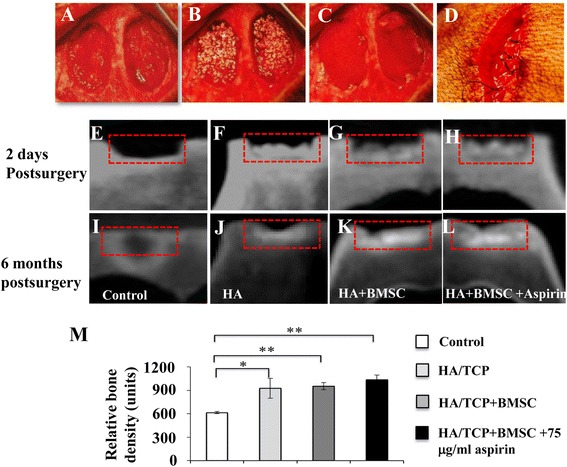
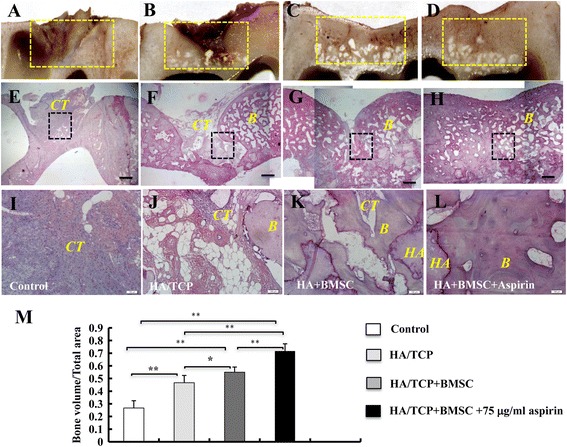
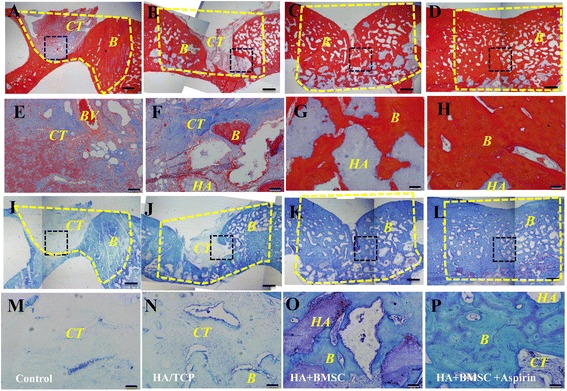
Calvarial bone defects (3 cm × 1.8 cm oval defect) in mini swine were treated with BMSC pretreated with 75 μg/ml aspirin for 24 h seeded onto hydroxyaptite/tricalcium phosphatel (HA/TCP), or with BMSC with HA/TCP, or with HA/TCP only, or remained untreated. Animals were scanned with micro-computed tomography (microCT) at 2 days and 6 months postsurgery and were sacrificed at 6 months postsurgery with decalcified tissues being processed for histomorphometric examination. The cytokine levels, including TNF-α and IFN-γ, were measured by enzyme-linked immunosorbent assay (ELISA).
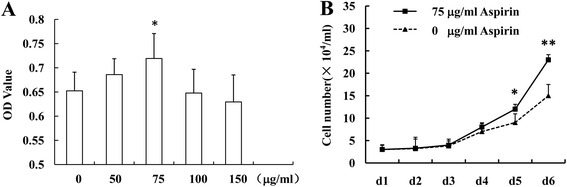
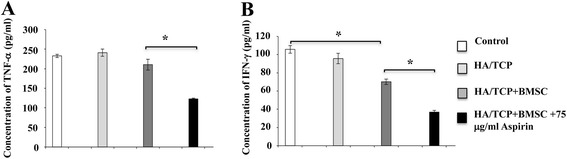
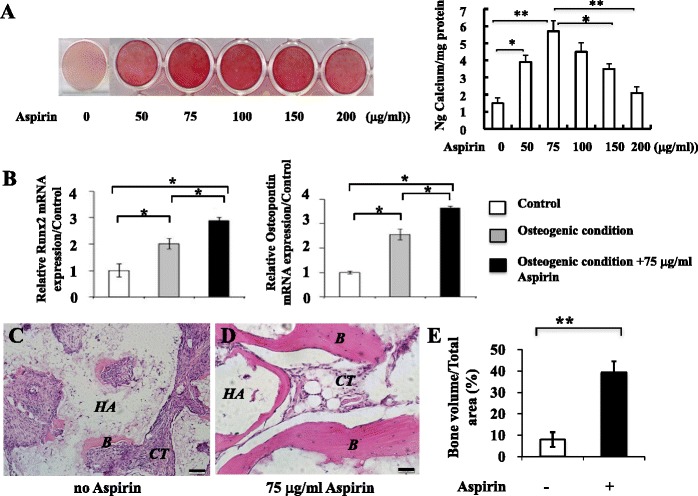
Aspirin at 75 μg/ml promoted the osteogenesis of BMSC in vitro and in vivo, shown by Alizarin Red staining and new bone volume in the nude mice transplantation model (p < 0.01), respectively. Defects treated with aspirin-BMSC showed significantly greater new bone fill compared with other three groups at 6 months postsurgery (p < 0.01). Aspirin-BMSC treatment has significantly decreased the concentration of TNF-α and IFN-γ (p < 0.05).
The present study shows that BMSC pretreated with aspirin have a greater capacity to repair calvarial bone defects in a mini swine model. The results suggest that the administration of aspirin is capable of improving BMSC-mediated calvarial bone regeneration in a big animal model.
干细胞因其自我更新能力以及分化为多种细胞谱系的潜力而具有巨大的治疗潜力。最近研究表明,在骨修复过程中,宿主免疫系统对移植的间充质干细胞的命运具有重要影响,局部应用阿司匹林能够通过抑制肿瘤坏死因子-α(TNF-α)和干扰素-γ(IFN-γ)的产生来改善啮齿动物的颅骨修复。本研究调查了在小型猪颅骨缺损模型中,阿司匹林是否能够加速骨髓间充质干细胞(BMSC)的再生潜力。
将小型猪的颅骨缺损(3厘米×1.8厘米椭圆形缺损)用75μg/ml阿司匹林预处理24小时后的BMSC接种到羟基磷灰石/磷酸三钙(HA/TCP)上进行治疗,或用接种了HA/TCP的BMSC治疗,或仅用HA/TCP治疗,或不进行治疗。在术后2天和6个月用微型计算机断层扫描(microCT)对动物进行扫描,并在术后6个月处死动物,对脱钙组织进行组织形态计量学检查。通过酶联免疫吸附测定(ELISA)测量细胞因子水平,包括TNF-α和IFN-γ。
75μg/ml的阿司匹林在体外和体内均促进了BMSC的成骨作用,分别通过茜素红染色和裸鼠移植模型中的新骨体积得以体现(p<0.01)。在术后6个月,用阿司匹林-BMSC治疗的缺损与其他三组相比,新骨填充明显更多(p<0.01)。阿司匹林-BMSC治疗显著降低了TNF-α和IFN-γ的浓度(p<0.05)。
本研究表明,用阿司匹林预处理的BMSC在小型猪模型中具有更大的修复颅骨缺损的能力。结果表明,在大型动物模型中,应用阿司匹林能够改善BMSC介导的颅骨再生。