Keyser Chad A, De Fine Licht Henrik H, Steinwender Bernhardt M, Meyling Nicolai V
Department of Plant and Environmental Sciences, University of Copenhagen, Thorvaldsensvej 40, 1871, Frederiksberg, Denmark.
BMC Microbiol. 2015 Oct 30;15:249. doi: 10.1186/s12866-015-0589-z.
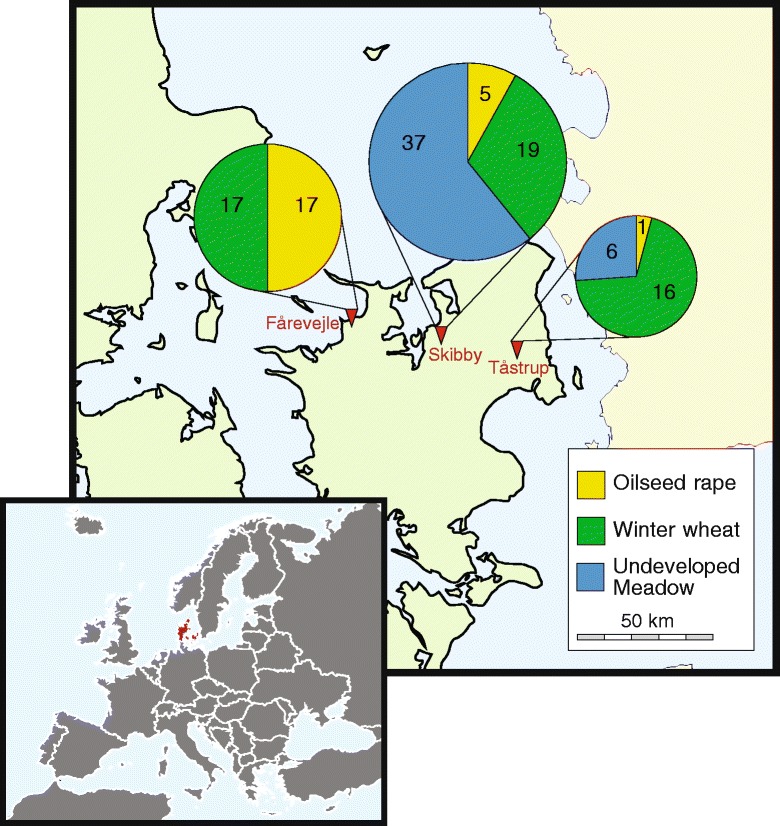
Knowledge of the natural occurrence and community structure of entomopathogenic fungi is important to understand their ecological role. Species of the genus Metarhizium are widespread in soils and have recently been reported to associate with plant roots, but the species M. flavoviride has so far received little attention and intra-specific diversity among isolate collections has never been assessed. In the present study M. flavoviride was found to be abundant among Metarhizium spp. isolates obtained from roots and root-associated soil of winter wheat, winter oilseed rape and neighboring uncultivated pastures at three geographically separated locations in Denmark. The objective was therefore to evaluate molecular diversity and resolve the potential population structure of M. flavoviride.
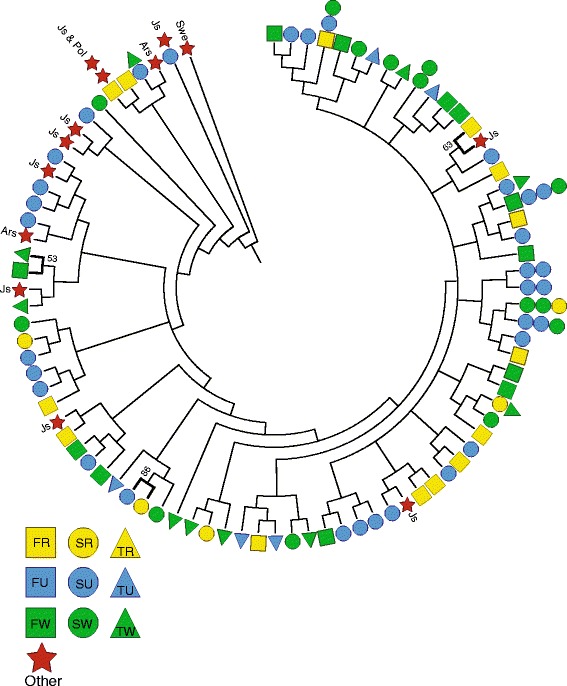
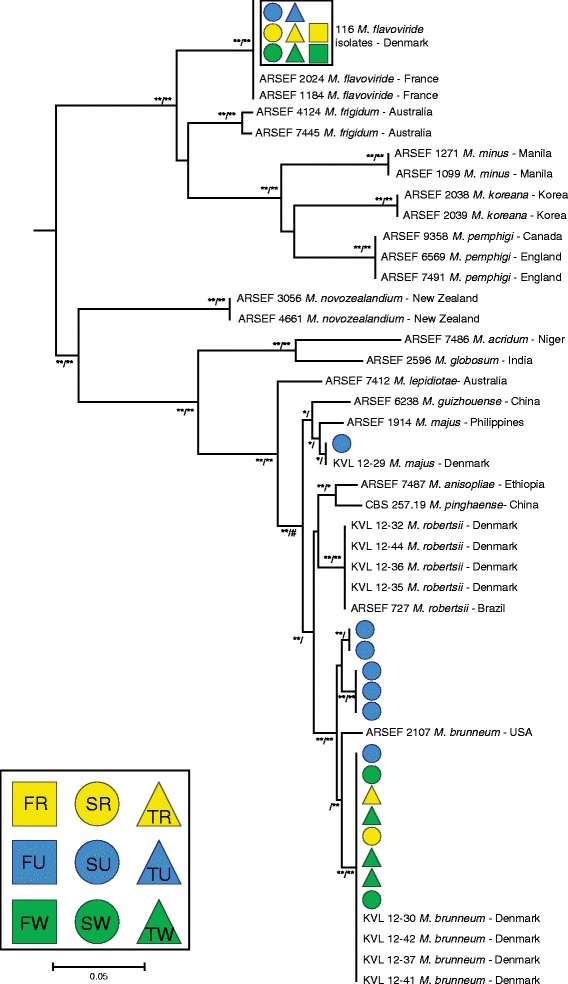
Of the 132 Metarhizium isolates obtained, morphological data and DNA sequencing revealed that 118 belonged to M. flavoviride, 13 to M. brunneum and one to M. majus. Further characterization of intraspecific variability within M. flavoviride was done by using amplified fragment length polymorphisms (AFLP) to evaluate diversity and potential crop and/or locality associations. A high level of diversity among the M. flavoviride isolates was observed, indicating that the isolates were not of the same clonal origin, and that certain haplotypes were shared with M. flavoviride isolates from other countries. However, no population structure in the form of significant haplotype groupings or habitat associations could be determined among the 118 analyzed M. flavoviride isolates.
This study represents the first in-depth analysis of the molecular diversity within a large isolate collection of the species M. flavoviride. The AFLP analysis confirmed a high level of intra-specific diversity within the species and lack of apparent association patterns with crop or location indicates limited ecological specialization. The relatively infrequent isolation of M. flavoviride directly from crop roots suggests low dependence of root association for the species.
了解昆虫病原真菌的自然发生情况和群落结构对于理解其生态作用至关重要。绿僵菌属的物种广泛存在于土壤中,最近有报道称它们与植物根系有关联,但迄今为止,黄绿僵菌物种很少受到关注,而且从未对分离菌株集合中的种内多样性进行过评估。在本研究中,从丹麦三个地理上分离的地点的冬小麦、冬油菜和相邻未开垦牧场的根系及根际土壤中获得的绿僵菌属分离物中发现黄绿僵菌数量丰富。因此,本研究的目的是评估黄绿僵菌的分子多样性并解析其潜在的种群结构。
在所获得的132株绿僵菌分离物中,形态学数据和DNA测序显示,118株属于黄绿僵菌,13株属于布氏绿僵菌,1株属于大孢绿僵菌。通过使用扩增片段长度多态性(AFLP)对黄绿僵菌的种内变异性进行进一步表征,以评估多样性以及潜在的作物和/或地点关联。观察到黄绿僵菌分离物之间存在高度多样性,这表明这些分离物并非来自相同的克隆起源,并且某些单倍型与来自其他国家的黄绿僵菌分离物相同。然而,在118株分析的黄绿僵菌分离物中,未发现以显著单倍型分组或生境关联形式存在的种群结构。
本研究首次对大量黄绿僵菌分离菌株集合中的分子多样性进行了深入分析。AFLP分析证实了该物种内的高度种内多样性,并且缺乏与作物或地点的明显关联模式,这表明其生态特化程度有限。直接从作物根系中相对较少分离到黄绿僵菌,这表明该物种对根系关联的依赖性较低。