Hwang Kihwan, Hwang Gyojun, Kwon O-Ki, Kim Chang Hyeun, Ban Seung Pil, Han Moon-Ku, Bae Hee-Joon, Kim Beom Joon, Bang Jae Seung, Oh Chang Wan, Lee Boram, Jeong Eun-A
Department of Neurosurgery, Regional Caridocerebrovascular Center, Seoul National University Bundang Hospital, Seongnam, Korea.
Department of Neurology, Regional Caridocerebrovascular Center, Seoul National University Bundang Hospital, Seongnam, Korea.
J Cerebrovasc Endovasc Neurosurg. 2015 Sep;17(3):173-9. doi: 10.7461/jcen.2015.17.3.173. Epub 2015 Sep 30.
We evaluated the effect of endovascular treatment (EVT) for acute ischemic stroke in patients over 80 years of age.
The records of 156 acute stroke patients aged over 80 years who were considered as candidates for EVT were analyzed. Fifty-six patients (35.9%, EVT group) underwent EVT and 100 patients (64.1%, non-EVT group) did not. Outcomes, in terms of functional outcomes and rates of symptomatic hemorrhage, in-hospital morbidity and mortality, were compared between groups. Each comparison was adjusted for age, time from onset, initial National Institute of Health Stroke Scale, and pre-stroke modified Rankin Scale (mRS).
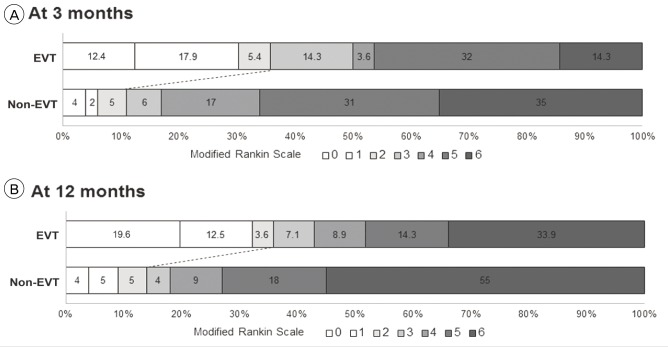
More patients in the EVT group achieved good outcomes (mRS score of 0-2) at 3 months (35.7% vs. 11.0%, adjusted odds ratio [OR] 4.779 [95% confidence interval 1.972-11.579], p = 0.001) and 12 months (35.7% vs. 14.0%, adjusted OR 3.705 [1.574-8.722], p = 0.003) after stroke. During admission, rates of hospital-acquired infection including pneumonia (12.5% vs. 29.0%, adjusted OR 0.262 [0.098-0.703], p = 0.008) and urinary tract infection (16.0% vs. 34.0%, adjusted OR 0.256 [0.099-0.657], p = 0.005) were significantly lower in the EVT group. More symptomatic hemorrhages (10.7% vs. 2.0%, adjusted OR 6.859 [1.139-41.317], p = 0.036) occurred in the EVT group, but no significant difference was observed in in-hospital mortality rate (12.5% vs. 8.0%, adjusted OR 1.380 [0.408-4.664], p = 0.604).
EVT improved functional outcome and reduced the risk of hospital-acquired infections in acute stroke patients over 80 years of age without increasing the risk of in-hospital mortality, although symptomatic hemorrhage occurred more frequently after EVT.
我们评估了血管内治疗(EVT)对80岁以上急性缺血性脑卒中患者的疗效。
分析了156例被视为EVT候选者的80岁以上急性脑卒中患者的记录。56例患者(35.9%,EVT组)接受了EVT,100例患者(64.1%,非EVT组)未接受。比较了两组在功能结局、症状性出血率、住院发病率和死亡率方面的结果。每次比较都对年龄、发病时间、初始美国国立卫生研究院卒中量表评分和卒中前改良Rankin量表(mRS)进行了调整。
EVT组更多患者在卒中后3个月(35.7%对11.0%,调整优势比[OR]4.779[95%置信区间1.972 - 11.579],p = 0.001)和12个月(35.7%对14.0%,调整OR 3.705[1.574 - 8.722],p = 0.003)时获得了良好结局(mRS评分为0 - 2)。住院期间,EVT组医院获得性感染率,包括肺炎(12.5%对29.0%,调整OR 0.262[0.098 - 0.703],p = 0.008)和尿路感染(16.0%对34.0%,调整OR 0.256[0.099 - 0.657],p = 0.005)显著更低。EVT组发生更多症状性出血(10.7%对2.0%,调整OR 6.859[1.139 - 41.317],p = 0.036),但住院死亡率无显著差异(12.5%对8.0%,调整OR 1.380[0.408 - 4.664],p = 0.604)。
EVT改善了80岁以上急性脑卒中患者的功能结局并降低了医院获得性感染风险,且未增加住院死亡率风险,尽管EVT后症状性出血更频繁发生。