Tu Yiheng, Zhang Zhiguo, Tan Ao, Peng Weiwei, Hung Yeung Sam, Moayedi Massieh, Iannetti Gian Domenico, Hu Li
Key Laboratory of Cognition and Personality (Ministry of Education) and Faculty of Psychology, Southwest University, Chongqing, China.
Department of Electrical and Electronic Engineering, the University of Hong Kong, Hong Kong.
Hum Brain Mapp. 2016 Feb;37(2):501-14. doi: 10.1002/hbm.23048. Epub 2015 Nov 2.
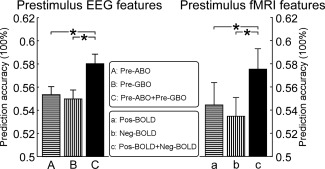
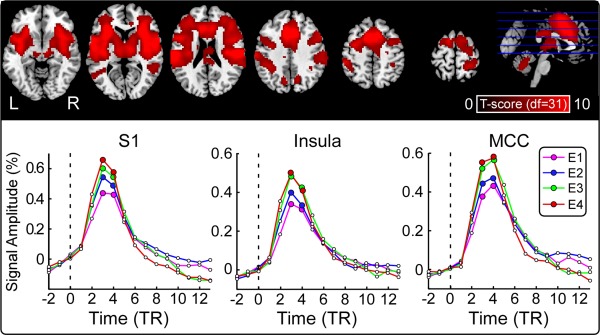
Ongoing fluctuations of intrinsic cortical networks determine the dynamic state of the brain, and influence the perception of forthcoming sensory inputs. The functional state of these networks is defined by the amplitude and phase of ongoing oscillations of neuronal populations at different frequencies. The contribution of functionally different cortical networks has yet to be elucidated, and only a clear dependence of sensory perception on prestimulus alpha oscillations has been clearly identified. Here, we combined electroencephalography (EEG) and functional magnetic resonance imaging (fMRI) in a large sample of healthy participants to investigate how ongoing fluctuations in the activity of different cortical networks affect the perception of subsequent nociceptive stimuli. We observed that prestimulus EEG oscillations in the alpha (at bilateral central regions) and gamma (at parietal regions) bands negatively modulated the perception of subsequent stimuli. Combining information about alpha and gamma oscillations predicted subsequent perception significantly more accurately than either measure alone. In a parallel experiment, we found that prestimulus fMRI activity also modulated the perception of subsequent stimuli: perceptual ratings were higher when the BOLD signal was higher in nodes of the sensorimotor network and lower in nodes of the default mode network. Similar to what observed in the EEG data, prediction accuracy was improved when the amplitude of prestimulus BOLD signals in both networks was combined. These findings provide a comprehensive physiological basis to the idea that dynamic changes in brain state determine forthcoming behavioral outcomes. Hum Brain Mapp 37:501-514, 2016. © 2015 Wiley Periodicals, Inc.
大脑内在网络的持续波动决定了大脑的动态状态,并影响对即将到来的感觉输入的感知。这些网络的功能状态由不同频率下神经元群体持续振荡的幅度和相位定义。功能不同的皮质网络的作用尚待阐明,目前仅明确确定了感觉知觉对刺激前α振荡的明显依赖性。在此,我们在大量健康参与者样本中结合了脑电图(EEG)和功能磁共振成像(fMRI),以研究不同皮质网络活动的持续波动如何影响对随后伤害性刺激的感知。我们观察到,刺激前α频段(双侧中央区域)和γ频段(顶叶区域)的脑电图振荡对随后刺激的感知产生负向调节作用。结合α和γ振荡的信息比单独使用任何一种测量方法能更准确地预测随后的感知。在一个平行实验中,我们发现刺激前的功能磁共振成像活动也调节了对随后刺激的感知:当感觉运动网络节点的血氧水平依赖(BOLD)信号较高而默认模式网络节点的信号较低时,感知评分更高。与脑电图数据中观察到的情况类似,当结合两个网络中刺激前BOLD信号的幅度时,预测准确性得到提高。这些发现为大脑状态的动态变化决定即将出现的行为结果这一观点提供了全面的生理基础。《人类大脑图谱》37:501 - 514,2016年。© 2015威利期刊公司。