Jiang Yinghua, Fan Xiang, Yu Zhanyang, Liao Zhengbu, Wang Xiao-Shu, van Leyen Klaus, Sun Xiaochuan, Lo Eng H, Wang Xiaoying
Department of Neurosurgery, The First Affiliated Hospital, Chongqing Medical University , Chongqing , China ; Neuroscience Program, Neuroprotection Research Laboratory, Department of Neurology and Radiology, Massachusetts General Hospital, Harvard Medical School , Boston, MA , USA.
Neuroscience Program, Neuroprotection Research Laboratory, Department of Neurology and Radiology, Massachusetts General Hospital, Harvard Medical School , Boston, MA , USA ; Research Institute of Traditional Chinese Medicine, Tianjin University of Traditional Chinese Medicine , Tianjin , China.
Front Cell Neurosci. 2015 Oct 14;9:397. doi: 10.3389/fncel.2015.00397. eCollection 2015.
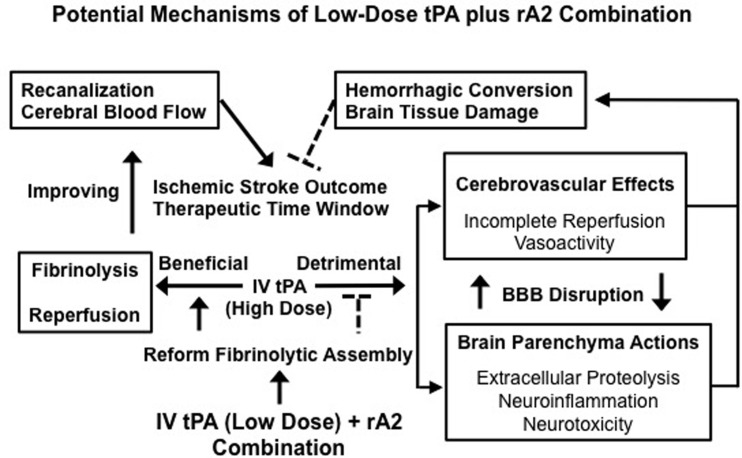
Risk of hemorrhagic transformation, incomplete reperfusion, neurotoxicity, and a short treatment time window comprises major challenges for tissue plasminogen activator (tPA) thrombolytic stroke therapy. Improving tPA therapy has become one of the highest priorities in the stroke field. This mini review article focuses on our recent efforts aimed at evaluating a novel combination approach of low-dose tPA plus recombinant annexin A2 (rA2, a tPA, and plasminogen co-receptor), which might enhance tPA thrombolytic efficacy, while reducing its associated complications related to intracerebral hemorrhagic transformation. Results of our experimental studies using a focal embolic stroke model in rats support the feasibility of the combination approach and suggest the potential for successful clinical translation.
出血转化、再灌注不完全、神经毒性以及较短的治疗时间窗风险是组织型纤溶酶原激活剂(tPA)溶栓治疗脑卒中面临的主要挑战。改进tPA治疗已成为脑卒中领域的首要任务之一。这篇小型综述文章聚焦于我们近期的研究工作,旨在评估低剂量tPA联合重组膜联蛋白A2(rA2,一种tPA和纤溶酶原共同受体)的新型联合方法,该方法可能增强tPA溶栓疗效,同时减少其与脑内出血转化相关的并发症。我们在大鼠局灶性栓塞性脑卒中模型上进行的实验研究结果支持了这种联合方法的可行性,并提示了其成功临床转化的潜力。