Simmank Jakob, Murawski Carsten, Bode Stefan, Horstmann Annette
Junior Research Group 'Decision-making in obesity', IFB Adiposity Diseases, Leipzig University Medical Center Leipzig, Germany ; Department of Neurology, Max Planck Institute for Human Cognitive and Brain Sciences Leipzig, Germany.
Department of Finance, The University of Melbourne Melbourne, Victoria, Australia.
Front Behav Neurosci. 2015 Oct 15;9:278. doi: 10.3389/fnbeh.2015.00278. eCollection 2015.
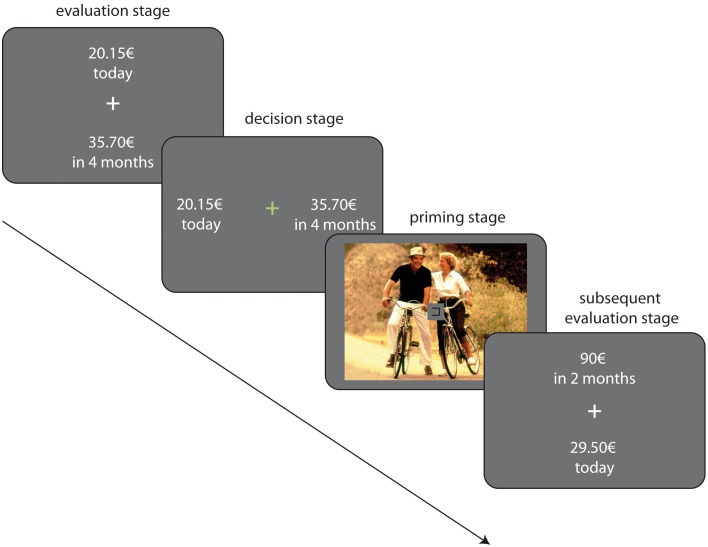
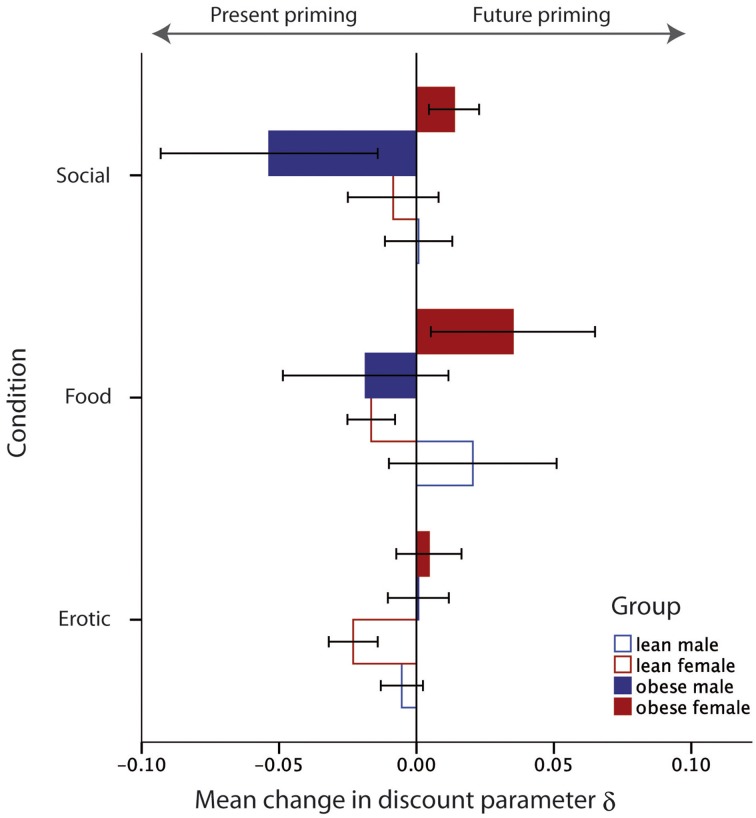
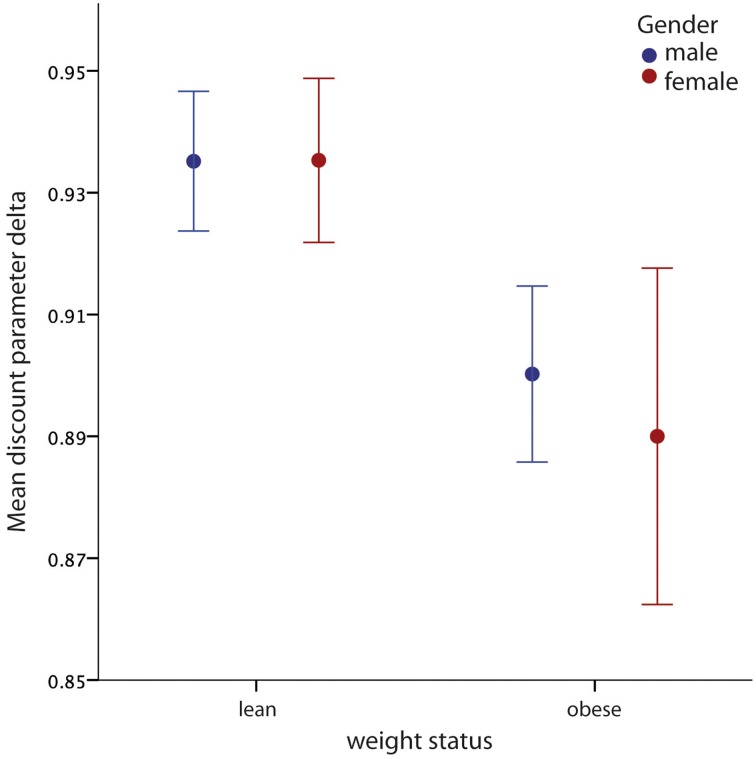
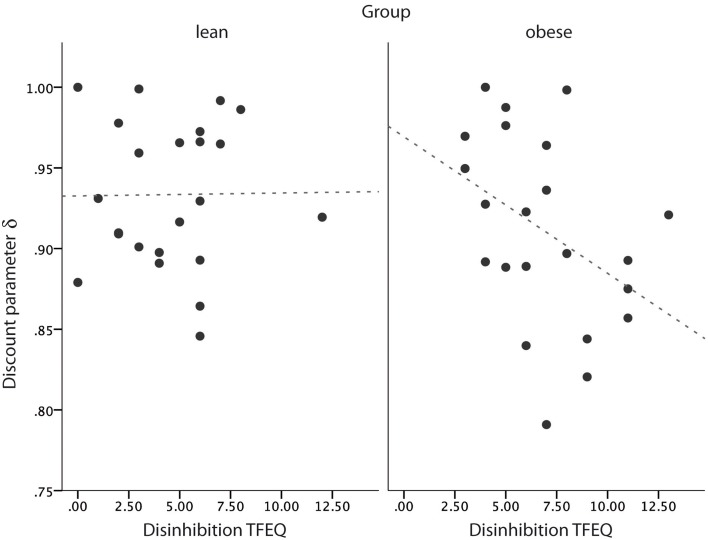
Recent research suggests that obesity is linked to prominent alterations in learning and decision-making. This general difference may also underlie the preference for immediately consumable, highly palatable but unhealthy and high-calorie foods. Such poor food-related inter-temporal decision-making can explain weight gain; however, it is not yet clear whether this deficit can be generalized to other domains of inter-temporal decision-making, for example financial decisions. Further, little is known about the stability of decision-making behavior in obesity, especially in the presence of rewarding cues. To answer these questions, obese and lean participants (n = 52) completed two sessions of a novel priming paradigm including a computerized monetary delay discounting task. In the first session, general differences between groups in financial delay discounting were measured. In the second session, we tested the general stability of discount rates. Additionally, participants were primed by affective visual cues of different contextual categories before making financial decisions. We found that the obese group showed stronger discounting of future monetary rewards than the lean group, but groups did not differ in their general stability between sessions nor in their sensitivity toward changes in reward magnitude. In the obese group, a fast decrease of subjective value over time was directly related to a higher tendency for opportunistic eating. Obese in contrast to lean people were primed by the affective cues, showing a sex-specific pattern of priming direction. Our findings demonstrate that environments rich of cues, aiming at inducing unhealthy consumer decisions, can be highly detrimental for obese people. It also underscores that obesity is not merely a medical condition but has a strong cognitive component, meaning that current dietary and medical treatment strategies may fall too short.
最近的研究表明,肥胖与学习和决策方面的显著改变有关。这种普遍差异也可能是人们偏好即时可食用、美味但不健康且高热量食物的原因。这种与食物相关的跨期决策能力差可以解释体重增加的现象;然而,目前尚不清楚这种缺陷是否可以推广到其他跨期决策领域,例如金融决策。此外,对于肥胖人群决策行为的稳定性,尤其是在存在奖励线索的情况下,我们了解得还很少。为了回答这些问题,肥胖和瘦体重参与者(n = 52)完成了两个阶段的新型启动范式,包括一个计算机化的货币延迟折扣任务。在第一阶段,测量了两组在金融延迟折扣方面的总体差异。在第二阶段,我们测试了折扣率的总体稳定性。此外,在做出金融决策之前,参与者受到不同情境类别的情感视觉线索的启动。我们发现,肥胖组对未来货币奖励的折扣比瘦体重组更强,但两组在不同阶段之间的总体稳定性以及对奖励幅度变化的敏感性方面没有差异。在肥胖组中,主观价值随时间的快速下降与机会性进食的较高倾向直接相关。与瘦体重者相比,肥胖者受到情感线索的启动,呈现出特定性别的启动方向模式。我们的研究结果表明,富含线索的环境旨在诱导不健康的消费决策,这对肥胖人群可能非常有害。这也强调了肥胖不仅仅是一种医学状况,还具有很强的认知成分,这意味着目前的饮食和医学治疗策略可能远远不够。