Zeineddine Rafaa, Yerbury Justin J
Illawarra Health and Medical Research Institute, University of Wollongong Wollongong, NSW, Australia ; Faculty of Science, Medicine and Health, School of Biological Sciences, University of Wollongong Wollongong, NSW, Australia.
Front Physiol. 2015 Oct 16;6:277. doi: 10.3389/fphys.2015.00277. eCollection 2015.
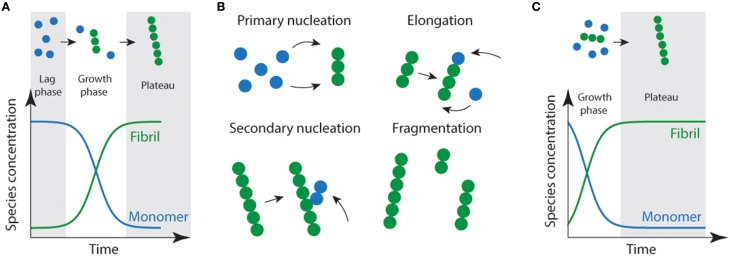
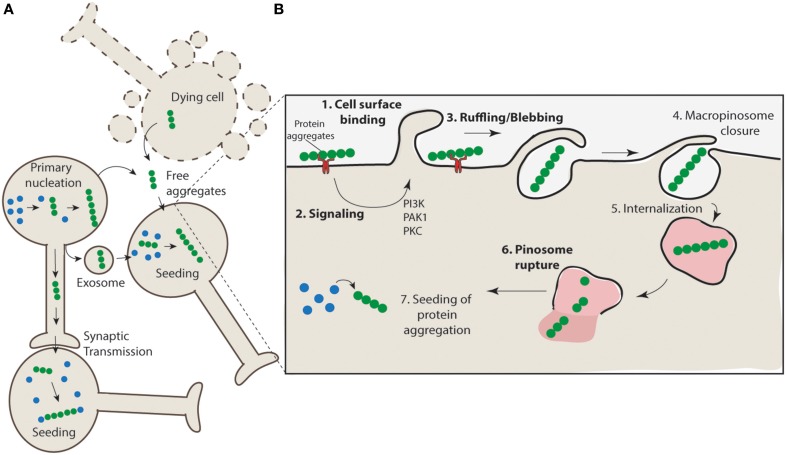
With the onset of the rapidly aging population, the impact of age related neurodegenerative diseases is becoming a predominant health and economic concern. Neurodegenerative diseases such as Alzheimer's disease, Creutzfeldt-Jakob disease (CJD), Parkinson's disease, Huntington's disease, frontotemporal dementia (FTD), and amyotrophic lateral sclerosis (ALS) result from the loss of a specific subsets of neurons, which is closely associated with accumulation and deposition of specific protein aggregates. Protein aggregation, or fibril formation, is a well-studied phenomenon that occurs in a nucleation-dependent growth reaction. Recently, there has been a swell of literature implicating protein aggregation and its ability to propagate cell-to-cell in the rapid progression of these diseases. In order for protein aggregation to be kindled in recipient cells it is a requisite that aggregates must be able to be released from one cell and then taken up by others. In this article we will explore the relationship between protein aggregates, their propagation and the role of macropinocytosis in their uptake. We highlight the ability of neurons to undergo stimulated macropinocytosis and identify potential therapeutic targets.
随着人口迅速老龄化,与年龄相关的神经退行性疾病的影响正成为主要的健康和经济问题。神经退行性疾病,如阿尔茨海默病、克雅氏病(CJD)、帕金森病、亨廷顿病、额颞叶痴呆(FTD)和肌萎缩侧索硬化症(ALS),是由特定神经元亚群的丧失引起的,这与特定蛋白质聚集体的积累和沉积密切相关。蛋白质聚集或原纤维形成是一种在成核依赖性生长反应中发生的、已得到充分研究的现象。最近,大量文献表明蛋白质聚集及其在这些疾病快速进展中在细胞间传播的能力。为了使蛋白质聚集在受体细胞中被引发,聚集体必须能够从一个细胞释放出来,然后被其他细胞摄取。在本文中,我们将探讨蛋白质聚集体、它们的传播以及巨吞饮作用在其摄取中的作用之间的关系。我们强调神经元进行刺激诱导的巨吞饮作用的能力,并确定潜在的治疗靶点。