Desanghere Loni, Marotta Jonathan J
Perception and Action Laboratory, Department of Psychology, University of Manitoba, Winnipeg MB, Canada ; Postgraduate Medical Education, College of Medicine, University of Saskatchewan, Saskatoon SK, Canada.
Perception and Action Laboratory, Department of Psychology, University of Manitoba, Winnipeg MB, Canada.
Front Psychol. 2015 Oct 16;6:1537. doi: 10.3389/fpsyg.2015.01537. eCollection 2015.
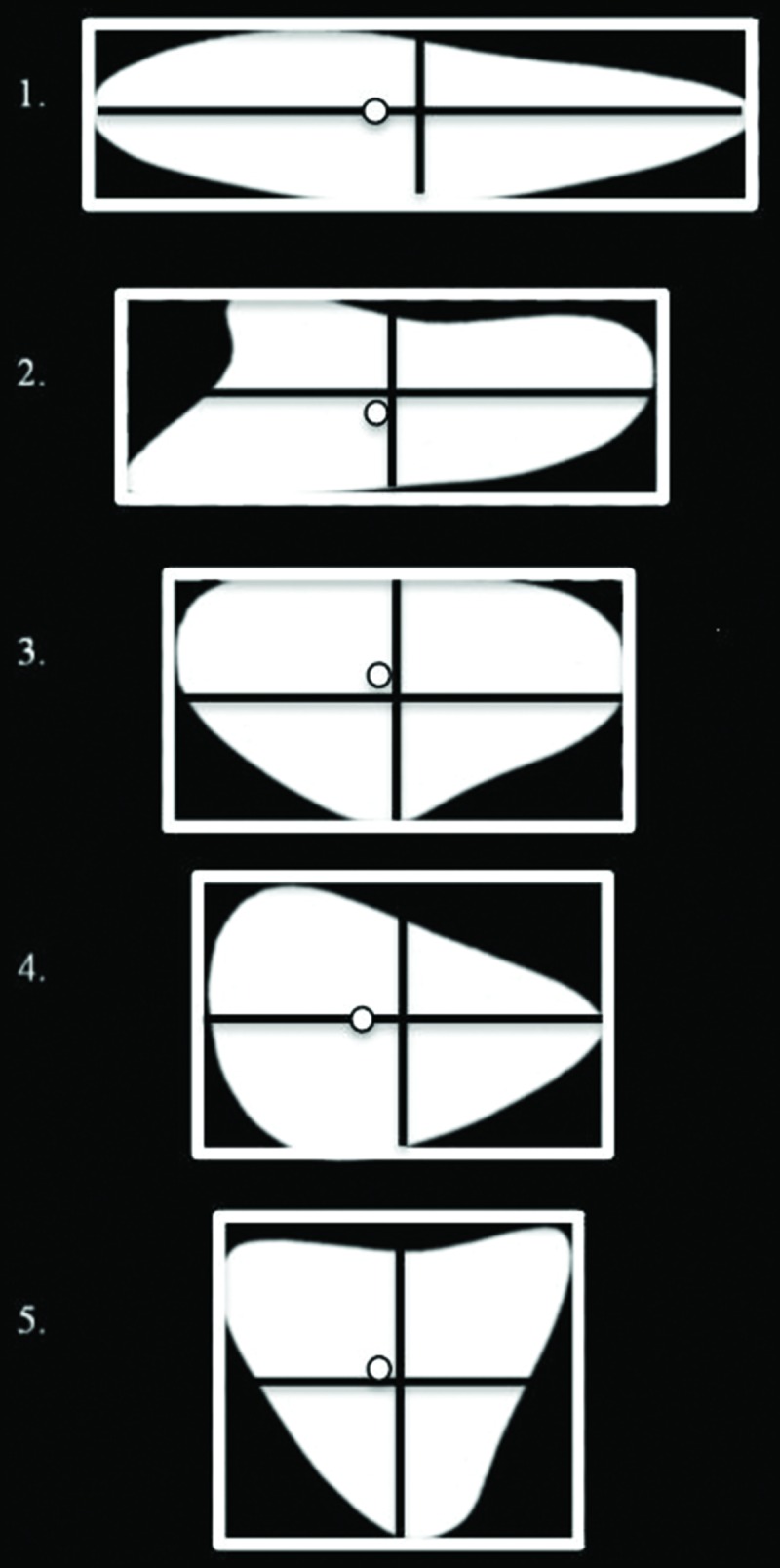
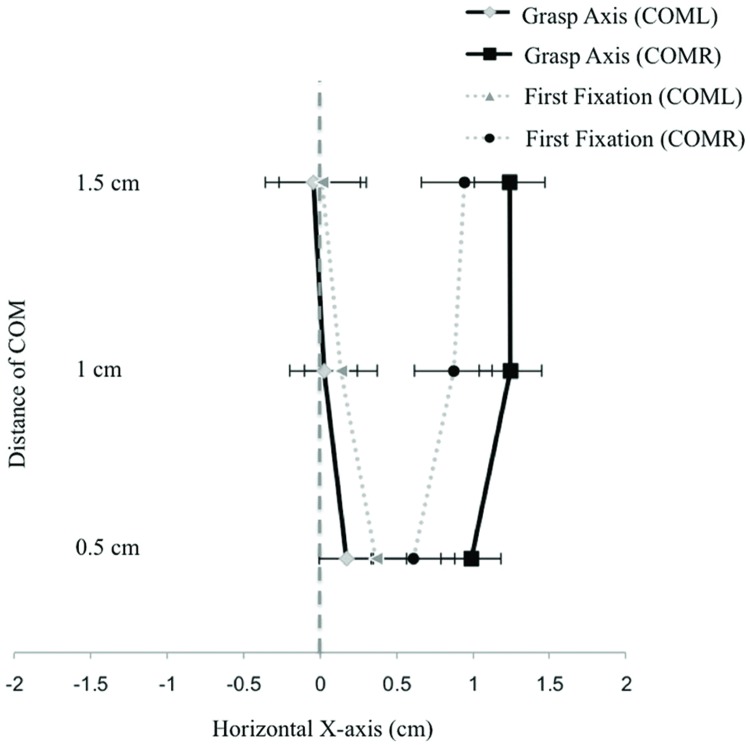
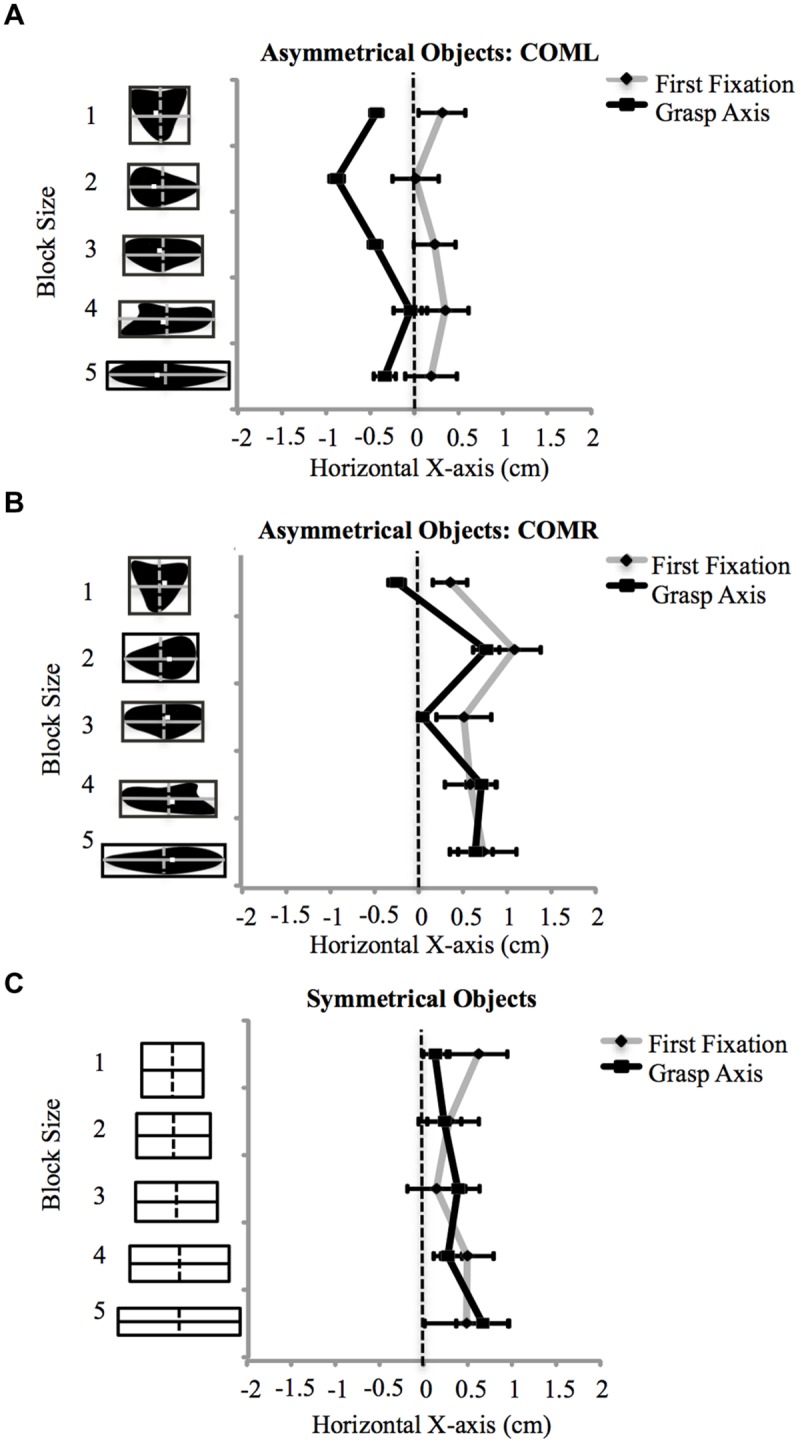
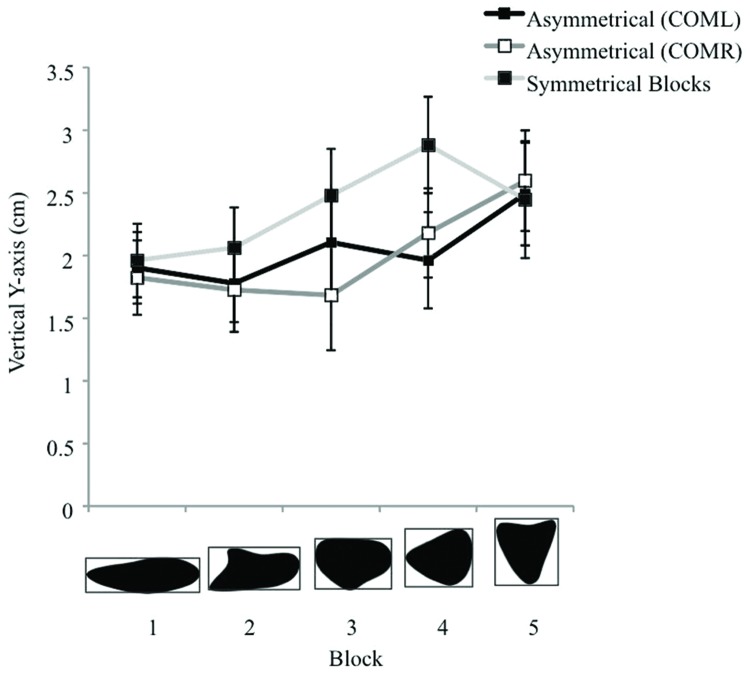
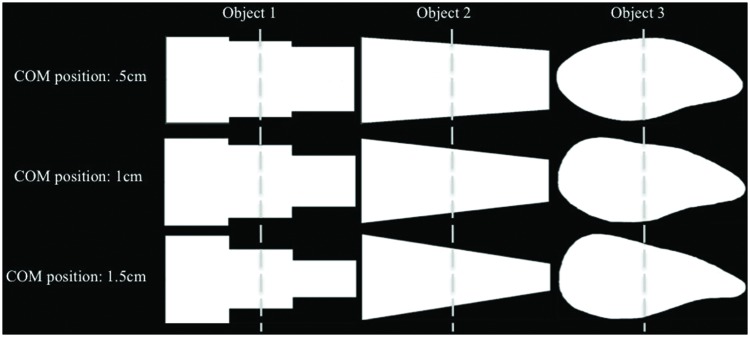
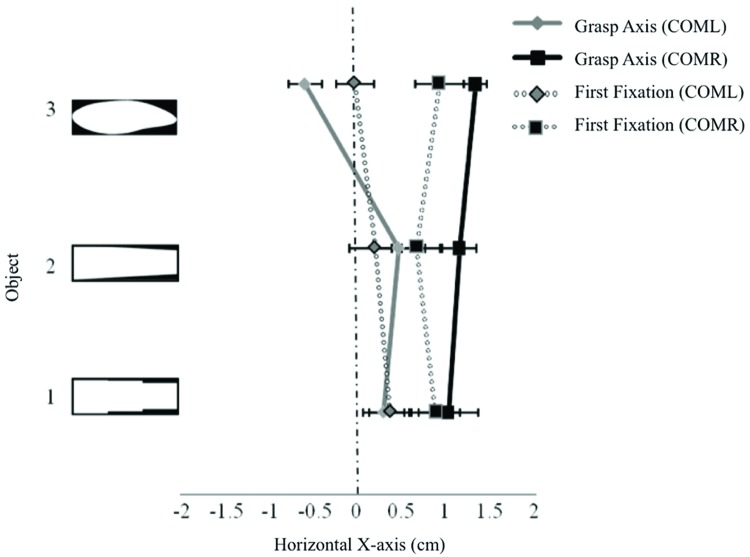
Recent experiments examining where participants look when grasping an object found that fixations favor the eventual index finger landing position on the object. Even though the act of picking up an object must involve complex high-level computations such as the visual analysis of object contours, surface properties, knowledge of an object's function and center of mass (COM) location, these investigations have generally used simple symmetrical objects - where COM and horizontal midline overlap. Less research has been aimed at looking at how variations in object properties, such as differences in curvature and changes in COM location, affect visual and motor control. The purpose of this study was to examine grasp and fixation locations when grasping objects whose COM was positioned to the left or right of the objects horizontal midline (Experiment 1) and objects whose COM was moved progressively further from the midline of the objects based on the alteration of the object's shape (Experiment 2). Results from Experiment 1 showed that object COM position influenced fixation locations and grasp locations differently, with fixations not as tightly linked to index finger grasp locations as was previously reported with symmetrical objects. Fixation positions were also found to be more central on the non-symmetrical objects. This difference in gaze position may provide a more holistic view, which would allow both index finger and thumb positions to be monitored while grasping. Finally, manipulations of COM distance (Experiment 2) exerted marked effects on the visual analysis of the objects when compared to its influence on grasp locations, with fixation locations more sensitive to these manipulations. Together, these findings demonstrate how object features differentially influence gaze vs. grasp positions during object interaction.
最近关于参与者在抓取物体时注视位置的实验发现,注视点更倾向于食指最终在物体上的落点位置。尽管拿起物体的动作必然涉及复杂的高级计算,如物体轮廓的视觉分析、表面属性、物体功能知识以及质心(COM)位置,但这些研究通常使用简单的对称物体——质心与水平中线重叠。较少有研究关注物体属性的变化,如曲率差异和质心位置变化,如何影响视觉和运动控制。本研究的目的是考察在抓取质心位于物体水平中线左侧或右侧的物体时(实验1)以及基于物体形状改变质心逐渐远离物体中线的物体时(实验2)的抓握和注视位置。实验1的结果表明,物体质心位置对注视位置和抓握位置的影响不同,与之前关于对称物体的报道相比,注视与食指抓握位置的联系没那么紧密。还发现注视位置在非对称物体上更居中。这种注视位置的差异可能提供更全面的视角,从而在抓握时能够同时监测食指和拇指的位置。最后,与质心距离对抓握位置的影响相比,质心距离的操纵(实验2)对物体的视觉分析产生了显著影响,注视位置对这些操纵更敏感。总之,这些发现证明了在物体交互过程中物体特征如何不同地影响注视与抓握位置。