Yu Yang, Dong Li, Li Dapeng, Chuai Shaokun, Wu Zhigang, Zheng Xiangqian, Cheng Yanan, Han Lei, Yu Jinpu, Gao Ming
Department of Thyroid and Neck Tumor, Tianjin Medical University Cancer Institute and Hospital, National Clinical Research Center for Cancer, Huanhuxi Road, Ti-Yuan-Bei, Hexi District, Tianjin 300060, China.
Key Laboratory of Cancer Prevention and Therapy, Tianjin, Huanhuxi Road, Ti-Yuan-Bei, Hexi District, Tianjin 300060, China.
Sci Rep. 2015 Nov 4;5:16129. doi: 10.1038/srep16129.
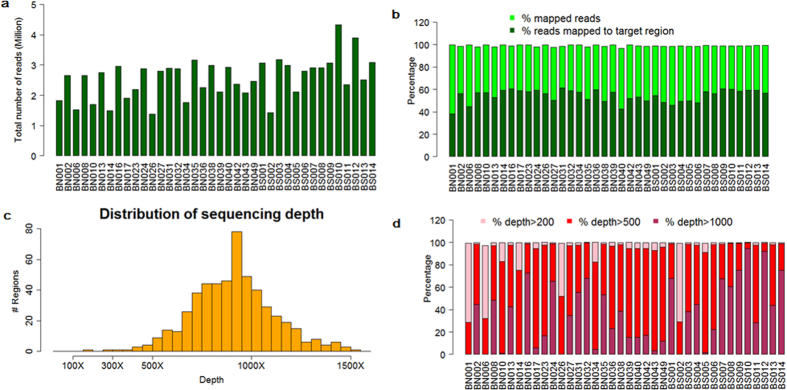
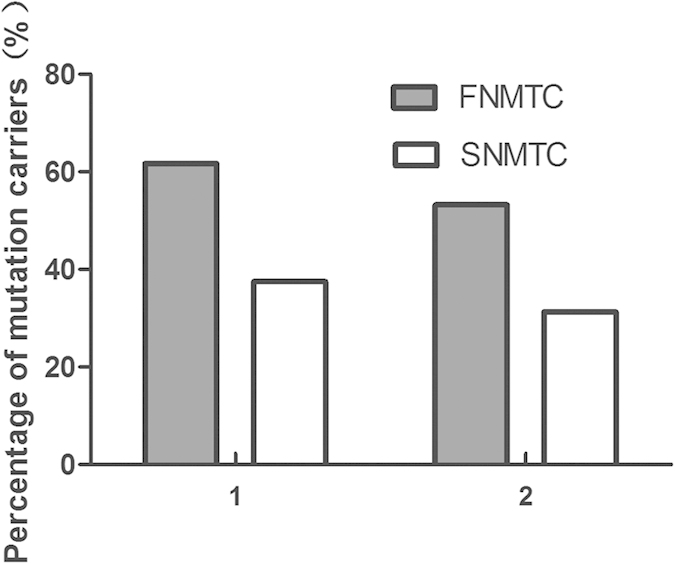
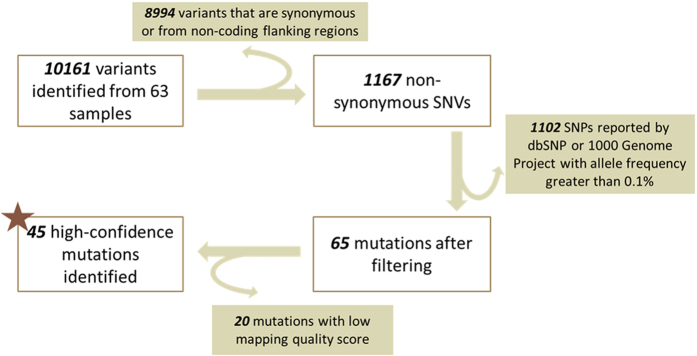
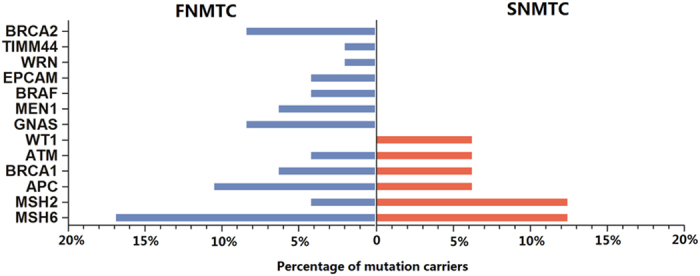
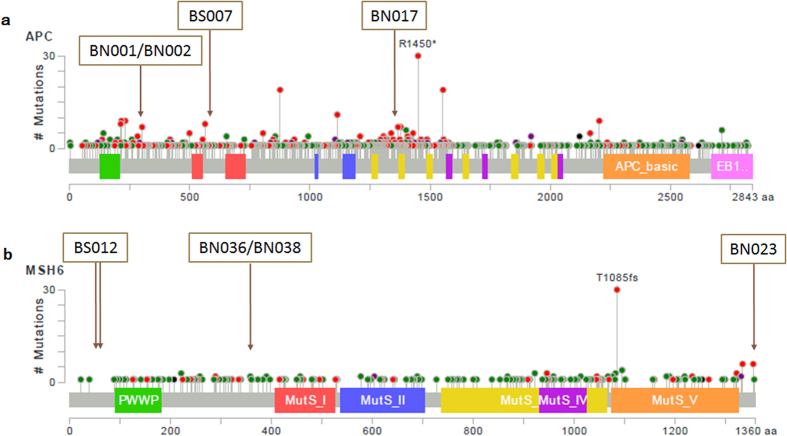
Some studies have demonstrated that familial non-medullary thyroid cancer (FNMTC) has a more aggressive clinical behavior compared to sporadic NMTC (SNMTC). However, FNMTC is difficult to differentiate from SNMTC by the morphology and immunohistochemistry. Although genes responsible for FNMTC were unclear, screening for rare germline mutations on known important tumor suppressor genes might offer more insights on predicting susceptibility to FNMTC. Here, a customized panel was designed to capture all exons of 31 cancer susceptive genes possibly related to FNMTC. Using next-generation sequencing we performed deep sequencing to achieve 500× coverage of the targeted regions. At the end 45 variants were identified in 29 of 47 familial patients and 6 of 16 sporadic patients. Notably, several germline mutations were found matching between paired FNMTC patients from the same family, including APC L292F and A2778S, BRAF D22N, MSH6 G355S and A36V, MSH2 L719F, MEN1 G508D, BRCA1 SS955S, BRCA2 G2508S, and a GNAS inframe insertion. We demonstrated a novel approach to help diagnose and elucidate the genetic cause of the FNMTC patients, and assess whether their family members are exposed to a higher genetic risk. The findings would also provide insights on monitoring the potential second cancers for thyroid cancer patients.
一些研究表明,与散发性非髓样甲状腺癌(SNMTC)相比,家族性非髓样甲状腺癌(FNMTC)具有更具侵袭性的临床行为。然而,通过形态学和免疫组织化学很难将FNMTC与SNMTC区分开来。尽管导致FNMTC的基因尚不清楚,但对已知重要肿瘤抑制基因进行罕见种系突变筛查可能会为预测FNMTC易感性提供更多见解。在此,设计了一个定制的检测板来捕获31个可能与FNMTC相关的癌症易感基因的所有外显子。使用下一代测序技术,我们进行了深度测序,以实现目标区域500倍的覆盖。最后,在47名家族性患者中的29名和16名散发性患者中的6名中鉴定出45个变异。值得注意的是,在来自同一家族的配对FNMTC患者之间发现了几种匹配的种系突变,包括APC L292F和A2778S、BRAF D22N、MSH6 G355S和A36V、MSH2 L719F、MEN1 G508D、BRCA1 SS955S、BRCA2 G2508S以及一个GNAS框内插入突变。我们展示了一种新的方法来帮助诊断和阐明FNMTC患者的遗传病因,并评估其家庭成员是否面临更高的遗传风险。这些发现也将为监测甲状腺癌患者潜在的二次癌症提供见解。