Department of Public Health, Section of Sport Science, Aarhus University, Aarhus, Denmark. ; Orthopaedic Surgery Research Unit, Science and Innovation Center, Aalborg University Hospital, Aalborg, Denmark.
Center for Sports Medicine, University Medical Center Groningen, University of Groningen, Groningen, the Netherlands.
Orthop J Sports Med. 2013 May 2;1(1):2325967113487316. doi: 10.1177/2325967113487316. eCollection 2013 Jan-Jun.
To identify persons at high risk of sustaining running-related injuries, an evidence-based understanding of the risk factors associated with injury is needed.
To identify demographic and behavioral risk factors associated with running-related injuries.
Observational prospective cohort study with a 1-year follow-up.
Exposures including sex, age, body mass index (BMI), behavior (Type A Self-Rating Inventory [TASRI]), running experience, other sports activity, previous running-related injuries, and other injuries not related to running were assessed prior to or at baseline. The outcome of interest was a running-related injury, defined as any musculoskeletal complaint of the lower extremity or back caused by running that restricted the amount of running (volume, duration, pace, or frequency) for at least 1 week. All participants quantified their running volume by global positioning system (GPS) and used a neutral running shoe. Time to first injury for each exposure variable was analyzed using a generalized linear model, with cumulative kilometers of the training sessions as the time scale.
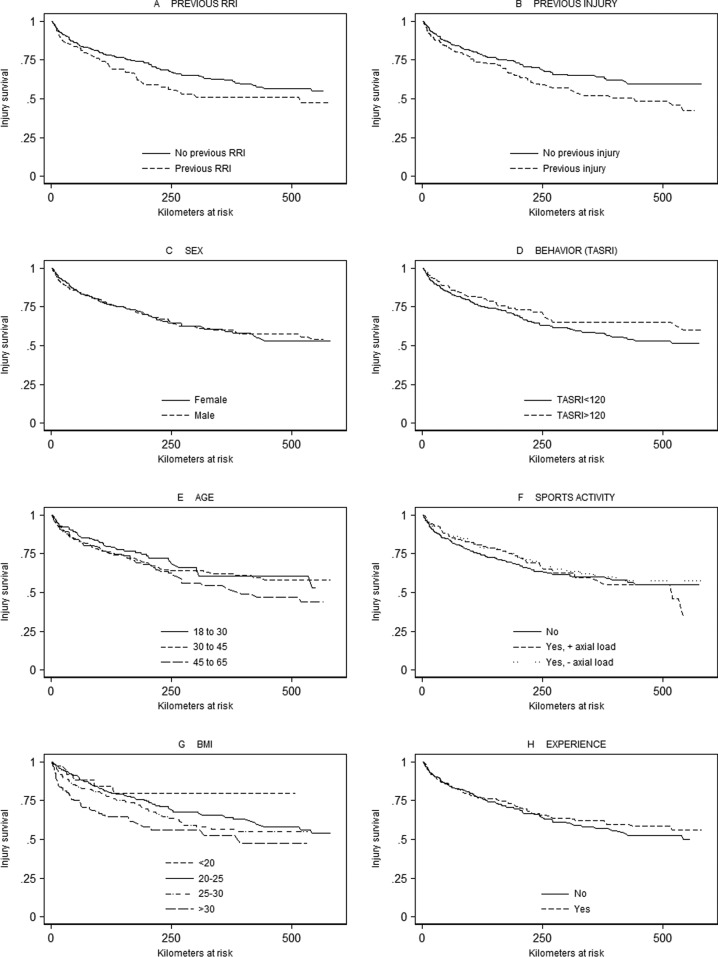
A total of 930 individuals were included in the study, of which 254 sustained a running-related injury during a total of 155.318 km of running. By calculating the cumulative injury risk differences (cIRDs) [95% confidence intervals] after 500 km of running, the TASRI Type B behavior (cIRD, 11.9% [-0.5%; 23.3%]; P = .04) was found to be a significant predictor of injury, while age between 45 and 65 years (cIRD, 14.7% [-2.1%; 31.5%]; P = .08) and previous injuries not related to running (cIRD, 11.1% [-0.2%; 22.4%]; P = .05) were considered clinically interesting, although not statistically significant. In addition, χ(2) test results across 4 BMI groups also revealed a borderline significant relationship (P = .06). No significant or clinically relevant relationships were found for sex (P = .42), previous running-related injury (P = .47), running experience (P = .30), and other sports activities (P = .30).
The findings of the present study suggest BMI >30 kg/m(2), age between 45 and 65 years, noncompetitive behavior, and previous injuries not related to running are associated with increased risk of injury among novice runners, while BMI <20 kg/m(2) was protective. Still, the role of the risk factors in the causal mechanism leading to injury needs to be investigated.
为了识别易发生跑步相关损伤的人群,需要基于循证医学来了解与损伤相关的风险因素。
明确与跑步相关损伤相关的人口统计学和行为学风险因素。
前瞻性队列研究,随访时间为 1 年。
在基线或之前评估了暴露因素,包括性别、年龄、体重指数(BMI)、行为(A型自我评定量表[TASRI])、跑步经验、其他运动项目、既往跑步相关损伤和与跑步无关的其他损伤。研究的结局指标为跑步相关损伤,定义为任何由跑步引起的下肢或背部肌肉骨骼不适,导致跑步量(距离、持续时间、速度或频率)减少至少 1 周。所有参与者都使用全球定位系统(GPS)来量化他们的跑步量,并使用中性跑鞋。使用广义线性模型分析每个暴露变量的首次损伤时间,以训练次数的累积公里数作为时间尺度。
本研究共纳入 930 名参与者,其中 254 名在总计 155.318 公里的跑步中发生了跑步相关损伤。计算 500 公里后累积损伤风险差异(cIRD)[95%置信区间],发现 TASRI 型 B 行为(cIRD,11.9%[-0.5%;23.3%];P=.04)是损伤的显著预测因素,而 45 岁至 65 岁之间的年龄(cIRD,14.7%[-2.1%;31.5%];P=.08)和与跑步无关的既往损伤(cIRD,11.1%[-0.2%;22.4%];P=.05)被认为具有临床意义,但无统计学意义。此外,4 个 BMI 组的χ²检验结果也显示出临界显著的关系(P=.06)。性别(P=.42)、既往跑步相关损伤(P=.47)、跑步经验(P=.30)和其他运动项目(P=.30)与损伤无显著或临床相关关系。
本研究结果表明,BMI>30 kg/m²、45 岁至 65 岁之间的年龄、非竞技行为和与跑步无关的既往损伤与新手跑步者的损伤风险增加相关,而 BMI<20 kg/m²则具有保护作用。然而,需要进一步研究这些风险因素在导致损伤的因果机制中的作用。