Iizuka Yoichi, Iizuka Haku, Mieda Tokue, Tajika Tsuyoshi, Yamamoto Atsushi, Ohsawa Takashi, Sasaki Tsuyoshi, Takagishi Kenji
Department of Orthopaedic Surgery, Gunma University Graduate School of Medicine, 3-39-22, Showa, Maebashi, Gunma, 371-8511, Japan.
BMC Musculoskelet Disord. 2015 Nov 4;16:333. doi: 10.1186/s12891-015-0759-z.
Neck and shoulder pain, back pain and low back pain are common symptoms in Japanese subjects, and it is important to elucidate the pathology and associated factors of these pains due to their frequency and impact on the quality of life (QOL) and activities of daily living (ADL). The purpose of the present study was to investigate whether body composition is associated with these pains.
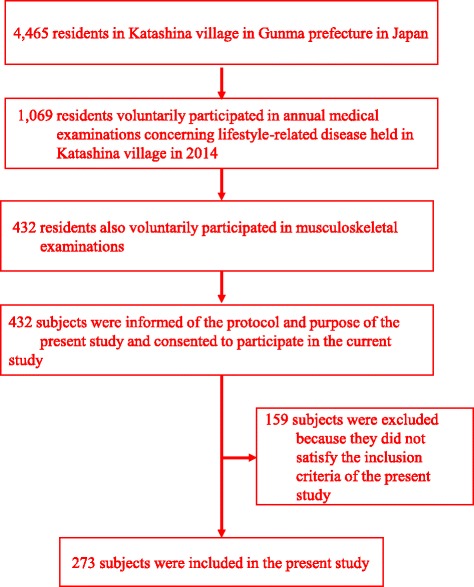
We collected the data of 273 Japanese subjects regarding the presence and the visual analogue scale (VAS) of neck and shoulder pain, back pain, low back pain and body composition parameters calculated using bioelectrical impedance analysis (BIA) technology. Furthermore, we investigated the association between these pains and the body composition using statistical methods.
According to a multivariate analysis adjusted for age and gender, lower total body water ratio was significantly associated with the presence of neck and shoulder pain at present (P < 0.05); additionally, total body muscle mass (standardized β = -0.26, 95 % CI, -0.17 - -0.008, P < 0.05), total body water (standardized β = -0.27, 95 % CI, -0.23 - -0.04, P < 0.01), appendicular muscle mass (standardized β = -0.29, 95 % CI, -0.36 - -0.04, P < 0.05), and the appendicular muscle mass index (AMI) (standardized β = -0.24, 95 % CI, -1.18 - -0.20, P <0.01) were negatively correlated with the VAS of neck and shoulder pain, whereas no body composition parameters were significantly associated with back pain, low back pain at present and any type of chronic pain.
The present study demonstrated that some body composition parameters regarding body water and body muscle were associated or correlated with the presence or intensity of neck and shoulder pain.
颈部和肩部疼痛、背痛和腰痛是日本人群中的常见症状,鉴于这些疼痛的发生频率及其对生活质量(QOL)和日常生活活动(ADL)的影响,阐明其病理及相关因素非常重要。本研究的目的是调查身体成分是否与这些疼痛相关。
我们收集了273名日本受试者关于颈部和肩部疼痛、背痛、腰痛的存在情况及视觉模拟量表(VAS)的数据,以及使用生物电阻抗分析(BIA)技术计算得出的身体成分参数。此外,我们使用统计方法研究了这些疼痛与身体成分之间的关联。
根据对年龄和性别进行校正的多变量分析,较低的全身水比率与目前存在颈部和肩部疼痛显著相关(P<0.05);此外,全身肌肉量(标准化β=-0.26,95%CI,-0.17--0.008,P<0.05)、全身水分(标准化β=-0.27,95%CI,-0.23--0.04,P<0.01)、上肢肌肉量(标准化β=-0.29,95%CI,-0.36--0.04,P<0.05)以及上肢肌肉量指数(AMI)(标准化β=-0.24,95%CI,-1.18--0.20,P<0.01)与颈部和肩部疼痛的VAS呈负相关,而目前没有身体成分参数与背痛、腰痛及任何类型的慢性疼痛显著相关。
本研究表明,一些关于身体水分和肌肉的身体成分参数与颈部和肩部疼痛的存在或强度相关或具有相关性。