Garcia Ignacio, Chiodo Vincent, Ma Yan, Boskey Adele
a Mineralized Tissue Laboratory , Hospital for Special Surgery , New York , NY , USA.
b Department of Epidemiology and Biostatistics , Milken Institute School of Public Health, The George Washington University , Washington , DC , USA.
Connect Tissue Res. 2016;57(1):28-37. doi: 10.3109/03008207.2015.1088531. Epub 2015 Nov 5.
Idiopathic juvenile osteoporosis (IJO) is a rare condition in children, characterized by bone pain and long bone and vertebral fractures. Previously, IJO bone was solely characterized by histomorphometry and quantitative computed tomography. The goal of this study is to describe IJO bone composition.
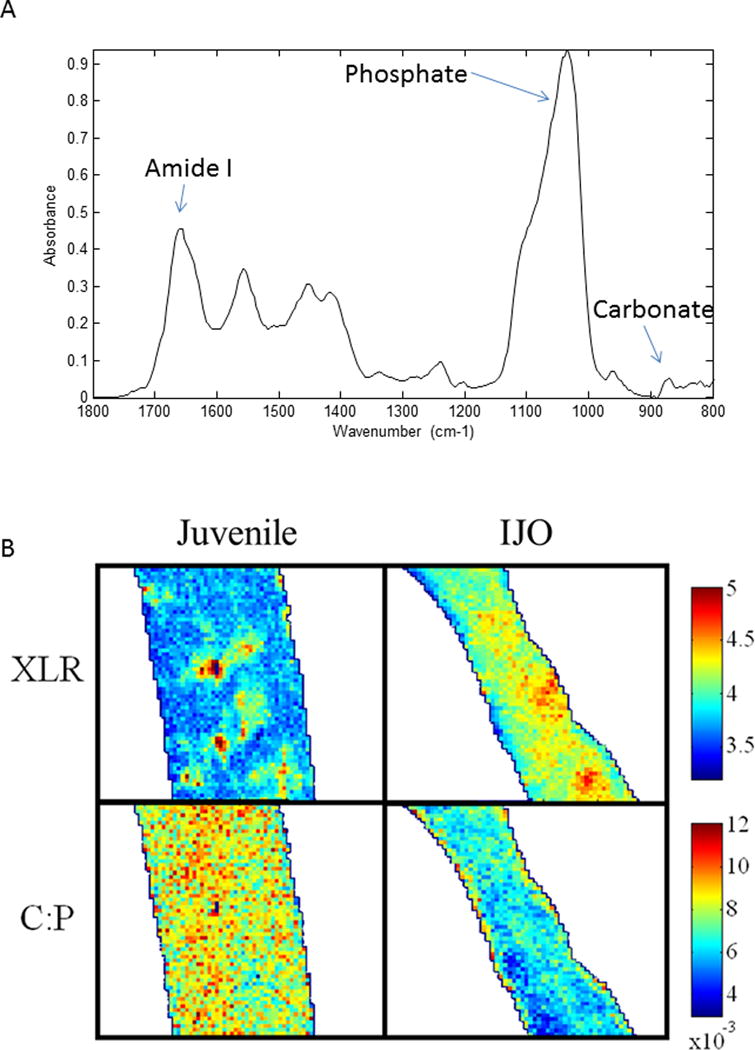
Fourier transform infrared imaging (FTIRI), a vibrational spectroscopic technique providing spatially resolved images of chemical composition, was used to determine whether iliac crest biopsies from children with IJO differed in composition from and age- and sex-matched controls, and, as a secondary analysis, whether IJO bone showed the same disease dependent change in composition as do iliac crest bone biopsies from women with post-menopausal osteoporosis (PMO). Wilcoxon rank tests and linear regressions were used to analyze FTIRI variables (mineral-to-matrix ratio, carbonate-to-phosphate ratio, crystallinity, acid phosphate substitution, collagen maturity) and their individual pixel distributions (heterogeneity).
Mineral-to-matrix ratio was comparable in IJO and age-matched controls. Contrastingly, collagen maturity (also known as collagen cross-link ratio) was higher in cortical and cancellous IJO bone compared with juvenile controls. Acid phosphate substitution was greater in IJO cancellous bone than in age-matched controls, suggesting IJO bone mineral is formed more recently, reflecting a slower mineralization process. This agrees with findings of increased heterogeneity for mineral-to-matrix and collagen maturity ratios in IJO cancellous bone. There were negative correlations between cancellous collagen maturity and previously reported histomorphometric bone formation markers. There were no correlations with indices of remodeling.
IJO bone, similar to PMO bone, had elevated collagen maturity relative to its age-matched controls. This emphasizes the importance of the collagen matrix for bone health. IJO bone differed from PMO bone as IJO bone contains more recently formed mineral than age-matched controls but has a more mature matrix, whereas in PMO bone both mineral and matrix have older characteristics.
特发性青少年骨质疏松症(IJO)在儿童中较为罕见,其特征为骨痛以及长骨和椎骨骨折。此前,IJO骨仅通过组织形态计量学和定量计算机断层扫描进行表征。本研究的目的是描述IJO骨的组成。
傅里叶变换红外成像(FTIRI)是一种振动光谱技术,可提供化学成分的空间分辨图像,用于确定IJO患儿的髂嵴活检组织在组成上是否与年龄和性别匹配的对照组存在差异,作为次要分析,还用于确定IJO骨是否显示出与绝经后骨质疏松症(PMO)女性的髂嵴骨活检组织相同的疾病相关组成变化。使用Wilcoxon秩和检验和线性回归分析FTIRI变量(矿物质与基质比率、碳酸盐与磷酸盐比率、结晶度、酸性磷酸盐取代、胶原成熟度)及其单个像素分布(异质性)。
IJO组与年龄匹配的对照组的矿物质与基质比率相当。相比之下,与青少年对照组相比,IJO皮质骨和松质骨中的胶原成熟度(也称为胶原交联比率)更高。IJO松质骨中的酸性磷酸盐取代比年龄匹配的对照组更大,这表明IJO骨矿物质形成时间更近,反映出矿化过程较慢。这与IJO松质骨中矿物质与基质及胶原成熟度比率异质性增加的研究结果一致。松质骨胶原成熟度与先前报道的组织形态计量学骨形成标志物之间存在负相关。与重塑指标无相关性。
与PMO骨相似,IJO骨相对于其年龄匹配的对照组胶原成熟度升高。这强调了胶原基质对骨骼健康的重要性。IJO骨与PMO骨不同,因为IJO骨所含的矿物质形成时间比年龄匹配的对照组更近,但基质更成熟,而PMO骨的矿物质和基质都具有更老的特征。