de Vries K J, Bagnaschi E A, Buchmueller O, Cavanaugh R, Citron M, De Roeck A, Dolan M J, Ellis J R, Flächer H, Heinemeyer S, Isidori G, Malik S, Marrouche J, Santos D Martínez, Olive K A, Sakurai K, Weiglein G
High Energy Physics Group, Blackett Laboratory, Imperial College, Prince Consort Road, London, SW7 2AZ UK.
DESY, Notkestraße 85, 22607 Hamburg, Germany.
Eur Phys J C Part Fields. 2015;75(9):422. doi: 10.1140/epjc/s10052-015-3599-y. Epub 2015 Sep 15.
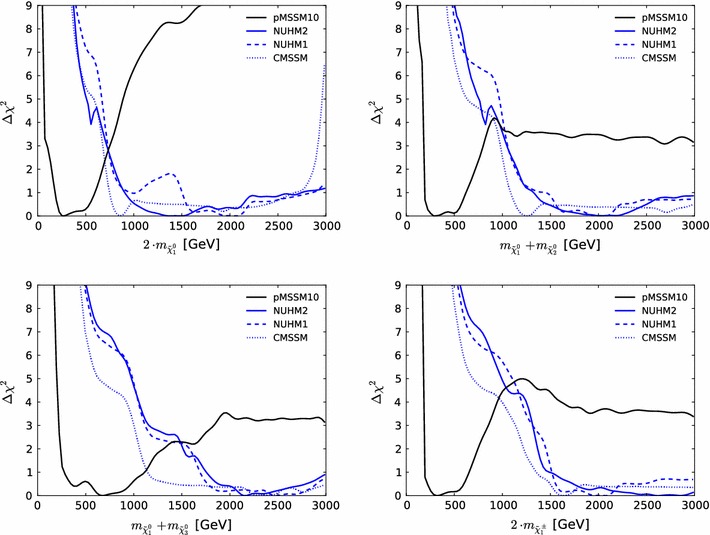
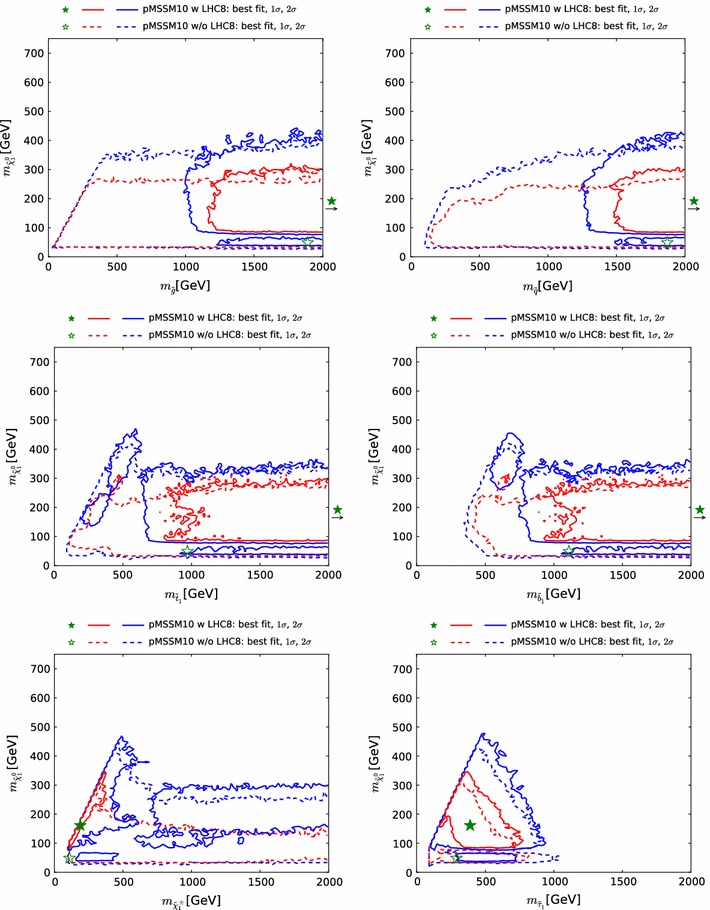
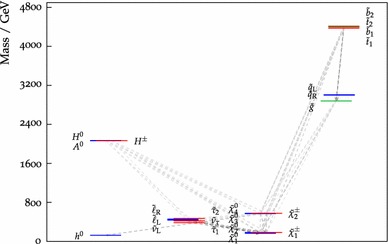
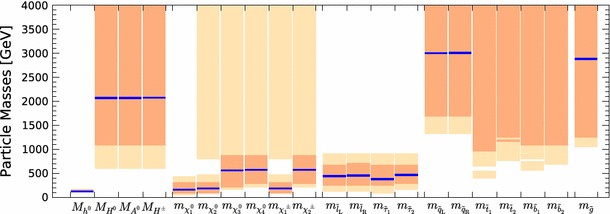
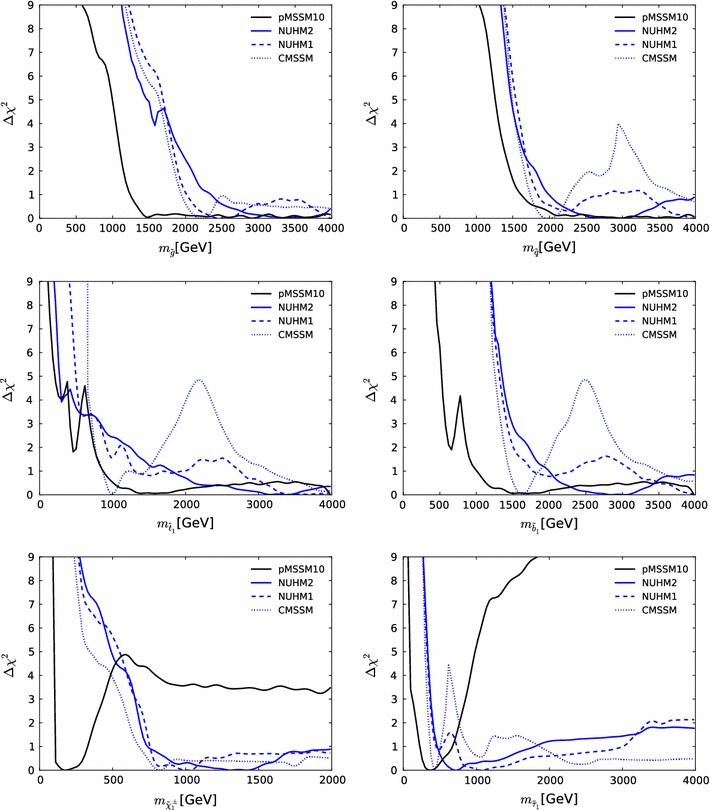
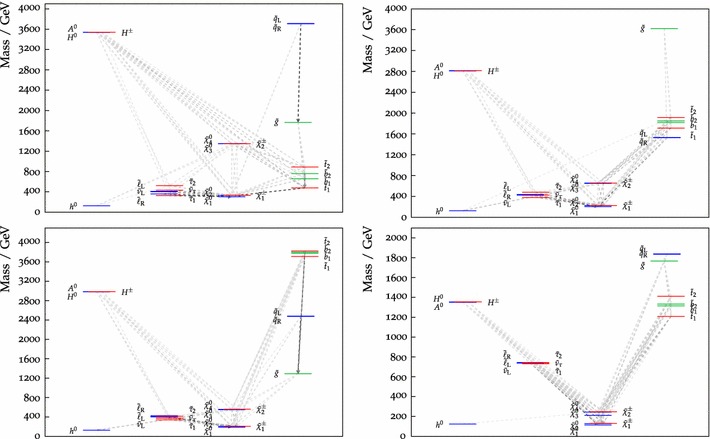
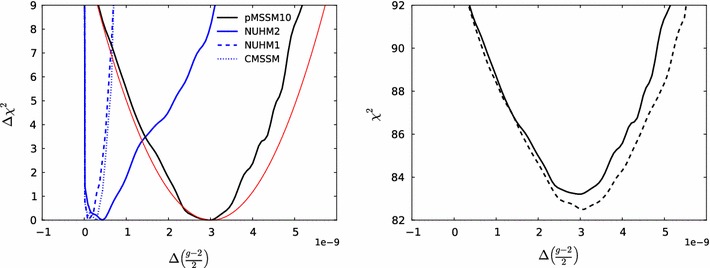
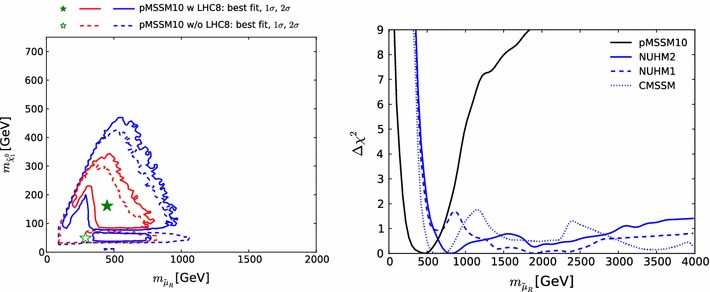
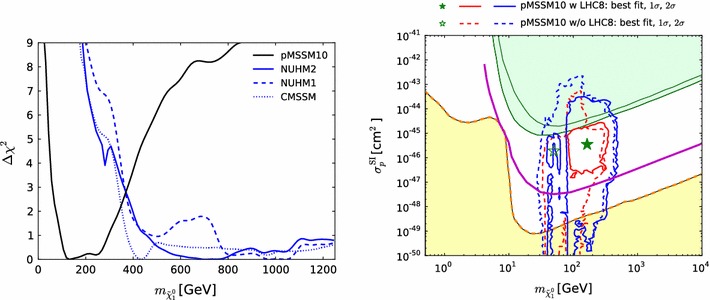
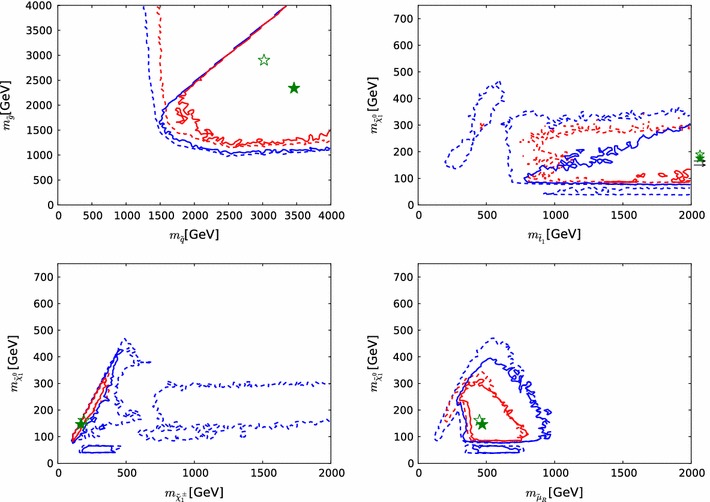
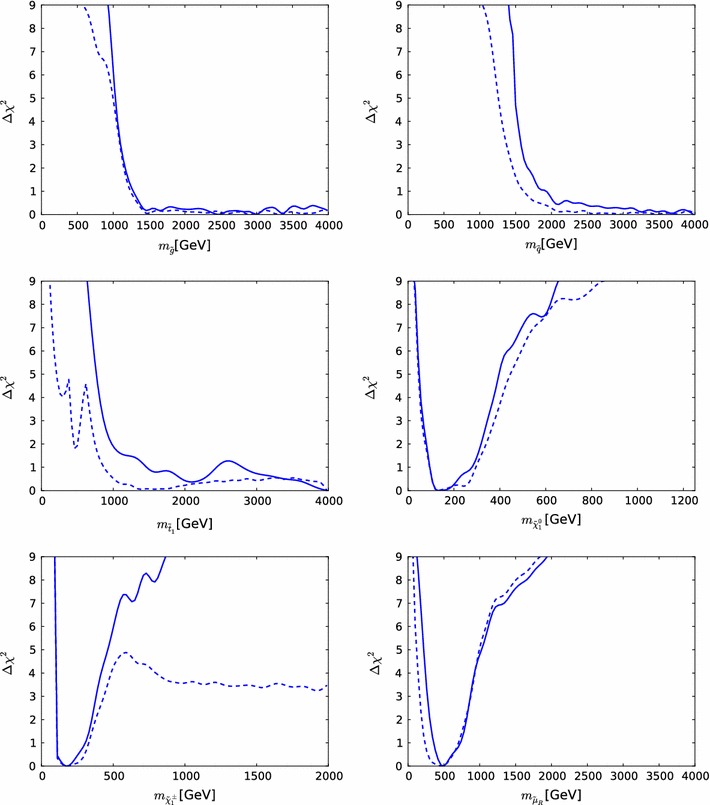
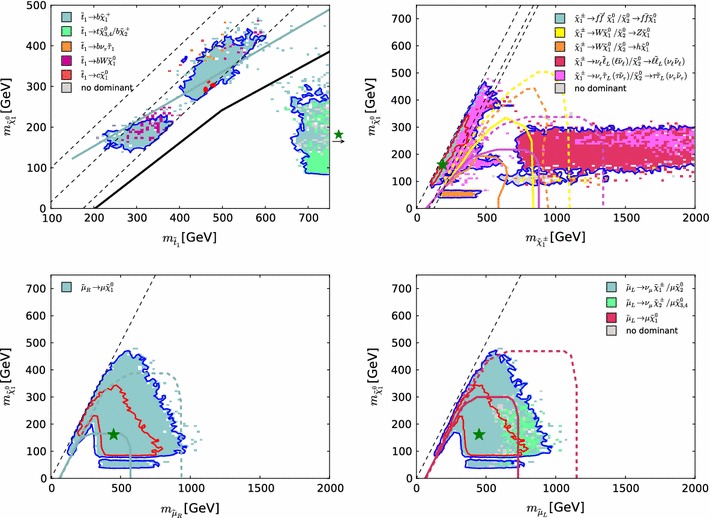
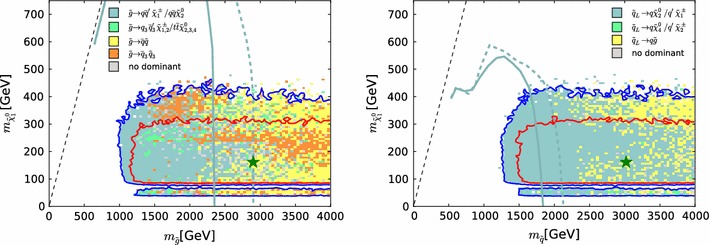
We present a frequentist analysis of the parameter space of the pMSSM10, in which the following ten soft SUSY-breaking parameters are specified independently at the mean scalar top mass scale [Formula: see text]: the gaugino masses [Formula: see text], the first-and second-generation squark masses [Formula: see text], the third-generation squark mass [Formula: see text], a common slepton mass [Formula: see text] and a common trilinear mixing parameter , as well as the Higgs mixing parameter [Formula: see text], the pseudoscalar Higgs mass [Formula: see text] and [Formula: see text], the ratio of the two Higgs vacuum expectation values. We use the MultiNest sampling algorithm with [Formula: see text]1.2 [Formula: see text] points to sample the pMSSM10 parameter space. A dedicated study shows that the sensitivities to strongly interacting sparticle masses of ATLAS and CMS searches for jets, leptons [Formula: see text][Formula: see text] signals depend only weakly on many of the other pMSSM10 parameters. With the aid of the Atom and Scorpion codes, we also implement the LHC searches for electroweakly interacting sparticles and light stops, so as to confront the pMSSM10 parameter space with all relevant SUSY searches. In addition, our analysis includes Higgs mass and rate measurements using the HiggsSignals code, SUSY Higgs exclusion bounds, the measurements of [Formula: see text] by LHCb and CMS, other -physics observables, electroweak precision observables, the cold dark matter density and the XENON100 and LUX searches for spin-independent dark matter scattering, assuming that the cold dark matter is mainly provided by the lightest neutralino [Formula: see text]. We show that the pMSSM10 is able to provide a supersymmetric interpretation of [Formula: see text], unlike the CMSSM, NUHM1 and NUHM2. As a result, we find (omitting Higgs rates) that the minimum [Formula: see text] with 18 degrees of freedom (d.o.f.) in the pMSSM10, corresponding to a [Formula: see text] probability of 30.8 %, to be compared with [Formula: see text] in the CMSSM (NUHM1) (NUHM2). We display the one-dimensional likelihood functions for sparticle masses, and we show that they may be significantly lighter in the pMSSM10 than in the other models, e.g., the gluino may be as light as [Formula: see text]1250 [Formula: see text] at the 68 % CL, and squarks, stops, electroweak gauginos and sleptons may be much lighter than in the CMSSM, NUHM1 and NUHM2. We discuss the discovery potential of future LHC runs, [Formula: see text] colliders and direct detection experiments.
我们给出了对pMSSM10参数空间的频率分析,其中以下十个软超对称破缺参数在平均标量顶夸克质量标度[公式:见正文]下独立指定:规范玻色子质量[公式:见正文]、第一代和第二代 squark 质量[公式:见正文]、第三代 squark 质量[公式:见正文]、一个共同的 slepton 质量[公式:见正文]和一个共同的三线性混合参数,以及希格斯混合参数[公式:见正文]、赝标希格斯质量[公式:见正文]和[公式:见正文],即两个希格斯真空期望值的比值。我们使用具有[公式:见正文]1.2 [公式:见正文]个点的MultiNest采样算法来采样pMSSM10参数空间。一项专门研究表明,ATLAS和CMS对喷注、轻子[公式:见正文][公式:见正文]信号的强相互作用超对称粒子质量的灵敏度仅微弱地依赖于许多其他pMSSM10参数。借助Atom和Scorpion代码,我们还实现了大型强子对撞机对弱电相互作用超对称粒子和轻停子的搜索,以便将pMSSM10参数空间与所有相关的超对称搜索进行对比。此外,我们的分析包括使用HiggsSignals代码进行的希格斯质量和产率测量、超对称希格斯排除界限、LHCb和CMS对[公式:见正文]的测量、其他 - 物理可观测量、弱电精确可观测量、冷暗物质密度以及XENON100和LUX对与自旋无关的暗物质散射的搜索,假设冷暗物质主要由最轻的中性伴随子[公式:见正文]提供。我们表明,与CMSSM、NUHM1和NUHM2不同,pMSSM10能够为[公式:见正文]提供超对称解释。结果,我们发现(省略希格斯产率)在pMSSM10中18个自由度(d.o.f.)下的最小[公式:见正文],对应于30.8%的[公式:见正文]概率,与CMSSM(NUHM1)(NUHM2)中的[公式:见正文]进行比较。我们展示了超对称粒子质量的一维似然函数,并且我们表明它们在pMSSM10中可能比在其他模型中显著更轻,例如,在68%的置信水平下,胶微子可能轻至[公式:见正文]1250 [公式:见正文],并且squarks、停子、弱电规范玻色子和sleptons可能比在CMSSM、NUHM1和NUHM2中轻得多。我们讨论了未来大型强子对撞机运行、[公式:见正文]对撞机和直接探测实验的发现潜力。