Njuguna Christine, Stewart Annemie, Mouton Johannes P, Blockman Marc, Maartens Gary, Swart Annoesjka, Chisholm Briony, Jones Jackie, Dheda Mukesh, Igumbor Ehimario U, Cohen Karen
Division of Clinical Pharmacology, Department of Medicine, University of Cape Town, Cape Town, South Africa.
National Department of Health, Pretoria, South Africa.
Drug Saf. 2016 Feb;39(2):159-69. doi: 10.1007/s40264-015-0359-8.
The National HIV & Tuberculosis Health Care Worker (HCW) Hotline provides advice on the management of suspected adverse drug reactions (ADRs). We describe suspected ADRs reported to the hotline by HCWs, concordance with advice, and patient outcomes.
We reviewed suspected ADRs in HIV-infected patients, patients taking antiretrovirals and patients taking anti-tuberculosis therapy reported from May 2013 to October 2014. We performed causality assessment using the World Health Organization Uppsala Monitoring Centre (WHO-UMC) criteria. We included suspected ADRs categorized as certain, probable or possible in further analysis.
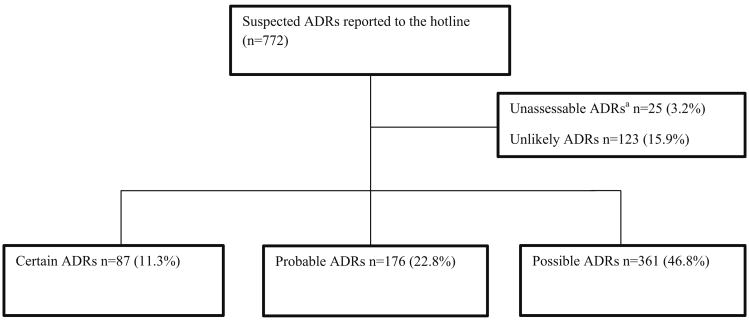
We received 772 ADR reports, of which 87/772 (11.3%) were classified as certain, 176/772 (22.8%) as probable, 361/772 (46.8%) as possible, and 148/772 (19.2%) as unlikely or unassessable. The most frequent ADRs were rash, drug-induced liver injury (DILI) and kidney injury, comprising 110/624 (17.6%), 87/624 (13.9%), and 77/624 (12.3%), respectively. The ADR was severe in 27.3% of rashes, 36.4% of kidney injury reports and 88.5% of DILI reports. Most frequently implicated drugs, either alone or in combination with other potentially causative drugs, were efavirenz (rashes), efavirenz and anti-tuberculosis drugs (DILI) and tenofovir (kidney injury). In 383 cases with HCW follow-up, 254 (66.3%) improved, 9 (2.3%) had complete resolution, 32 (8.4%) remained unchanged, 6 (1.6%) deteriorated, 10 (2.6%) died and 72 (18.8%) had unknown outcome. Advice provided was followed in 93.2% of these cases. Of 223 ADRs with preventability data, 40 (17.9%) were preventable.
Queries about rashes, DILIs and kidney injuries were common. Detection and management of these ADRs should be included in HCW training. In cases with follow-up, concordance with advice was high, and HCWs reported improvement in the majority.
国家艾滋病毒与结核病医护人员热线提供关于疑似药物不良反应(ADR)管理的建议。我们描述了医护人员向该热线报告的疑似ADR、与建议的一致性以及患者的结局。
我们回顾了2013年5月至2014年10月期间报告的艾滋病毒感染患者、服用抗逆转录病毒药物的患者以及接受抗结核治疗的患者中的疑似ADR。我们使用世界卫生组织乌普萨拉监测中心(WHO-UMC)标准进行因果关系评估。我们将分类为肯定、很可能或可能的疑似ADR纳入进一步分析。
我们共收到772份ADR报告,其中87/772(11.3%)被分类为肯定,176/772(22.8%)为很可能,361/772(46.8%)为可能,148/772(19.2%)为不太可能或无法评估。最常见的ADR是皮疹、药物性肝损伤(DILI)和肾损伤,分别占110/624(17.6%)、87/624(13.9%)和77/624(12.3%)。27.3%的皮疹、36.4%的肾损伤报告和88.5%的DILI报告中的ADR为严重。最常涉及的药物,单独或与其他潜在致病药物联合使用时,是依非韦伦(皮疹)、依非韦伦和抗结核药物(DILI)以及替诺福韦(肾损伤)。在383例有医护人员随访的病例中,254例(66.3%)病情改善,9例(2.3%)完全缓解,32例(8.4%)无变化,6例(1.6%)病情恶化,10例(2.6%)死亡,72例(18.8%)结局未知。在这些病例中,93.2%遵循了提供的建议。在223例有可预防性数据的ADR中,40例(17.9%)是可预防的。
关于皮疹、DILI和肾损伤的咨询很常见。这些ADR的检测和管理应纳入医护人员培训。在有随访的病例中,与建议的一致性很高,医护人员报告大多数患者病情有所改善。