
一种新的DNA测序方法。
A new method for sequencing DNA.
作者信息
Maxam A M, Gilbert W
出版信息
Proc Natl Acad Sci U S A. 1977 Feb;74(2):560-4. doi: 10.1073/pnas.74.2.560.
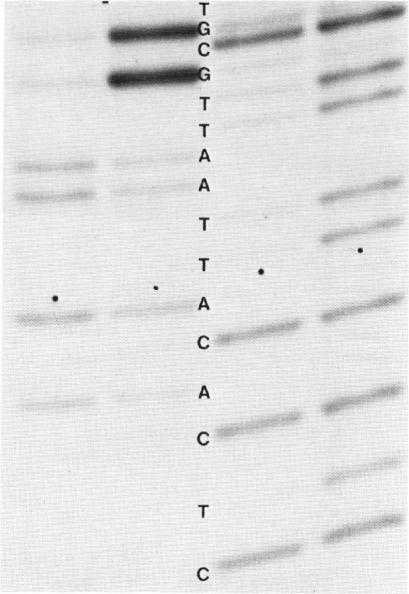
DNA can be sequenced by a chemical procedure that breaks a terminally labeled DNA molecule partially at each repetition of a base. The lengths of the labeled fragments then identify the positions of that base. We describe reactions that cleave DNA preferentially at guanines, at adenines, at cytosines and thymines equally, and at cytosines alone. When the products of these four reactions are resolved by size, by electrophoresis on a polyacrylamide gel, the DNA sequence can be read from the pattern of radioactive bands. The technique will permit sequencing of at least 100 bases from the point of labeling.
DNA可以通过一种化学方法进行测序,该方法在每次碱基重复时部分地切断末端标记的DNA分子。然后,标记片段的长度确定该碱基的位置。我们描述了优先在鸟嘌呤处、腺嘌呤处、胞嘧啶和胸腺嘧啶处同等程度地以及仅在胞嘧啶处切割DNA的反应。当通过聚丙烯酰胺凝胶电泳按大小分离这四种反应的产物时,DNA序列可以从放射性条带的模式中读出。该技术将允许从标记点开始对至少100个碱基进行测序。


 Zotero 插件