Fu Qiang, Chang Yuan, An Huimin, Fu Hangcheng, Zhu Yu, Xu Le, Zhang Weijuan, Xu Jiejie
Department of Biochemistry and Molecular Biology, School of Basic Medical Sciences, Fudan University, Shanghai, 200032, China.
Department of Urology, Zhongshan Hospital, Fudan University, Shanghai 200032, China.
Br J Cancer. 2015 Dec 1;113(11):1581-9. doi: 10.1038/bjc.2015.379. Epub 2015 Nov 10.
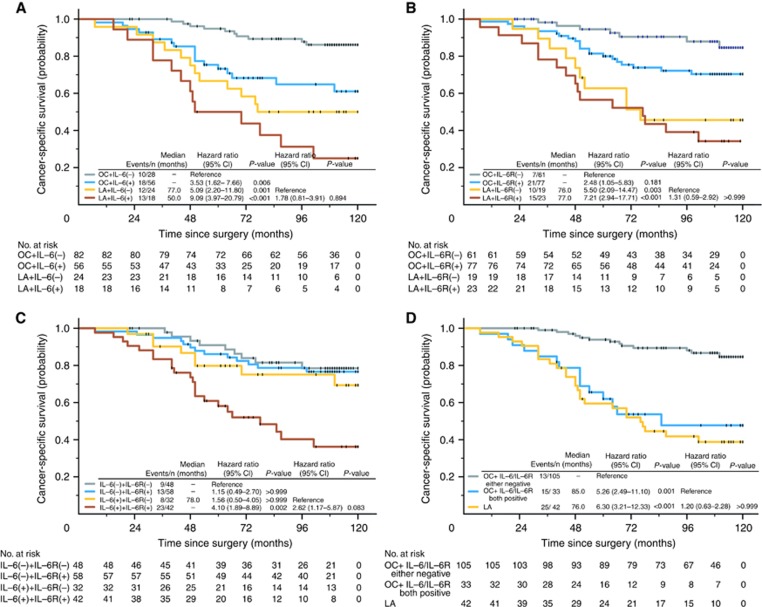
Interleukin-6 (IL-6) is the major cytokine that induces transcriptional acute and chronic inflammation responses, and was recently incorporated as a recurrence prognostication signature for localised clear-cell renal cell carcinoma (ccRCC). As the prognostic efficacy of initial risk factors may ebb during long-term practice, we aim to report conditional cancer-specific survival (CCSS) of RCC patients and evaluate the impact of IL-6 as well as its receptor (IL-6R) to offer more relevant prognostic information accounting for elapsing time.
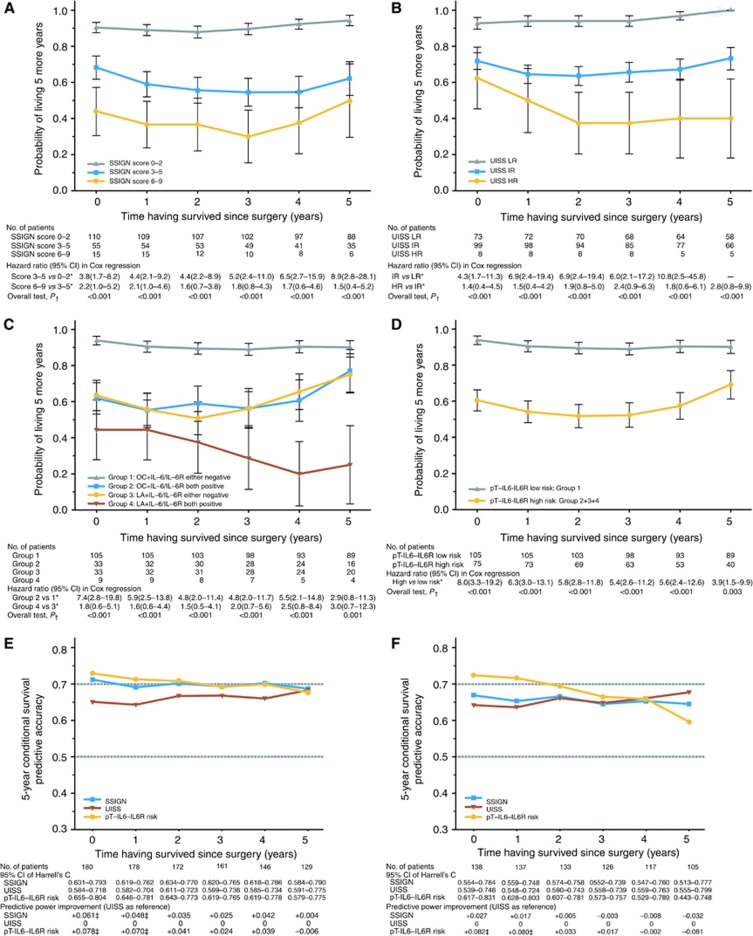
We enrolled 180 histologically proven localised ccRCC patients who underwent nephrectomy between 2001 and 2004 with available pathologic information. Five-year CCSS was determined and stratified by future prognostic factors. Constant Cox regression analysis and Harrell's concordance index were used to indicate the predictive accuracy of established models.
The 5-year CCSS of organ-confined ccRCC patients with both IL-6- and IL-6R-positive expression was 52% at year 2 after surgery, which was close to locally advanced patients (48%, P=0.564) and was significantly poorer than organ-confined patients with IL-6- or IL-6R-negative expression (89%, P<0.001). Multivariate analyses proved IL-6 and IL-6R as independent predictors after adjusting for demographic factors. Concordance index of pT-IL-6-IL-6R risk stratification was markedly higher compared with the stage, size, grade and necrosis prognostic model (0.724 vs 0.669, P=0.002) or UCLA Integrated Staging System (0.724 vs 0.642, P=0.007) in organ-confined ccRCC population during the first 5 years.
Combined IL-6 and IL-6R coexpression emerges as an independent early-stage immunologic prognostic factor for organ-confined ccRCC patients.
白细胞介素-6(IL-6)是诱导转录性急性和慢性炎症反应的主要细胞因子,最近被纳入局部透明细胞肾细胞癌(ccRCC)的复发预后特征。由于初始风险因素的预后效力在长期实践中可能会减弱,我们旨在报告肾细胞癌患者的条件性癌症特异性生存率(CCSS),并评估IL-6及其受体(IL-6R)的影响,以便提供更多考虑到时间推移的相关预后信息。
我们纳入了180例在2001年至2004年间接受肾切除术且有可用病理信息的经组织学证实的局部ccRCC患者。通过未来的预后因素确定并分层5年CCSS。采用恒定Cox回归分析和Harrell一致性指数来表明已建立模型的预测准确性。
术后2年时,IL-6和IL-6R均呈阳性表达的器官局限性ccRCC患者的5年CCSS为52%,这与局部进展期患者相近(48%,P=0.564),且显著低于IL-6或IL-6R呈阴性表达的器官局限性患者(89%,P<0.001)。多变量分析证明,在调整人口统计学因素后,IL-6和IL-6R是独立的预测因子。在器官局限性ccRCC人群的前5年中,pT-IL-6-IL-6R风险分层的一致性指数明显高于分期、大小、分级和坏死预后模型(0.724对0.669,P=0.002)或加州大学洛杉矶分校综合分期系统(0.724对0.642,P=0.007)。
IL-6和IL-6R共表达联合出现是器官局限性ccRCC患者独立的早期免疫预后因素。