Laboratory of Translational Bioinformatics, Moscow Institute of Physics and Technology, Dolgoprudny, Russia.
PathoBiology Group, European Organization for Research and Treatment of Cancer (EORTC), Brussels, Belgium.
Front Immunol. 2023 Mar 15;14:1099921. doi: 10.3389/fimmu.2023.1099921. eCollection 2023.
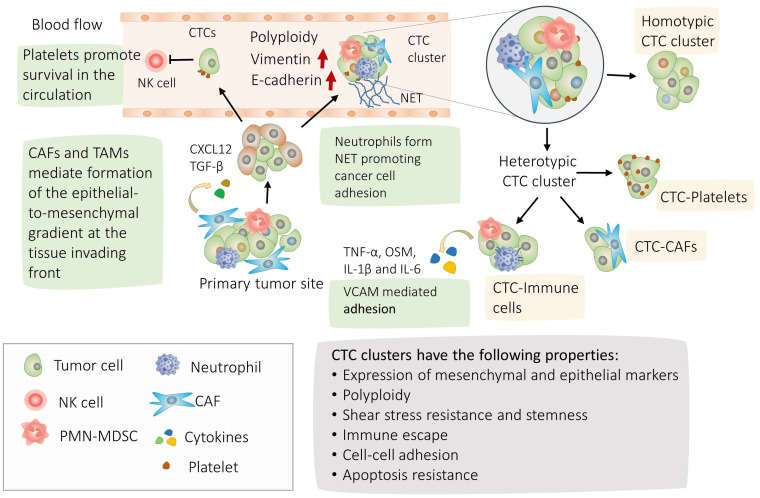
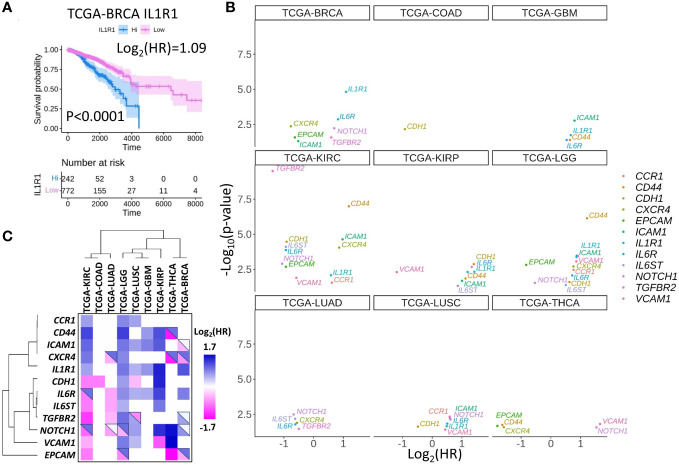
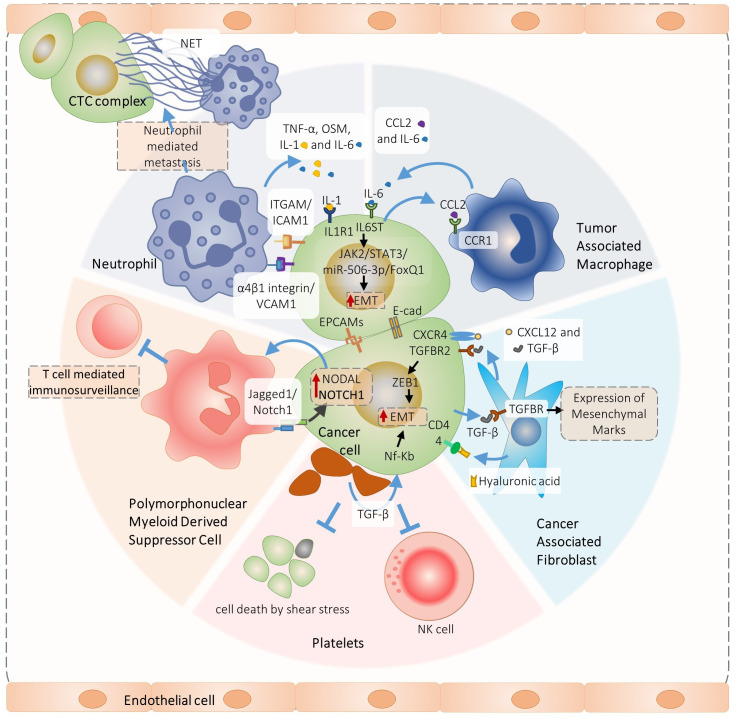
Treatment of metastatic disease remains among the most challenging tasks in oncology. One of the early events that predicts a poor prognosis and precedes the development of metastasis is the occurrence of clusters of cancer cells in the blood flow. Moreover, the presence of heterogeneous clusters of cancerous and noncancerous cells in the circulation is even more dangerous. Review of pathological mechanisms and biological molecules directly involved in the formation and pathogenesis of the heterotypic circulating tumor cell (CTC) clusters revealed their common properties, which include increased adhesiveness, combined epithelial-mesenchymal phenotype, CTC-white blood cell interaction, and polyploidy. Several molecules involved in the heterotypic CTC interactions and their metastatic properties, including IL6R, CXCR4 and EPCAM, are targets of approved or experimental anticancer drugs. Accordingly, analysis of patient survival data from the published literature and public datasets revealed that the expression of several molecules affecting the formation of CTC clusters predicts patient survival in multiple cancer types. Thus, targeting of molecules involved in CTC heterotypic interactions might be a valuable strategy for the treatment of metastatic cancers.
转移性疾病的治疗仍然是肿瘤学中最具挑战性的任务之一。预测预后不良并先于转移发生的早期事件之一是癌细胞在血流中聚集。此外,循环中存在异质的癌性和非癌性细胞簇甚至更危险。对直接参与异型循环肿瘤细胞(CTC)簇形成和发病机制的病理机制和生物分子的综述揭示了它们的共同特性,包括增加的粘附性、上皮-间充质表型的组合、CTC-白细胞相互作用和多倍体。涉及异型 CTC 相互作用及其转移特性的几种分子,包括 IL6R、CXCR4 和 EPCAM,是已批准或实验性抗癌药物的靶点。因此,对来自已发表文献和公共数据集的患者生存数据分析表明,影响 CTC 簇形成的几种分子的表达可预测多种癌症类型的患者生存。因此,针对参与 CTC 异型相互作用的分子可能是治疗转移性癌症的有价值的策略。