Megnanou Rose-Monde, Niamke Sébastien
Laboratoire de Biotechnologies, UFR Biosciences, Université Félix Houphouët-Boigny, 22 BP 582, Abidjan 22, Côte d'Ivoire.
Springerplus. 2015 Nov 4;4:667. doi: 10.1186/s40064-015-1454-0. eCollection 2015.
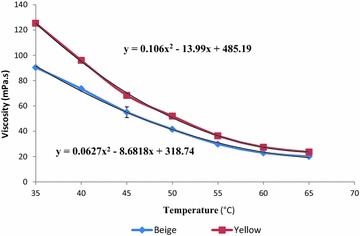
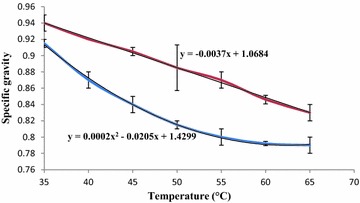
Industrials interest in fats as raw material, resides in their exceptional quality and potentialities of exploitation in several fields. This study aimed to exalt the optimized shea butter quality and present its wide potentialities of utilization. Hence, the characteristics of beige and yellow optimized shea butters were determined. Both samples recorded very weak acid (0.280 ± 0.001 and 0.140 ± 0.001 mgKOH/g) and peroxide (0.960 ± 0.001 and 1.010 ± 0.001 mEgO2/kg) indexes, when the iodine indexes (52.64 ± 0.20 and 53.06 ± 0.20 gI2/100 g) and the unsaponifiable matters (17.61 ± 0.01 and 17.27 ± 0.01 %) were considerable. The refractive indexes (1.454 ± 0.00 and 1.453 ± 0.00) and the pH (6.50 ± 0.30 and 6.78 ± 0.30) were statistically similar; but the specific gravity (0.915 ± 0.01-0.79 ± 0.01 and 0.94 ± 0.01-0.83 ± 0.01) and the viscosity (90.41 ± 0.20-20.02 ± 0.20 and 125.37 ± 0.20-23.55 ± 0.20 MPas) differed and decreased exponentially with the temperature increasing (35-65 °C), except for the specific gravity of the yellow butter which decreased linearly. The UV-Vis spectrum showed a high peak at 300 nm and a rapid decrease from 300 to 500 nm when the near infra-red one, revealed peaks at 450, 1200, 1400, 1725 and 2150 nm for all the samples. The chromatographic profile identified palmitic (16.42 and 26.36 %), stearic (32.39 and 36.36 %), oleic (38.12 and 29.09 %), linoleic (9.72 and 5.92 %) and arachidic (1.84 and 1.59 %) acids, and also exaltolide compound (1.51 and 0.68 %). The samples also contained essential minerals (Calcium, magnesium, zinc, iron, etc.) carotene (550 ± 50 and 544 ± 50 ppm), vitamins A (0.065 ± 0.001 and 0.032 ± 0.001 µg/g) and E (2992.09 ± 1.90 and 3788.44 ± 1.90 ppm) in relatively important amounts; neither microbiological germs nor heavy were detected. All these valorizing characteristics would confer to the optimized shea butters good aptitude for exportation and exploitation in food, cosmetic and pharmaceutical industries.
工业界对将脂肪用作原材料感兴趣,这在于其卓越的品质以及在多个领域的开发潜力。本研究旨在提升优化后的乳木果油品质,并展现其广泛的利用潜力。因此,测定了米色和黄色优化乳木果油的特性。两个样品的酸值(0.280±0.001和0.140±0.001mgKOH/g)和过氧化值(0.960±0.001和1.010±0.001mEgO2/kg)都非常低,而碘值(52.64±0.20和53.06±0.20gI2/100g)和不皂化物含量(17.61±0.01和17.27±0.01%)相当可观。折光率(1.454±0.00和1.453±0.00)和pH值(6.50±0.30和6.78±0.30)在统计学上相似;但比重(0.915±0.01 - 0.79±0.01和0.94±0.01 - 0.83±0.01)和粘度(90.41±0.20 - 20.02±0.20和125.37±0.20 - 23.55±0.20mPas)不同,且随着温度升高(35 - 65°C)呈指数下降,黄色乳木果油的比重除外,其呈线性下降。紫外 - 可见光谱在300nm处有一个高峰,从300nm到500nm迅速下降,而近红外光谱显示所有样品在450、1200、1400、1725和2150nm处有峰。色谱分析确定了棕榈酸(16.42和26.36%)、硬脂酸(32.39和36.36%)、油酸(38.12和29.09%)、亚油酸(9.72和5.92%)和花生酸(1.84和1.59%),以及内酯化合物(1.51和0.68%)。样品还含有必需矿物质(钙、镁、锌、铁等)、胡萝卜素(550±50和544±50ppm)、维生素A((0.065±0.001和0.032±0.001μg/g)和维生素E(2992.09±1.90和3788.44±1.90ppm),含量相对较高;未检测到微生物和重金属。所有这些有价值的特性将使优化后的乳木果油在食品、化妆品和制药行业具有良好的出口和开发适应性。