Owusu-Kwarteng James, Tano-Debrah Kwaku, Akabanda Fortune, Jespersen Lene
Department of Applied Biology, Faculty of Applied Sciences, University for Development Studies, P. O. Box 24, Navrongo Campus, Navrongo, Ghana.
Department of Nutrition and Food Science, University of Ghana, P. O. Box 134, Legon-Accra, Ghana.
BMC Microbiol. 2015 Nov 11;15:261. doi: 10.1186/s12866-015-0602-6.
Throughout Africa, food fermentations are still driven by indigenous microorganisms which influence the nutritional, organoleptic and safety of the final products. However, for improved safety, consistent quality and beneficial health effects, a trend has emerged which involves the isolation of indigenous strains from traditional fermented products to be used as functional starter cultures. These functional starter cultures possess inherent functional characteristics and can contribute to food quality and safety by offering one or more organoleptic, nutritional, technological or health advantage (probiotics). With the aim of selecting potential probiotic starter cultures, Lactobacillus fermentum strains isolated from fermented millet dough were investigated for technological properties and probiotic traits in-vitro.
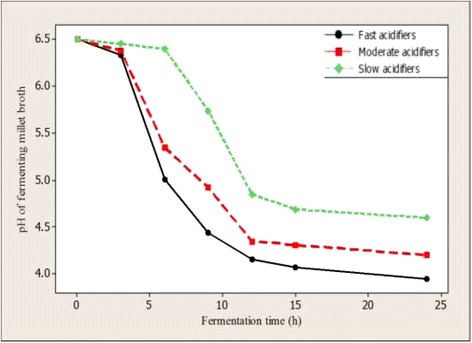
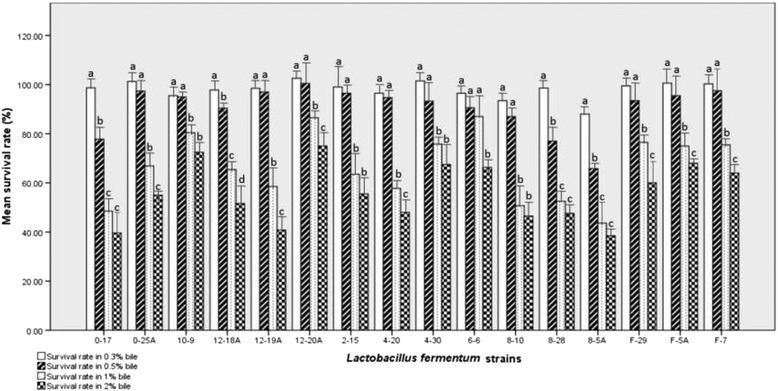
A total of 176 L. fermentum strains were assessed for technological properties including rate of acidification, exopolysaccharide production and amylase activity. Following this, 48 strains showing desirable technological properties were first screened for acid resistance. Sixteen acid resistant strains were assessed for additional probiotic properties including resistance to bile salts, bile salt hydrolysis, antimicrobial property, haemolysis and antibiotics resistance. L. fermentum strains clustered into 3 groups represented by 36 %, 47 % and 17 % as fast, medium and slow acidifiers respectively. About 8 %, 78 % and 14 % of the strains showed strong, weak and no exopolysaccharides production respectively. Amylase activity was generally weak or not detected. After exposure of 48 L. fermentum strains to pH 2.5 for 4 h, 16 strains were considered to be acid resistant. All 16 strains were resistant to bile salt. Four strains demonstrated bile salt hydrolysis. Antimicrobial activity was observed towards Listeria monocytogenes and Staphylococcus aureus but not E. coli and Salmonella enteritidis. Lactobacillus fermentum strains were generally susceptible to antibiotics except 6 strains which showed resistance towards streptomycin, gentamicin and kanamycin.
In vitro determination of technological and probiotic properties have shown strain specific difference among L. fermentum strains isolated from fermented millet dough. Sixteen (16) L. fermentum strains have been shown to possess desirable technological and probiotic characteristics in vitro. These strains are therefore good candidates for further studies to elucidate their full potential and possible application as novel probiotic starter cultures.
在整个非洲,食品发酵仍然由本地微生物驱动,这些微生物会影响最终产品的营养、感官特性和安全性。然而,为了提高安全性、保证质量的一致性以及获得有益健康的效果,出现了一种趋势,即从传统发酵产品中分离本地菌株用作功能性发酵剂。这些功能性发酵剂具有内在的功能特性,可通过提供一种或多种感官、营养、技术或健康优势(益生菌)来提高食品质量和安全性。为了筛选潜在的益生菌发酵剂,对从发酵小米面团中分离出的发酵乳杆菌菌株的技术特性和益生菌特性进行了体外研究。
共评估了176株发酵乳杆菌菌株的技术特性,包括酸化速率、胞外多糖产量和淀粉酶活性。之后,首先对48株表现出理想技术特性的菌株进行耐酸性筛选。对16株耐酸菌株评估了其他益生菌特性,包括对胆盐的抗性、胆盐水解、抗菌性能、溶血和抗生素抗性。发酵乳杆菌菌株分为3组,分别以36%、47%和17%代表快速、中等和缓慢酸化剂。分别约有8%、78%和14%的菌株表现出强、弱和无胞外多糖产生。淀粉酶活性普遍较弱或未检测到。将48株发酵乳杆菌菌株在pH 2.5下暴露4小时后,16株被认为具有耐酸性。所有16株均对胆盐具有抗性。4株表现出胆盐水解作用。观察到对单核细胞增生李斯特菌和金黄色葡萄球菌有抗菌活性,但对大肠杆菌和肠炎沙门氏菌无抗菌活性。发酵乳杆菌菌株通常对抗生素敏感,除了6株对链霉素、庆大霉素和卡那霉素表现出抗性。
体外对技术特性和益生菌特性的测定表明,从发酵小米面团中分离出的发酵乳杆菌菌株之间存在菌株特异性差异。已证明16株发酵乳杆菌菌株在体外具有理想的技术和益生菌特性。因此,这些菌株是进一步研究以阐明其全部潜力以及作为新型益生菌发酵剂可能应用的良好候选菌株。