Noordeen Faseeha, Scougall Catherine A, Grosse Arend, Qiao Qiao, Ajilian Behzad B, Reaiche-Miller Georget, Finnie John, Werner Melanie, Broering Ruth, Schlaak Joerg F, Vaillant Andrew, Jilbert Allison R
Department of Molecular and Cellular Biology, School of Biological Sciences, University of Adelaide, Adelaide, SA, Australia.
Department of Microbiology, Faculty of Medicine, University of Peradeniya, Peradeniya, Sri Lanka.
PLoS One. 2015 Nov 11;10(11):e0140909. doi: 10.1371/journal.pone.0140909. eCollection 2015.
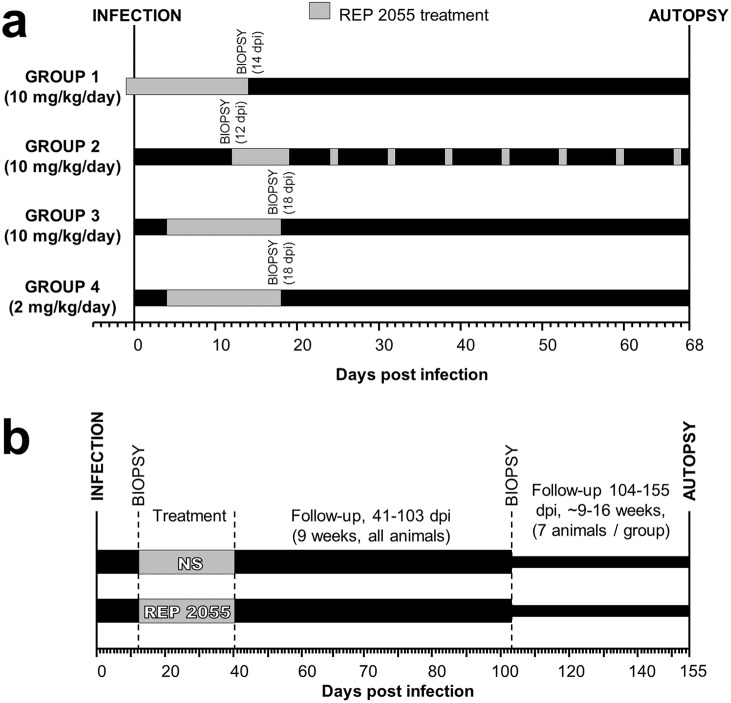
Previous studies have demonstrated that nucleic acid polymers (NAPs) have both entry and post-entry inhibitory activity against duck hepatitis B virus (DHBV) infection. The inhibitory activity exhibited by NAPs prevented DHBV infection of primary duck hepatocytes in vitro and protected ducks from DHBV infection in vivo and did not result from direct activation of the immune response. In the current study treatment of primary human hepatocytes with NAP REP 2055 did not induce expression of the TNF, IL6, IL10, IFNA4 or IFNB1 genes, confirming the lack of direct immunostimulation by REP 2055. Ducks with persistent DHBV infection were treated with NAP 2055 to determine if the post-entry inhibitory activity exhibited by NAPs could provide a therapeutic effect against established DHBV infection in vivo. In all REP 2055-treated ducks, 28 days of treatment lead to initial rapid reductions in serum DHBsAg and DHBV DNA and increases in anti-DHBs antibodies. After treatment, 6/11 ducks experienced a sustained virologic response: DHBsAg and DHBV DNA remained at low or undetectable levels in the serum and no DHBsAg or DHBV core antigen positive hepatocytes and only trace amounts of DHBV total and covalently closed circular DNA (cccDNA) were detected in the liver at 9 or 16 weeks of follow-up. In the remaining 5/11 REP 2055-treated ducks, all markers of DHBV infection rapidly rebounded after treatment withdrawal: At 9 and 16 weeks of follow-up, levels of DHBsAg and DHBcAg and DHBV total and cccDNA in the liver had rebounded and matched levels observed in the control ducks treated with normal saline which remained persistently infected with DHBV. These data demonstrate that treatment with the NAP REP 2055 can lead to sustained control of persistent DHBV infection. These effects may be related to the unique ability of REP 2055 to block release of DHBsAg from infected hepatocytes.
先前的研究表明,核酸聚合物(NAPs)对鸭乙型肝炎病毒(DHBV)感染具有进入前和进入后抑制活性。NAPs表现出的抑制活性可在体外阻止原代鸭肝细胞感染DHBV,并在体内保护鸭免受DHBV感染,且并非源于免疫反应的直接激活。在当前研究中,用NAP REP 2055处理原代人肝细胞并未诱导TNF、IL6、IL10、IFNA4或IFNB1基因的表达,证实了REP 2055缺乏直接免疫刺激作用。对持续感染DHBV的鸭用NAP 2055进行治疗,以确定NAPs表现出的进入后抑制活性是否能对体内已确立的DHBV感染产生治疗效果。在所有接受REP 2055治疗的鸭中,28天的治疗导致血清DHBsAg和DHBV DNA最初迅速下降,抗DHBs抗体增加。治疗后,6/11的鸭出现持续病毒学应答:血清中DHBsAg和DHBV DNA维持在低水平或检测不到的水平,且在随访9周或16周时,肝脏中未检测到DHBsAg或DHBV核心抗原阳性肝细胞,仅检测到微量的DHBV总量和共价闭合环状DNA(cccDNA)。在其余5/11接受REP 2055治疗的鸭中,治疗停药后所有DHBV感染标志物迅速反弹:在随访9周和16周时,肝脏中DHBsAg、DHBcAg以及DHBV总量和cccDNA水平已反弹,且与用生理盐水处理的对照鸭(持续感染DHBV)中观察到的水平相当。这些数据表明,用NAP REP 2055治疗可导致对持续性DHBV感染的持续控制。这些效应可能与REP 2055阻止DHBsAg从受感染肝细胞中释放的独特能力有关。