Rhein Bethany A, Powers Linda S, Rogers Kai, Anantpadma Manu, Singh Brajesh K, Sakurai Yasuteru, Bair Thomas, Miller-Hunt Catherine, Sinn Patrick, Davey Robert A, Monick Martha M, Maury Wendy
Department of Microbiology, The University of Iowa, Iowa City, Iowa, United States of America.
Department of Internal Medicine, The University of Iowa, Iowa City, Iowa, United States of America.
PLoS Pathog. 2015 Nov 12;11(11):e1005263. doi: 10.1371/journal.ppat.1005263. eCollection 2015.
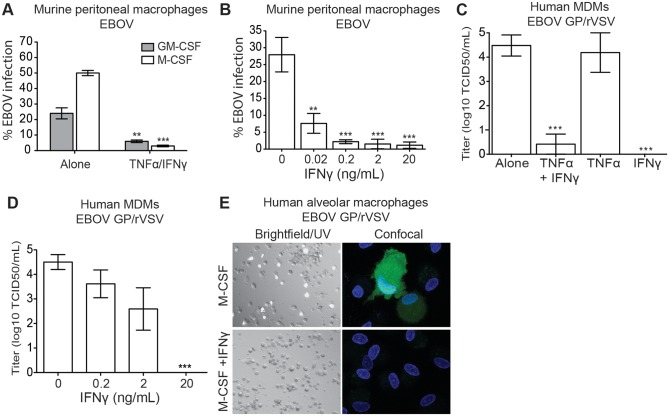
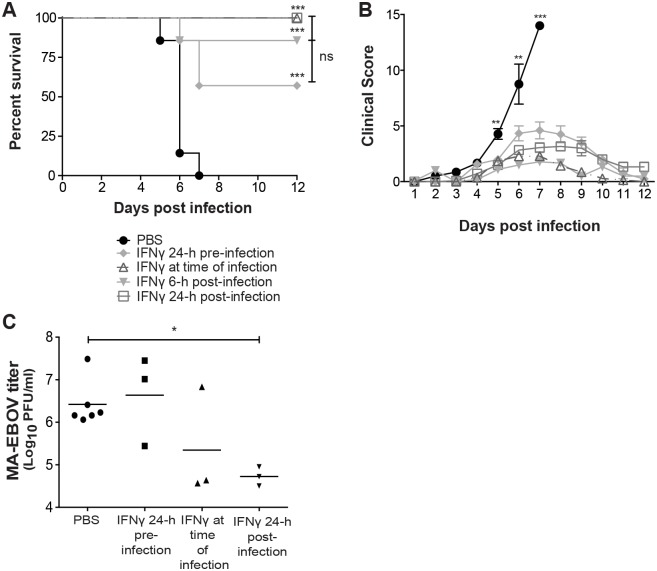
Ebola virus outbreaks, such as the 2014 Makona epidemic in West Africa, are episodic and deadly. Filovirus antivirals are currently not clinically available. Our findings suggest interferon gamma, an FDA-approved drug, may serve as a novel and effective prophylactic or treatment option. Using mouse-adapted Ebola virus, we found that murine interferon gamma administered 24 hours before or after infection robustly protects lethally-challenged mice and reduces morbidity and serum viral titers. Furthermore, we demonstrated that interferon gamma profoundly inhibits Ebola virus infection of macrophages, an early cellular target of infection. As early as six hours following in vitro infection, Ebola virus RNA levels in interferon gamma-treated macrophages were lower than in infected, untreated cells. Addition of the protein synthesis inhibitor, cycloheximide, to interferon gamma-treated macrophages did not further reduce viral RNA levels, suggesting that interferon gamma blocks life cycle events that require protein synthesis such as virus replication. Microarray studies with interferon gamma-treated human macrophages identified more than 160 interferon-stimulated genes. Ectopic expression of a select group of these genes inhibited Ebola virus infection. These studies provide new potential avenues for antiviral targeting as these genes that have not previously appreciated to inhibit negative strand RNA viruses and specifically Ebola virus infection. As treatment of interferon gamma robustly protects mice from lethal Ebola virus infection, we propose that interferon gamma should be further evaluated for its efficacy as a prophylactic and/or therapeutic strategy against filoviruses. Use of this FDA-approved drug could rapidly be deployed during future outbreaks.
埃博拉病毒爆发,如2014年西非的马科纳疫情,具有偶发性且致命。丝状病毒抗病毒药物目前尚未在临床上可用。我们的研究结果表明,一种已获美国食品药品监督管理局(FDA)批准的药物——干扰素γ,可能是一种新型且有效的预防或治疗选择。利用适应小鼠的埃博拉病毒,我们发现,在感染前或感染后24小时给予小鼠干扰素γ,能有力地保护受到致命挑战的小鼠,并降低发病率和血清病毒滴度。此外,我们证明干扰素γ能显著抑制巨噬细胞的埃博拉病毒感染,巨噬细胞是早期的细胞感染靶点。早在体外感染后6小时,经干扰素γ处理的巨噬细胞中的埃博拉病毒RNA水平就低于未处理的感染细胞。向经干扰素γ处理的巨噬细胞中添加蛋白质合成抑制剂环己酰亚胺,并未进一步降低病毒RNA水平,这表明干扰素γ阻断了需要蛋白质合成的生命周期事件,如病毒复制。对经干扰素γ处理的人类巨噬细胞进行的微阵列研究,鉴定出了160多个干扰素刺激基因。异位表达其中一组选定的基因可抑制埃博拉病毒感染。这些研究为抗病毒靶向提供了新的潜在途径,因为这些基因以前未被认识到可抑制负链RNA病毒,特别是埃博拉病毒感染。由于干扰素γ治疗能有力地保护小鼠免受致命的埃博拉病毒感染,我们建议应进一步评估干扰素γ作为预防和/或治疗丝状病毒策略的疗效。在未来疫情爆发期间,可以迅速部署使用这种已获FDA批准的药物。