Wang Juan, Hao Jie, Bai Donghui, Gu Qi, Han Weifang, Wang Lei, Tan Yuanqing, Li Xia, Xue Ke, Han Pencheng, Liu Zhengxin, Jia Yundan, Wu Jun, Liu Lei, Wang Liu, Li Wei, Liu Zhonghua, Zhou Qi
State Key of Stem Cells and Laboratory of Reproductive Biology, Institute of Zoology, Chinese Academy of Sciences, Beijing, 100101, China.
College of Life Science, Northeast Agricultural University of China, Harbin, 150030, China.
Stem Cell Res Ther. 2015 Nov 12;6:223. doi: 10.1186/s13287-015-0206-y.
Human induced pluripotent stem cells (hiPSCs) are considered as one of the most promising seed cell sources in regenerative medicine. Now hiPSC-based clinical trials are underway. To ensure clinical safety, cells used in clinical trials or therapies should be generated under GMP conditions, and with Xeno-free culture media to avoid possible side effects like immune rejection that induced by the Xeno reagents. However, up to now there are no reports for hiPSC lines developed completely under GMP conditions using Xeno-free reagents.
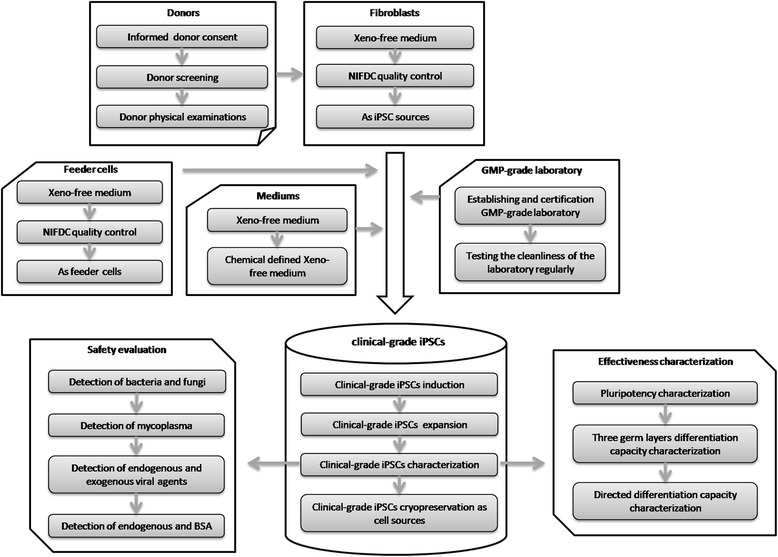
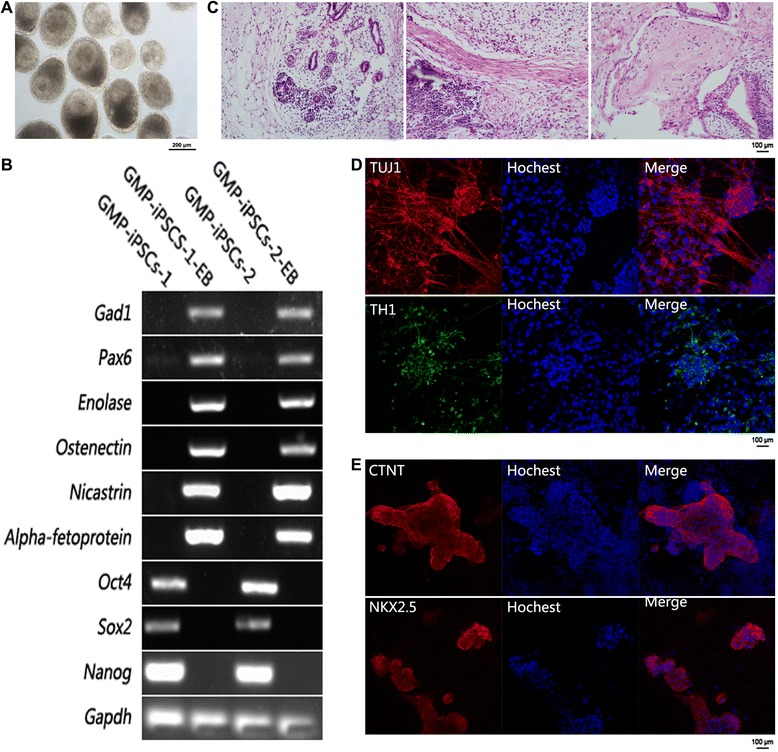
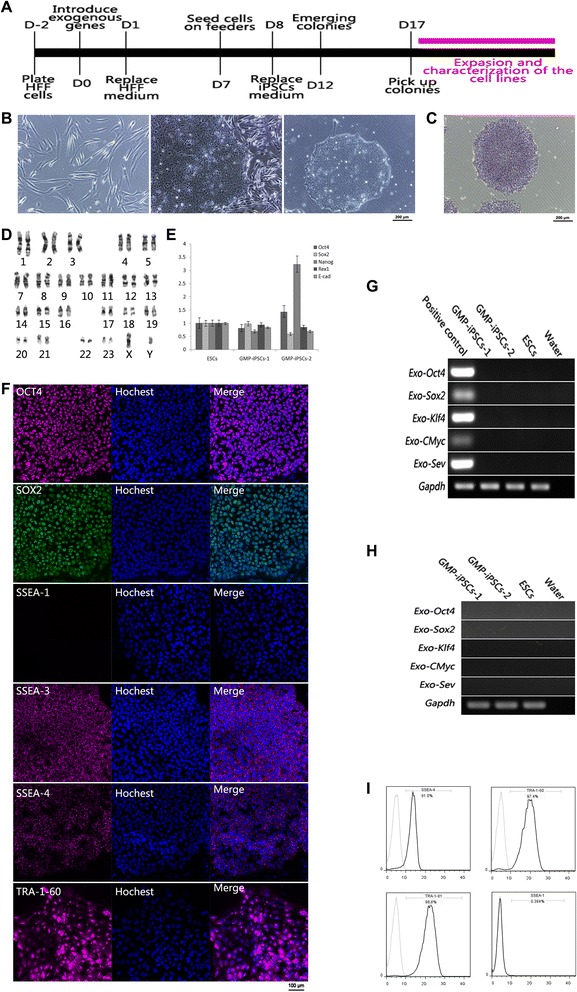
Clinical-grade human foreskin fibroblast (HFF) cells used as feeder cells and parental cells of the clinical-grade hiPSCs were isolated from human foreskin tissues and cultured in Xeno-free media. Clinical-grade hiPSCs were derived by integration-free Sendai virus-based reprogramming kit in Xeno-free pluriton™ reprogramming medium or X medium. Neural cells and cardiomyocytes differentiation were conducted following a series of spatial and temporal specific signals induction according to the corresponding lineage development signals. Biological safety evaluation of the clinical-grade HFF cells and hiPSCs were conducted following the guidance of the "Pharmacopoeia of the People's Republic of China, Edition 2010, Volume III".
We have successfully derived several integration-free clinical-grade hiPSC lines under GMP-controlled conditions and with Xeno-free reagents culture media in line with the current guidance of international and national evaluation criteria. As for the source of hiPSCs and feeder cells, biological safety evaluation of the HFF cells have been strictly reviewed by the National Institutes for Food and Drug Control (NIFDC). The hiPSC lines are pluripotent and have passed the safety evaluation. Moreover, one of the randomly selected hiPSC lines was capable of differentiating into functional neural cells and cardiomyocytes in Xeno-free culture media.
The clinical-grade hiPSC lines therefore could be valuable sources for future hiPSC-based clinical trials or therapies and for drug screening.
人诱导多能干细胞(hiPSC)被认为是再生医学中最有前景的种子细胞来源之一。目前基于hiPSC的临床试验正在进行。为确保临床安全性,用于临床试验或治疗的细胞应在GMP条件下使用无动物源培养基生成,以避免由动物源试剂引起的免疫排斥等可能的副作用。然而,迄今为止,尚无关于使用无动物源试剂在GMP条件下完全开发的hiPSC系的报道。
用作饲养细胞和临床级hiPSC亲本细胞的临床级人包皮成纤维细胞(HFF)从人包皮组织中分离出来,并在无动物源培养基中培养。临床级hiPSC通过基于仙台病毒的无整合重编程试剂盒在无动物源的pluriton™重编程培养基或X培养基中获得。根据相应谱系发育信号,通过一系列时空特异性信号诱导进行神经细胞和心肌细胞分化。按照《中华人民共和国药典》2010年版三部的指导原则,对临床级HFF细胞和hiPSC进行生物安全性评价。
我们已成功在GMP控制条件下,使用符合国际和国家评估标准当前指导原则的无动物源试剂培养基,获得了多个无整合的临床级hiPSC系。至于hiPSC和饲养细胞的来源,HFF细胞的生物安全性评价已由国家食品药品监督管理总局药品审评中心(NIFDC)严格审查。这些hiPSC系具有多能性并通过了安全性评价。此外,随机选择的一个hiPSC系能够在无动物源培养基中分化为功能性神经细胞和心肌细胞。
因此,临床级hiPSC系可能是未来基于hiPSC的临床试验或治疗以及药物筛选的宝贵来源。