Smith Brigitte K, Adsit Robert T, Jorenby Douglas E, Matsumura Jon S, Fiore Michael C
Department of Surgery, University of Wisconsin Hospital and Clinics, Madison, WI.
University of Wisconsin -Center for Tobacco Research & Intervention, Madison, WI.
Int J Cardiovasc Res. 2015;4(5). doi: 10.4172/2324-8602.1000231. Epub 2015 May 30.
Identification of hospitalized patients who smoke has shown significant improvement in recent years, but provision of evidence-based tobacco cessation treatment remains a challenge. This study evaluated the utilization of an electronic health record (EHR) to facilitate implementation of evidence-based clinical practice guidelines for smoking cessation on a vascular surgery inpatient unit.
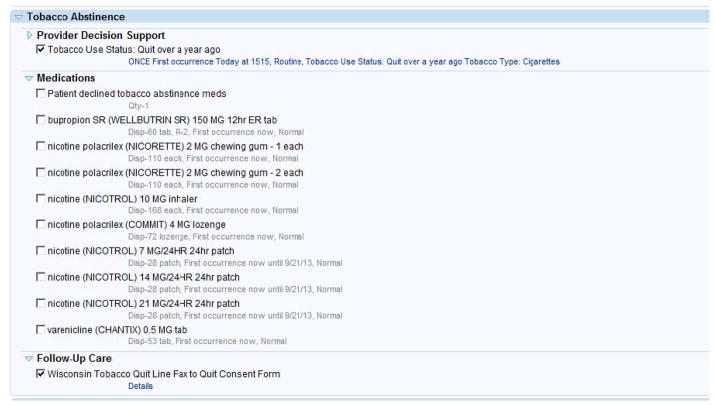
A pre-and post-intervention cohort study was conducted over 6 months at a single academic medical center with a comprehensive EHR. All patients admitted to the vascular surgery service and documented as current smokers were included. A vascular surgery discharge order set with an evidence-based smoking cessation module was developed and implemented. The primary outcome was prescription of nicotine replacement therapy (NRT) at the time of discharge. The secondary outcome was referral for smoking cessation counseling at the time of discharge.
There were 52 and 42 smokers in the pre-and post-intervention cohorts, respectively. Over the 3 months following implementation of the EHR order set, prescription of NRT at the time of discharge did not change significantly (27% vs 19%, =0.30). Referral for outpatient smoking cessation counseling increased in the post-intervention group, but did not reach significance (64% vs 72%, =0.20).
Implementation of a brief tobacco dependence treatment order set in an existing EHR increased cessation counseling referrals on a vascular surgery inpatient unit. One potential limitation of the study was the modest sample size. Not being able to make smoking cessation treatment a mandatory component in discharge orders may also have contributed to the modest effect. Assessing the differential effect of EHR-based order implementation will be important in future research on this topic.
近年来,识别住院吸烟患者的工作有了显著改善,但提供基于证据的戒烟治疗仍然是一项挑战。本研究评估了利用电子健康记录(EHR)来促进血管外科住院病房实施基于证据的戒烟临床实践指南。
在一家拥有综合电子健康记录的单一学术医疗中心进行了一项为期6个月的干预前后队列研究。纳入所有入住血管外科且记录为当前吸烟者的患者。制定并实施了包含基于证据的戒烟模块的血管外科出院医嘱集。主要结局是出院时尼古丁替代疗法(NRT)的处方情况。次要结局是出院时转介接受戒烟咨询的情况。
干预前队列中有52名吸烟者,干预后队列中有42名吸烟者。在实施电子健康记录医嘱集后的3个月里,出院时NRT的处方情况没有显著变化(27%对19%,P = 0.30)。干预后组中门诊戒烟咨询的转介有所增加,但未达到显著水平(64%对72%,P = 0.20)。
在现有电子健康记录中实施简短的烟草依赖治疗医嘱集增加了血管外科住院病房的戒烟咨询转介。该研究的一个潜在局限性是样本量较小。未能将戒烟治疗作为出院医嘱中的强制性组成部分也可能导致了效果不明显。在未来关于该主题的研究中,评估基于电子健康记录的医嘱实施的差异效应将很重要。