Qanbari Saber, Seidel Michael, Strom Tim-Mathias, Mayer Klaus F X, Preisinger Ruedi, Simianer Henner
Animal Breeding and Genetics Group, Georg-August University, Göttingen, Germany
Institute of Plant Genome and Systems Biology, Helmholtz Zentrum München, Neuherberg, Germany.
Genome Biol Evol. 2015 Nov 13;7(12):3299-306. doi: 10.1093/gbe/evv222.
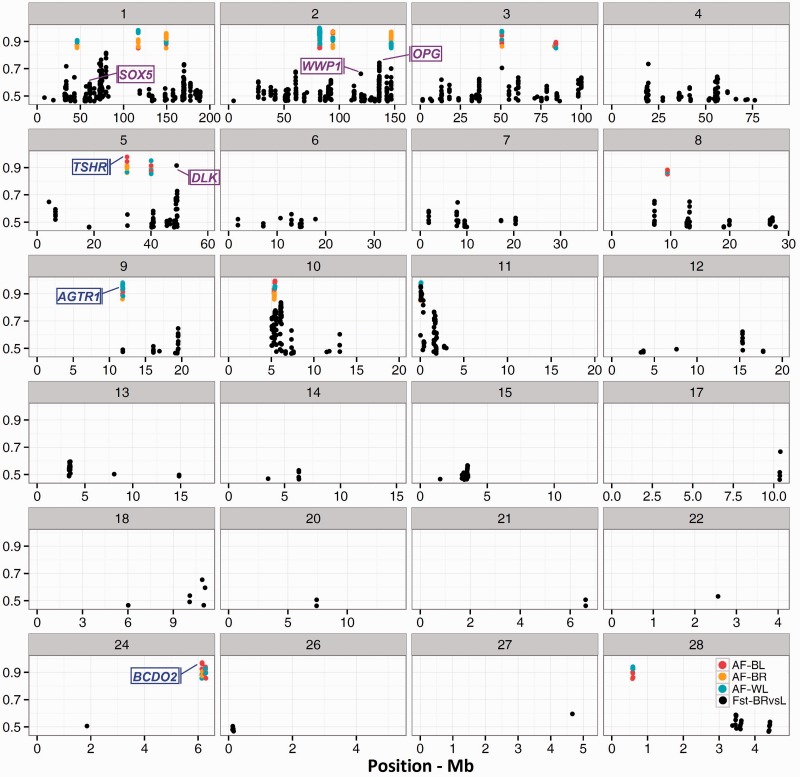
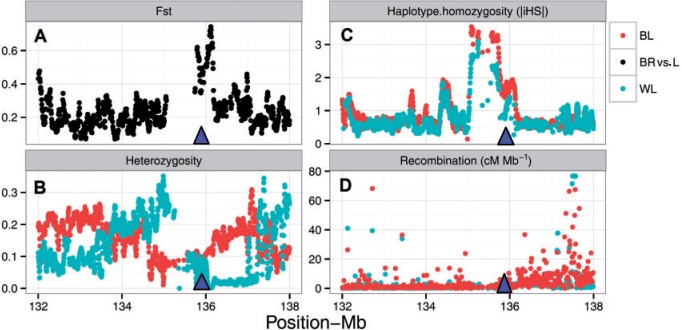
Human-driven selection during domestication and subsequent breed formation has likely left detectable signatures within the genome of modern chicken. The elucidation of these signatures of selection is of interest from the perspective of evolutionary biology, and for identifying genes relevant to domestication and improvement that ultimately may help to further genetically improve this economically important animal. We used whole genome sequence data from 50 hens of commercial white (WL) and brown (BL) egg-laying chicken along with pool sequences of three meat-type chicken to perform a systematic screening of past selection in modern chicken. Evidence of positive selection was investigated in two steps. First, we explored evidence of parallel fixation in regions with overlapping elevated allele frequencies in replicated populations of layers and broilers, suggestive of selection during domestication or preimprovement ages. We confirmed parallel fixation in BCDO2 and TSHR genes and found four candidates including AGTR2, a gene heavily involved in "Ascites" in commercial birds. Next, we explored differentiated loci between layers and broilers suggestive of selection during improvement in chicken. This analysis revealed evidence of parallel differentiation in genes relevant to appearance and production traits exemplified with the candidate gene OPG, implicated in Osteoporosis, a disorder related to overconsumption of calcium in egg-laying hens. Our results illustrate the potential for population genetic techniques to identify genomic regions relevant to the phenotypes of importance to breeders.
在驯化及随后的品种形成过程中,人类驱动的选择可能在现代鸡的基因组中留下了可检测的印记。从进化生物学的角度以及识别与驯化和改良相关基因的角度来看,阐明这些选择印记是很有意义的,这些基因最终可能有助于进一步对这种经济上重要的动物进行基因改良。我们使用了来自50只商业白壳蛋鸡(WL)和褐壳蛋鸡(BL)母鸡的全基因组序列数据,以及三种肉用型鸡的混合序列,对现代鸡过去的选择进行了系统筛选。正向选择的证据分两步进行研究。首先,我们在蛋鸡和肉鸡的重复群体中,探索等位基因频率重叠升高区域的平行固定证据,这暗示了驯化或改良前阶段的选择。我们证实了BCDO2和TSHR基因中的平行固定,并发现了四个候选基因,包括AGTR2,该基因与商业禽类的“腹水症”密切相关。接下来,我们探索了蛋鸡和肉鸡之间的差异位点,这暗示了鸡在改良过程中的选择。该分析揭示了与外观和生产性状相关基因的平行分化证据,以候选基因OPG为例,该基因与骨质疏松症有关,骨质疏松症是一种与蛋鸡钙摄入过多有关的疾病。我们的结果说明了群体遗传技术在识别与育种者重要表型相关的基因组区域方面的潜力。