Cool Simon, Pieters Jan G, Mertens Koen C, Mora Sergio, Cointault Frédéric, Dubois Julien, van de Gucht Tim, Vangeyte Jürgen
Institute of Agricultural and Fisheries Research, Burg. van Gansberghelaan 115, Merelbeke 9820, Belgium.
Department of Biosystems Engineering, Ghent University, Coupure links 653, Gent 9000, Belgium.
Sensors (Basel). 2015 Nov 12;15(11):28627-45. doi: 10.3390/s151128627.
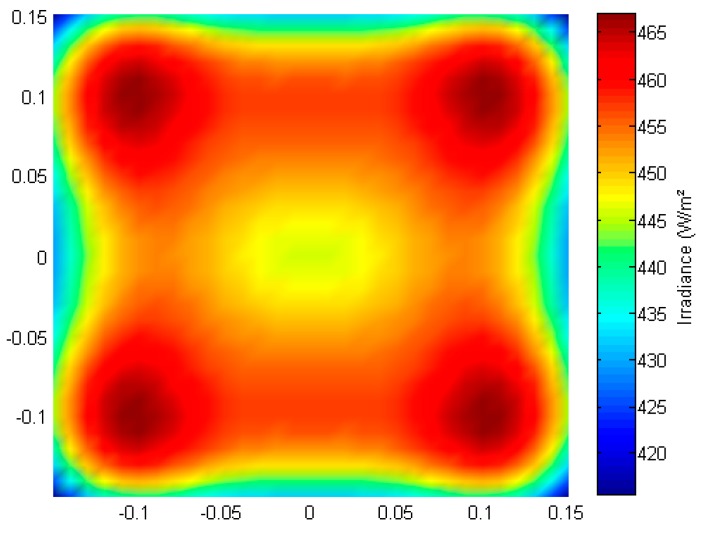
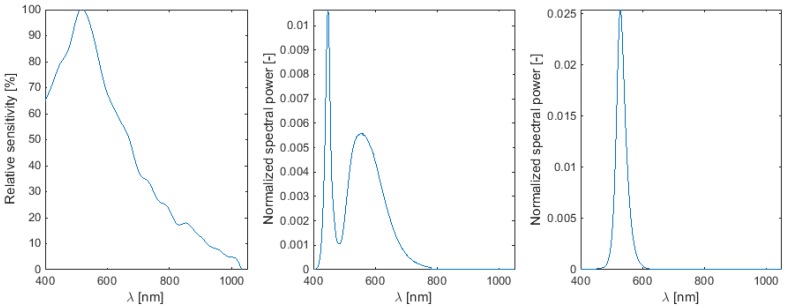
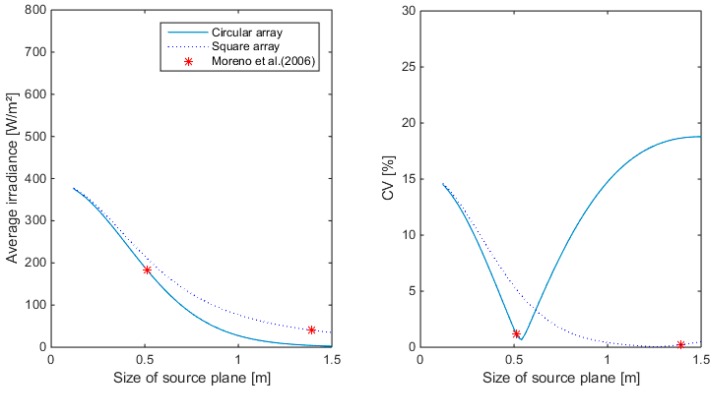
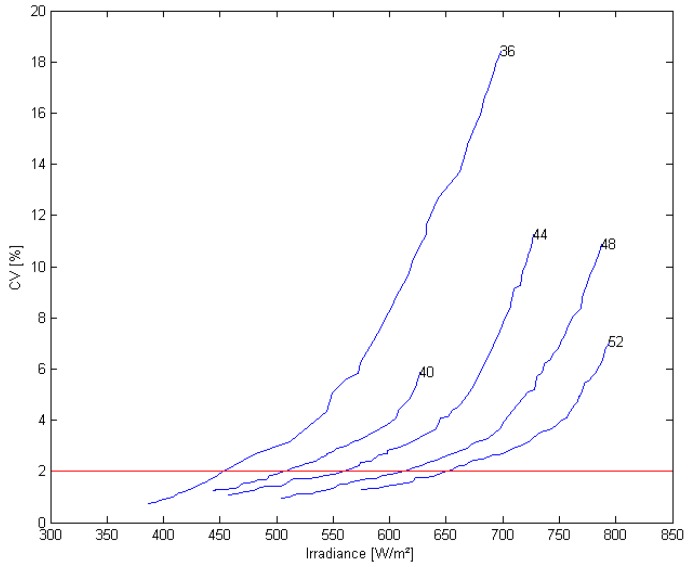
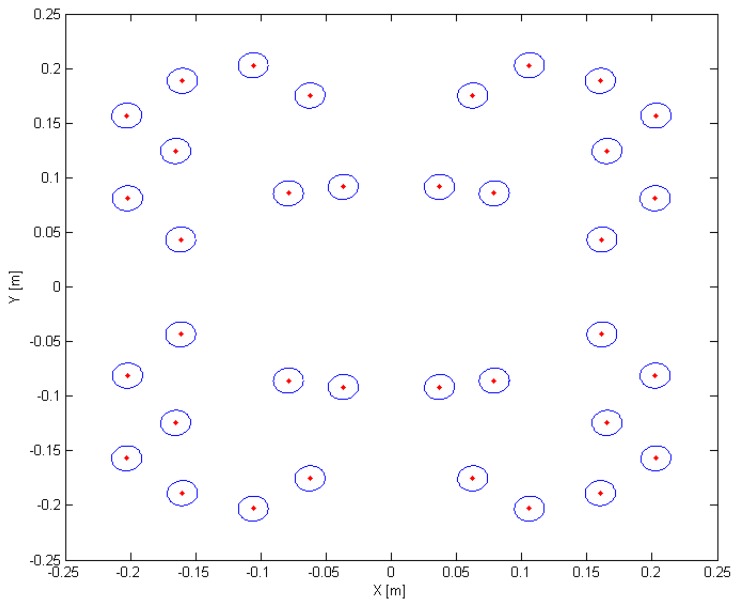
Better characterization of the fertilizer spreading process, especially the fertilizer pattern distribution on the ground, requires an accurate measurement of individual particle properties and dynamics. Both 2D and 3D high speed imaging techniques have been developed for this purpose. To maximize the accuracy of the predictions, a specific illumination level is required. This paper describes the development of a high irradiance LED system for high speed motion estimation of fertilizer particles. A spectral sensitivity factor was used to select the optimal LED in relation to the used camera from a range of commercially available high power LEDs. A multiple objective genetic algorithm was used to find the optimal configuration of LEDs resulting in the most homogeneous irradiance in the target area. Simulations were carried out for different lenses and number of LEDs. The chosen configuration resulted in an average irradiance level of 452 W/m² with coefficient of variation less than 2%. The algorithm proved superior and more flexible to other approaches reported in the literature and can be used for various other applications.
更好地描述肥料撒播过程,尤其是地面上肥料的分布模式,需要精确测量单个颗粒的特性和动力学。为此已开发了二维和三维高速成像技术。为了使预测的准确性最大化,需要特定的光照水平。本文描述了一种用于肥料颗粒高速运动估计的高辐照度LED系统的开发。使用光谱灵敏度因子从一系列市售高功率LED中选择与所用相机相关的最佳LED。使用多目标遗传算法来找到LED的最佳配置,从而在目标区域产生最均匀的辐照度。针对不同的镜头和LED数量进行了模拟。所选配置的平均辐照度水平为452 W/m²,变异系数小于2%。该算法被证明比文献中报道的其他方法更优越、更灵活,可用于各种其他应用。