Gillespie Steven M, Mitchell Ian J, Satherley Rose-Marie, Beech Anthony R, Rotshtein Pia
School of Psychology, University of Birmingham, Birmingham, United Kingdom.
PLoS One. 2015 Nov 16;10(11):e0143120. doi: 10.1371/journal.pone.0143120. eCollection 2015.
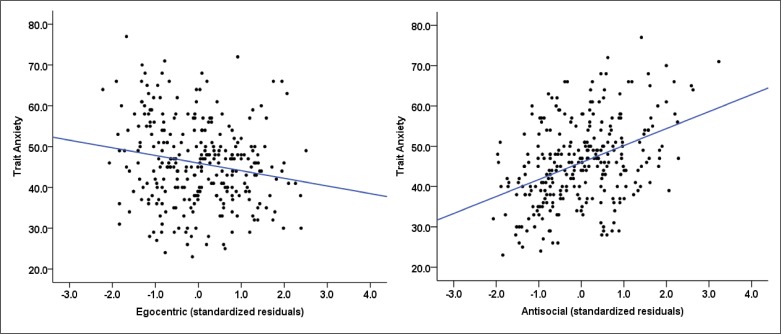
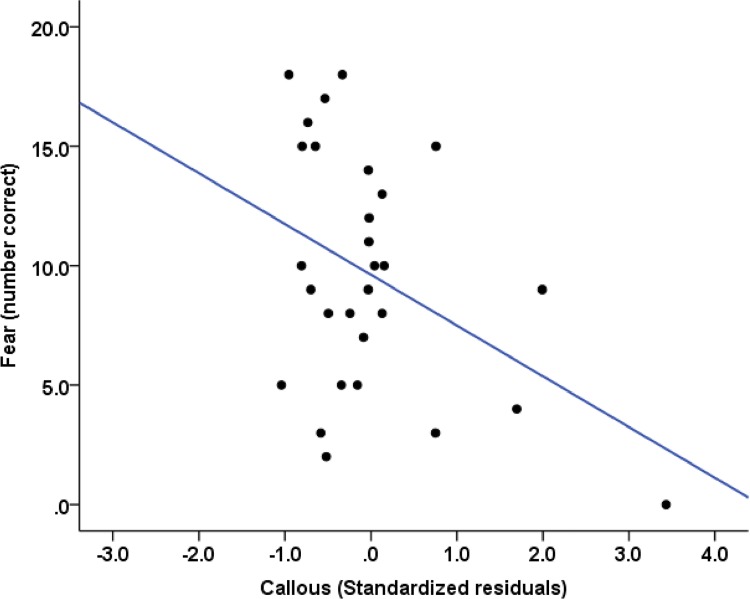
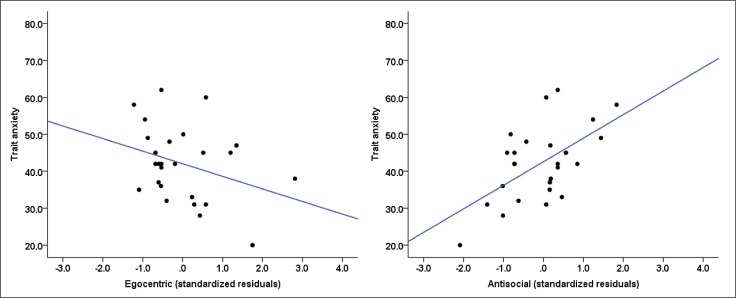
Early descriptions of psychopathy emphasise fearlessness and a lack of nervousness or anxiety as key characteristics of the disorder. However, conflicting evidence suggests that anxiety may be positively correlated with some aspects of the psychopathy construct. This position may seem somewhat paradoxical when considered alongside impaired processing of fear related stimuli in psychopathic personality. The aim of the current paper was to examine the distinct relations of callous, egocentric, and antisocial psychopathic traits with measures of anxiety and social anxiety in samples of non-offenders (Study 1) and violent offenders (Study 2). In Study 2 we also used an emotion recognition task to examine fearful face recognition. In Studies 1 and 2 we showed distinct and opposite significant relationships of egocentric and antisocial psychopathic traits with trait anxiety. Thus, while trait anxiety was negatively predicted by egocentric traits, it was predicted in a positive direction by antisocial traits in both samples. In Study 2 we found that callous traits were predictive of greater impairments in fearful face recognition. These findings suggest that anxiety and fear are distinguishable constructs in relation to psychopathic personality traits, and are discussed in terms of potentially separable mechanisms for these two constructs.
对心理变态的早期描述强调无畏以及缺乏紧张或焦虑是该障碍的关键特征。然而,相互矛盾的证据表明,焦虑可能与心理变态结构的某些方面呈正相关。当与心理变态人格中与恐惧相关刺激的加工受损一起考虑时,这一观点可能显得有些自相矛盾。本文的目的是在非犯罪样本(研究1)和暴力犯罪样本(研究2)中,检验冷酷、自我中心和反社会心理变态特质与焦虑和社交焦虑测量指标之间的不同关系。在研究2中,我们还使用了一项情绪识别任务来检验对恐惧面孔的识别。在研究1和研究2中,我们发现自我中心和反社会心理变态特质与特质焦虑之间存在明显且相反的显著关系。因此,在两个样本中,虽然特质焦虑由自我中心特质负向预测,但由反社会特质正向预测。在研究2中,我们发现冷酷特质预示着在恐惧面孔识别方面有更严重的损伤。这些发现表明,在与心理变态人格特质相关的方面,焦虑和恐惧是可区分的结构,并从这两种结构潜在的可分离机制方面进行了讨论。