Jang Min-Hee, Lee Seungho, Hwang Yu Sik
Future Environmental Research Center, Korea Institute of Toxicology, Jinju, 660-844, Republic of Korea.
Department of Chemistry, Hannam University, Daejeon, 305-811, Republic of Korea.
PLoS One. 2015 Nov 17;10(11):e0143149. doi: 10.1371/journal.pone.0143149. eCollection 2015.
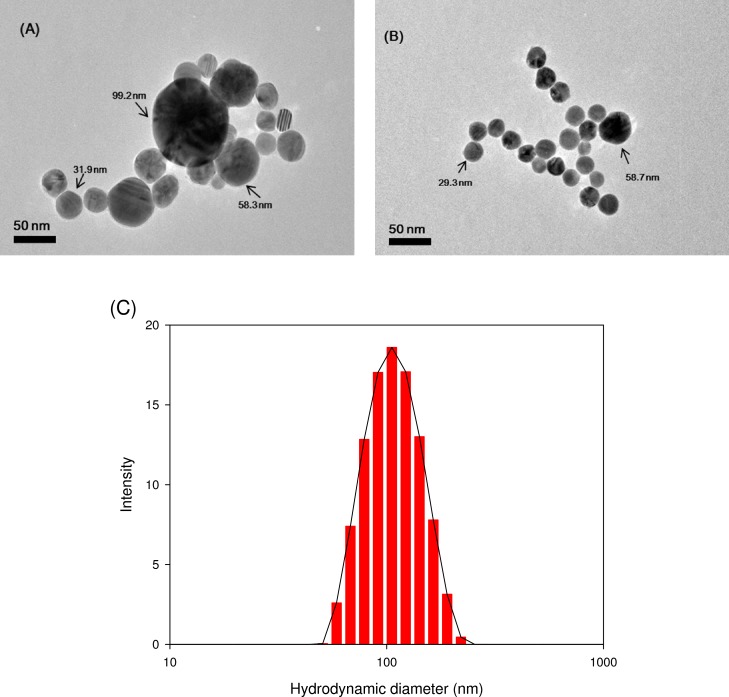
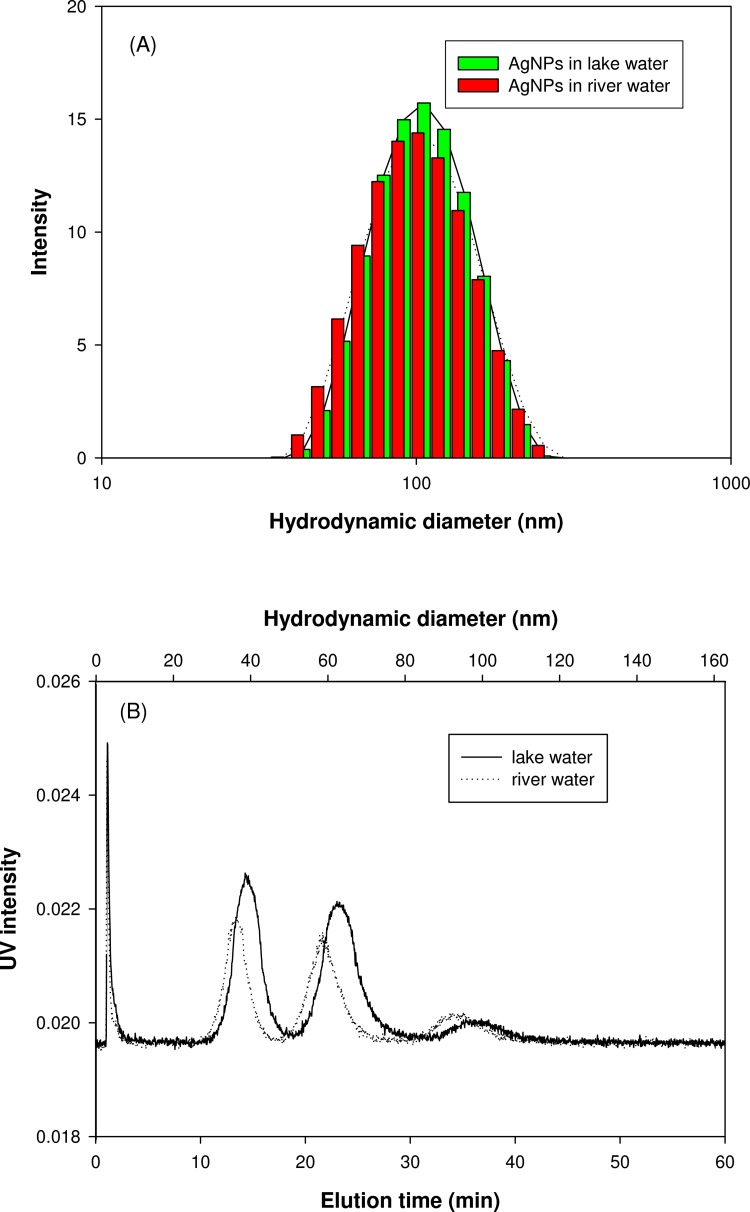
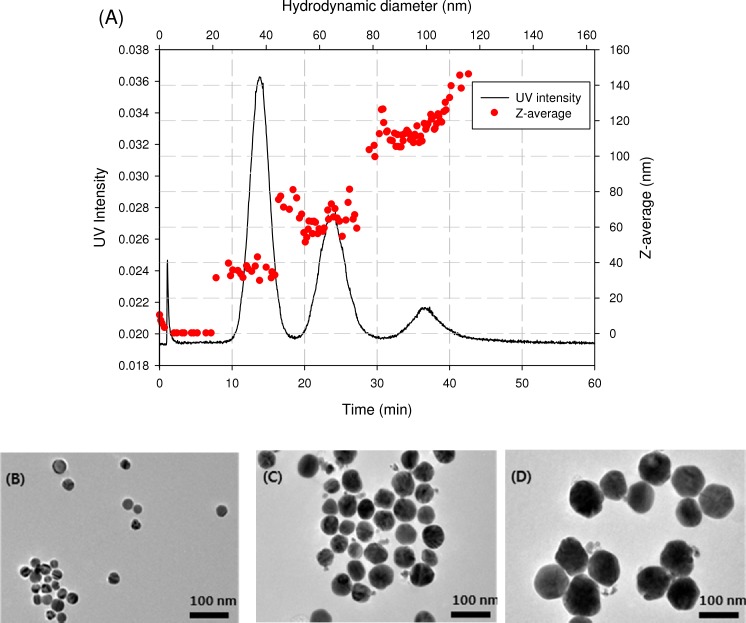
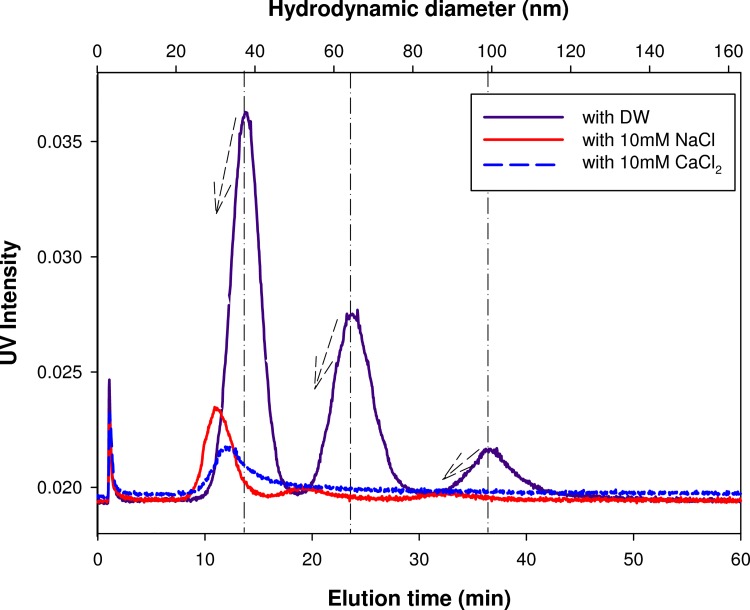
The development of methods to monitor manufactured nanomaterials in the environment is one of the crucial areas for the assessment of their risk. More specifically, particle size analysis is a key element, because many properties of nanomaterial are size dependent. The sizing of nanomaterials in real environments is challenging due to their heterogeneity and reactivity with other environmental components. In this study, the fractionation and characterization of a mixture of polyvinylpyrrolidone-coated silver nanoparticles (PVP-AgNPs) of three different sizes were investigated using asymmetrical flow field-flow fractionation (AF4) coupled with UV-Vis spectrophotometry. In particular, the effects of electrolyte composition and natural organic matter (NOM) on the particle size and stability were evaluated. The fractogram peaks (i.e., stability) of three different AgNPs decreased in the presence of both 10 mM NaCl and 10 mM CaCl2, while increased with increasing concentration of humic acid (HA). In addition, the hydrodynamic diameters of AgNPs in both electrolytes slightly increased with an increase of HA concentration, suggesting the adsorption (coating) of HA onto the particle surface. It is also interesting to note that an increase in the particle size depended on the types of electrolyte, which could be explained by the conformational characteristics of the adsorbed HA layers. Consistent these results, AgNPs suspended in lake water containing relatively high concentration of organic carbon (TOC) showed higher particle stability and larger particle size (i.e., by approximately 4 nm) than those in river water. In conclusion, the application of AF4 coupled with highly sensitive detectors could be a powerful method to characterize nanoparticles in natural waters.
开发监测环境中人造纳米材料的方法是评估其风险的关键领域之一。更具体地说,粒度分析是一个关键要素,因为纳米材料的许多特性都取决于尺寸。由于纳米材料的异质性以及它们与其他环境成分的反应性,在实际环境中对其进行粒度测定具有挑战性。在本研究中,使用不对称流场-流分级法(AF4)结合紫外-可见分光光度法,对三种不同尺寸的聚乙烯吡咯烷酮包覆银纳米颗粒(PVP-AgNPs)混合物进行了分级分离和表征。特别评估了电解质组成和天然有机物(NOM)对颗粒尺寸和稳定性的影响。在10 mM NaCl和10 mM CaCl2存在的情况下,三种不同AgNPs的分馏图谱峰(即稳定性)均下降,而随着腐殖酸(HA)浓度的增加而升高。此外,在两种电解质中,AgNPs的流体动力学直径均随HA浓度的增加而略有增加,这表明HA吸附(包覆)在了颗粒表面。还值得注意的是,颗粒尺寸的增加取决于电解质的类型,这可以用吸附的HA层的构象特征来解释。与这些结果一致,悬浮在含有相对高浓度有机碳(TOC)的湖水中的AgNPs比河水中的AgNPs表现出更高的颗粒稳定性和更大的颗粒尺寸(即大约大4 nm)。总之,AF4结合高灵敏度检测器的应用可能是表征天然水中纳米颗粒的一种强大方法。