Cummings Doyle M, Kirian Kari, Howard George, Howard Virginia, Yuan Ya, Muntner Paul, Kissela Brett, Redmond Nicole, Judd Suzanne E, Safford Monika M
Department of Family Medicine and the Diabetes and Obesity Institute, Brody School of Medicine, East Carolina University, Greenville, NC
Department of Family Medicine and the Diabetes and Obesity Institute, Brody School of Medicine, East Carolina University, Greenville, NC.
Diabetes Care. 2016 Jan;39(1):101-9. doi: 10.2337/dc15-1174. Epub 2015 Nov 17.
To evaluate the impact of comorbid depressive symptoms and/or stress on adverse cardiovascular (CV) outcomes in individuals with diabetes compared with those without diabetes.
Investigators examined the relationship between baseline depressive symptoms and/or stress in adults with and without diabetes and physician-adjudicated incident CV outcomes including stroke, myocardial infarction/acute coronary heart disease, and CV death over a median follow-up of 5.95 years in the national REGARDS cohort study.
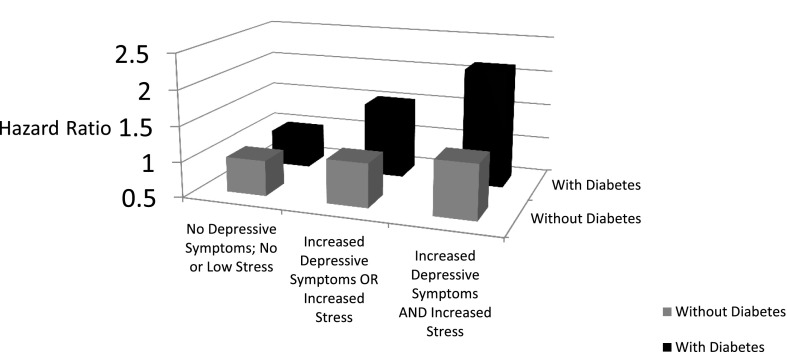
Subjects included 22,003 adults (4,090 with diabetes) (mean age 64 years, 58% female, 42% black, and 56% living in the southeastern "Stroke Belt"). Elevated stress and/or depressive symptoms were more common in subjects with diabetes (36.8% vs. 29.5%; P < 0.001). In fully adjusted models, reporting either elevated stress or depressive symptoms was associated with a significantly increased incidence of stroke (HR 1.57 [95% CI 1.05, 2.33] vs. 1.01 [0.79, 1.30]) and CV death (1.53 [1.08, 2.17] vs. 1.12 [0.90, 1.38]) in subjects with diabetes but not in those without diabetes. The combination of both elevated stress and depressive symptoms in subjects with diabetes was associated with a higher incidence of CV death (2.15 [1.33, 3.47]) than either behavioral comorbidity alone (1.53 [1.08, 2.17]) and higher than in those with both elevated stress and depressive symptoms but without diabetes (1.27 [0.86, 1.88]).
Comorbid stress and/or depressive symptoms are common in individuals with diabetes and together are associated with progressively increased risks for adverse CV outcomes.
评估合并抑郁症状和/或压力对糖尿病患者与非糖尿病患者不良心血管(CV)结局的影响。
在全国性的REGARDS队列研究中,研究人员调查了有糖尿病和无糖尿病成年人的基线抑郁症状和/或压力与医生判定的心血管事件结局(包括中风、心肌梗死/急性冠状动脉心脏病和心血管死亡)之间的关系,中位随访时间为5.95年。
研究对象包括22,003名成年人(4,090名患有糖尿病)(平均年龄64岁,58%为女性,42%为黑人,56%居住在东南部的“中风带”)。压力和/或抑郁症状升高在糖尿病患者中更为常见(36.8%对29.5%;P<0.001)。在完全调整模型中,报告压力升高或抑郁症状与糖尿病患者中风(风险比[HR]1.57[95%置信区间(CI)1.05,2.33]对1.01[0.79,1.30])和心血管死亡(1.53[1.08,2.17]对1.12[0.90,1.38])的发生率显著增加相关,但在非糖尿病患者中无此关联。糖尿病患者压力和抑郁症状均升高的组合与心血管死亡发生率较高(2.15[1.33,3.47])相关,高于单独任何一种行为合并症(1.53[1.08,2.17])且高于压力和抑郁症状均升高但无糖尿病的患者(1.27[0.86,1.88])。
合并压力和/或抑郁症状在糖尿病患者中很常见,并且共同与不良心血管结局的风险逐渐增加相关。