Jácome-Pinilla David, Hincapie-Peñaloza Eduwin, Ortiz Mario I, Ramírez Juan David, Guhl Felipe, Molina Jorge
Centro de Investigaciones en Microbiología y Parasitología Tropical (CIMPAT), Departamento de Ciencias Biológicas, Universidad de los Andes, Bogotá, Colombia.
Fundación Cataruben, Casanare-Bogotá, Colombia.
Parasit Vectors. 2015 Nov 19;8:600. doi: 10.1186/s13071-015-1209-3.
Control initiatives and continuous surveillance of vector-borne transmission have proved to be effective measures for diminishing the incidence of Chagas disease in endemic countries. However, the active dispersal of infected sylvatic adult triatomines by flight represents one of the main obstacles to eliminating domestic transmission.
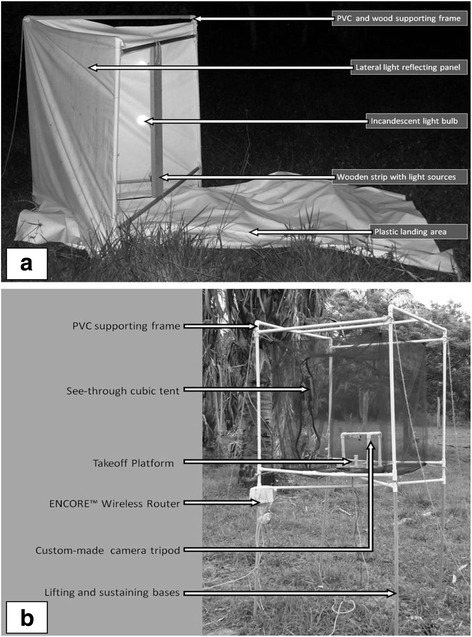
In order to determine the risk that active dispersal of sylvatic adult triatomines represents in Colombian northeastern plains, we quantified the distribution and abundance of triatomines in palm trees (primarily Attalea butyracea) using live bait traps. Directional light traps were used to estimate the frequency of sylvatic triatomine dispersal and their possible origin. Finally, the effect of environmental parameters and artificial light sources on the take-off of sylvatic Rhodnius prolixus was evaluated in field experiments.
R. prolixus was found in 90 % of the palm trees that densely aggregated toward the northern portion of the study area. R. prolixus, and three other sylvatic triatomine species were found to actively disperse and were attracted to the directional light traps (Triatoma maculata, Panstrongylus geniculatus and Psammolestes arthuri). Temperature, relative humidity, wind speed and night luminosity did not affect the active dispersal of the triatomines which is higher the first two hours after sunset. Artificial lights from houses at 60 and 110 m played a key role in the directionality of the R. prolixus take-offs. Trypanosoma cruzi was isolated from R. prolixus, T. maculata and P. geniculatus and was genotyped as T. cruzi I, III and IV.
Our results highlight the potential risk in Colombian northeastern plains of actively dispersing sylvatic triatomines and their role in the domestic introduction of Discrete Typing Units of T. cruzi associated to sylvatic foci of Chagas disease transmission.
控制措施以及对病媒传播的持续监测已被证明是在流行国家降低恰加斯病发病率的有效措施。然而,受感染的野生成年锥蝽通过飞行进行主动扩散是消除家庭传播的主要障碍之一。
为了确定野生成年锥蝽的主动扩散在哥伦比亚东北部平原所代表的风险,我们使用活饵诱捕器对棕榈树(主要是油棕)中锥蝽的分布和数量进行了量化。使用定向诱虫灯来估计野生锥蝽扩散的频率及其可能的来源。最后,在野外实验中评估了环境参数和人工光源对野生克氏锥蝽起飞的影响。
在研究区域北部密集聚集的90%的棕榈树中发现了克氏锥蝽。发现克氏锥蝽以及其他三种野生锥蝽物种会主动扩散,并被定向诱虫灯吸引(黄斑锥蝽、膝状锥猎蝽和阿瑟沙猎蝽)。温度、相对湿度、风速和夜间光照度并未影响锥蝽的主动扩散,其在日落后的头两个小时扩散更为频繁。距离房屋60米和110米处的人工光源在克氏锥蝽起飞的方向性方面起到了关键作用。从克氏锥蝽、黄斑锥蝽和膝状锥猎蝽中分离出了克氏锥虫,并将其基因分型为克氏锥虫I型、III型和IV型。
我们的研究结果突出了哥伦比亚东北部平原野生锥蝽主动扩散的潜在风险,以及它们在将与恰加斯病传播的野生疫源地相关的克氏锥虫离散型单元引入家庭方面所起的作用。