Phillips Christopher, Zeringue Angelique L, McDonald Jay R, Eisen Seth A, Ranganathan Prabha
Washington University School of Medicine, St. Louis, Missouri, United States of America.
St. Louis Veterans Affairs Medical Center, St. Louis, Missouri, United States of America.
PLoS One. 2015 Nov 23;10(11):e0143286. doi: 10.1371/journal.pone.0143286. eCollection 2015.
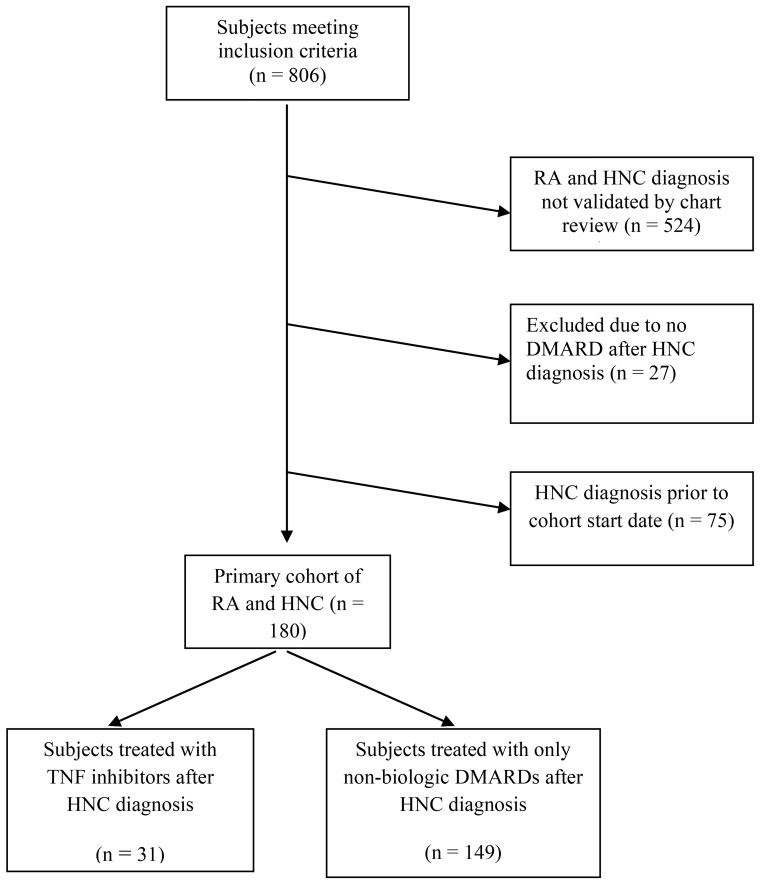
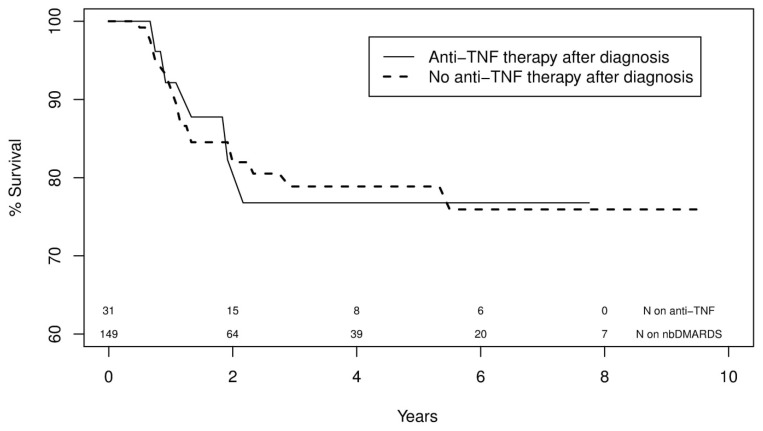
The objective of this retrospective cohort study was to determine the effect of tumor necrosis factor inhibitor (TNFi) therapy on the risk of head and neck cancer (HNC) recurrence or HNC-attributable death in patients with rheumatoid arthritis (RA). RA patients with HNC were assembled from the US national Veterans' Affairs (VA) administrative databases, and diagnoses confirmed and data collected by electronic medical record review. The cohort was divided into those treated with non-biologic disease-modifying anti-rheumatic drugs (nbDMARDs) versus TNF inhibitors (TNFi) after a diagnosis of HNC. Likelihood of a composite endpoint of recurrence or HNC-attributable death was determined by Cox proportional hazards regression. Of 180 patients with RA and HNC, 31 were treated with TNFi and 149 with nbDMARDs after the diagnosis of HNC. Recurrence or HNC-attributable death occurred in 5/31 (16.1%) patients in the TNFi group and 44/149 (29.5%) patients in the nbDMARD group (p = 0.17); it occurred in 2/16 (13%) patients who received TNFi in the year prior to HNC diagnosis but not after. Overall stage at diagnosis (p = 0.03) and stage 4 HNC (HR 2.49 [CI 1.06-5.89]; p = 0.04) were risk factors for recurrence or HNC-attributable death; treatment with radiation or surgery was associated with a lower risk (HR 0.35 [CI 0.17-0.74]; p = 0.01 and HR 0.39 [CI 0.20-0.76]; p = 0.01 respectively). Treatment with TNFi was not a risk factor for recurrence or HNC-attributable death (HR 0.75; CI 0.31-1.85; p = 0.54). We conclude that treatment with TNFi may be safe in patients with RA and HNC, especially as the time interval between HNC treatment and non-recurrence increases. In this study, TNF inhibition was not associated with an increase in recurrence or HNC-attributable death.
这项回顾性队列研究的目的是确定肿瘤坏死因子抑制剂(TNFi)治疗对类风湿关节炎(RA)患者头颈癌(HNC)复发风险或HNC所致死亡风险的影响。患有HNC的RA患者来自美国国家退伍军人事务部(VA)管理数据库,并通过电子病历审查确诊诊断并收集数据。该队列分为在诊断为HNC后接受非生物改善病情抗风湿药物(nbDMARDs)治疗的患者与接受肿瘤坏死因子抑制剂(TNFi)治疗的患者。通过Cox比例风险回归确定复发或HNC所致死亡这一复合终点的可能性。在180例患有RA和HNC的患者中,31例在诊断为HNC后接受了TNFi治疗,149例接受了nbDMARDs治疗。TNFi组5/31(16.1%)的患者和nbDMARD组44/149(29.5%)的患者发生了复发或HNC所致死亡(p = 0.17);在HNC诊断前一年接受TNFi治疗但之后未接受TNFi治疗的16例患者中有2/16(13%)发生了复发或HNC所致死亡。诊断时的总体分期(p = 0.03)和IV期HNC(风险比2.49 [可信区间1.06 - 5.89];p = 0.04)是复发或HNC所致死亡的危险因素;接受放疗或手术治疗的风险较低(风险比分别为0.35 [可信区间0.17 - 0.74];p = 0.01和0.39 [可信区间0.20 - 0.76];p = 0.01)。TNFi治疗不是复发或HNC所致死亡的危险因素(风险比0.75;可信区间0.31 - 1.85;p = 0.54)。我们得出结论,TNFi治疗对于患有RA和HNC的患者可能是安全的,尤其是随着HNC治疗与无复发之间的时间间隔增加。在本研究中,肿瘤坏死因子抑制与复发或HNC所致死亡的增加无关。