Department of Otorhinolaryngology-Head and Neck Surgery, Osaka General Medical Center, Osaka, Japan.
Department of Otorhinolaryngology-Head and Neck Surgery, Osaka University Graduate School of Medicine, Osaka, Japan.
Sci Rep. 2017 Aug 4;7(1):7297. doi: 10.1038/s41598-017-07752-1.
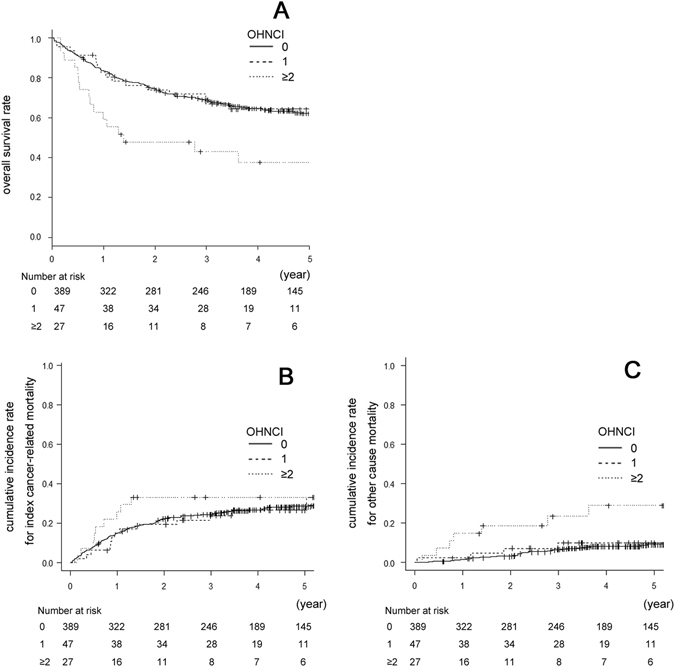
Due to habitual drinking and smoking and advanced age at diagnosis, patients with head and neck squamous cell carcinoma (HNSCC) frequently present with comorbidities. Several comorbidity indices have been developed and validated for HNSCC. However, none have become the standard method. In this study, we developed a new comorbidity index for Japanese patients with HNSCC, which was validated against an independent data set. A Cox proportional hazards analysis of 698 patients identified dementia, connective tissue diseases, and second primary malignancies in the oesophagus, head and neck, lungs, and stomach as prognostic comorbidities for overall survival. The Osaka head and neck comorbidity index (OHNCI) was generated from the weighted points of these comorbidities. In the independent data set, the 5-year overall survival rates for the low, moderate, and high scoring OHNCI groups were 62.1%, 64.3%, and 37.7%, respectively. In the multivariate analysis, the high scoring OHNCI group was an independent prognostic factor for overall survival (hazard ratio: 1.81, 95% confidence interval: 1.05-3.13; P = 0.031). The model including the OHNCI exhibited a higher prognostic capability compared to those including other commonly used comorbidity indices. The OHNCI could become the primary choice for comorbidity assessment in patients with HNSCC in Japan.
由于习惯性饮酒和吸烟以及诊断时年龄较大,头颈部鳞状细胞癌(HNSCC)患者常伴有合并症。已经开发并验证了几种用于 HNSCC 的合并症指数。然而,没有一种成为标准方法。在这项研究中,我们为日本 HNSCC 患者开发了一种新的合并症指数,并通过独立数据集进行了验证。对 698 名患者的 Cox 比例风险分析确定了痴呆、结缔组织疾病以及食管、头颈部、肺部和胃中的第二原发恶性肿瘤是总生存的预后合并症。大阪头颈部合并症指数(OHNCI)是根据这些合并症的加权分数得出的。在独立数据集中,OHNCI 评分低、中、高的患者 5 年总生存率分别为 62.1%、64.3%和 37.7%。在多变量分析中,OHNCI 评分高的患者是总生存的独立预后因素(风险比:1.81,95%置信区间:1.05-3.13;P=0.031)。与包括其他常用合并症指数的模型相比,包含 OHNCI 的模型显示出更高的预后能力。OHNCI 可能成为日本 HNSCC 患者合并症评估的首选。